It’s actually quite straight forward. Inside the record player there’s a small group of highly trained goblins. They watch the needle move side to side and they perfectly recreate the music using their tiny instruments.
Simple.
I heard their team-building theme song was Madonna’s Into the Groove.
It’s not that hard to grasp I don’t think. If you understand graphs of soundwaves, it’s literally just the wave scratched into the plastic. The movement of the needle dictates the movement of the speaker membrane which results in the same movement in your eardrum. Which is what you percieve as sound.

Even simpler to visualize: Its the movement of the membrane of the speaker/microphone turned into a physical line.
That explains just a tiny part. There are so many different sounds at the same volume and frequency
All the sounds get mixed together as they approach you (as they compress the same air), by the time it gets to your ear it can be represented by one complex wave.
Like when you flatten all the layers in a graphics project.
No, because flattening the layers is a lossy operation but this is reversible.
Hmm good point!
If you can build up intuition around Fourier decomposition I think it gets much easier to understand.
Multiple things going on at the same frequency are indistinguishable (up to a phase). Lots of stuff going on at different frequency can be separated. Light also has frequency (color) and volume (intensity)—it may be more intuitive to conceptualize in this way.
Ironically, I work a lot with Fourier Transform. Still feels like magic. I even taught it! I’m trying to develop more intuition about it (vs hard knowledge)
I forget most of them, but I remember there being several concepts in calculus that straight up felt like magic once I finally understood them.
Yeah, waves add. Which, well they add from the center which looks weird and bumpy. What’s more amazing is how good our ears are at picking out differences (it’s like 100x more sensitive to differences than other senses) so it can tell what all those individual waves would be so we can still hear the guitar vs drums vs bass vs vocals when it’s all one wave combined.
Magic!
But all sounds are vibration. If you capture the vibration, you capture all of the sound. The “different sounds” are all a single pattern of vibration; it’s the brain and inner ear that decodes the vibration into separate sounds. And hence it can also be difficult to do, depending on what the sounds are.
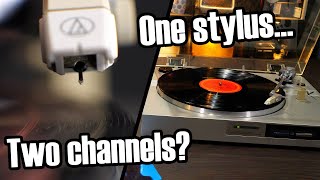 ](https://www.youtube.com/watch?v=3DdUvoc7tJ4)
The video explains how a single needle can play stereo sound, but in doing so explains how the basic idea works before going into the incredible design to do two channels.
Anything sufficiently advanced is indistinguishable from magic.
I’m convinced this is magic.
I agree, I’m still amazed that this shit works as well as it does.
What’s crazy to me is that this technology was used for only a few dozen years before it was replaced and for thousands of years beforehand there was nothing like it
It’s also interesting that it has made somewhat of a comeback after some newer technologies have faded away
Records are very easy to understand. Even without a microscope, you can see periodic patterns on test vinyls with beeps. And sound being periodic motion is also obvious from string and percussive instruments.
You can even see tracks starting and ending on pressed CDs under the right lighting with your own eyes. I wonder, is the encoding of silence (approx. 2 seconds) really that different or does the density of grooves or pit/land pattern intentionally differ to help the player seek there faster? I know that uncompressed audio naturally results in a repeated pattern when silence is encoded but given the 8-to-14 modulation and other error correctiion techniques, I find it hard to believe it would result in significantly different density unless they specifically added a special mode just for encoding silence that makes the track brighter-colored for easier coarse seeking.
Uhm
- ridges cause movement of needle
- gets mechanic/electrically amplified
- causes movement of membrane in speaker
- the membrane moves air = sound
Fucking how tho?
Magnets
How air makes sound? It moves our membrane.
Well ok, the movement is fast enough to vibrate.
Digital music is just 1s and 0s.
Aww, c’mon - some digital music surely deserves a better rating than that!
It’s really simple.
Sound is air vibrations at different strengths (volume) and frequencies (pitch). Taller waves are loud. Thinner waves are higher pitched. The math looks like this:
Volume * sin( Pitch * time)
Generally, low pitch sounds are louder and easier to see in a sound wave. A kick is really easy to spot. The rest of the weird janky movement of the sound wave is like a bunch of these equations added up to create the sound… generally.
The trick to understanding sound is that it’s a difference over time. The change in pressure is registered by your brain. A record player is literally just the physical transcription of this math and the speaker is just oscillating back and forth to reproduce the sound.
Okay maybe it’s not super simple, but I hope this helps.
It’s vibes man.
It makes your eardrum wiggle in the same shape as the grooves.
Some day, I’ll get my (20) albums turned into vinyl.
That day moved a little closer, seeing this.
I mean it’s pretty easy if you understand that sound is just a wave of vibration through a medium.