

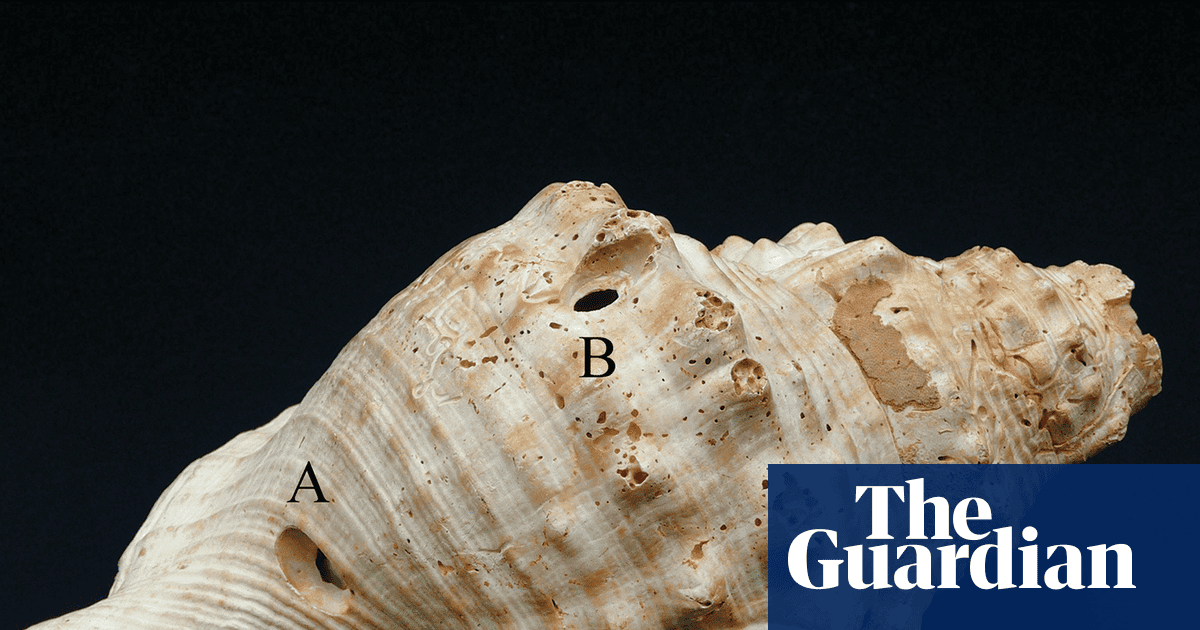
In an article co-authored with his colleague Margarita Díaz-Andreu, the University of Barcelona researcher argues that 12 large shell trumpets found in Neolithic settlements and mines in Catalonia – and dated to between the late fifth and early fourth millennia BC – may have been used as long-distance communication devices and as rudimentary musical instruments.
The fact that the shells appeared to have been collected after the Charonia lampas sea snails within them had died suggests they had been gathered for non-culinary purposes, just as the removal of the pointed tip of the shells indicates they were used as trumpets.
To put their theories to the test, the pair obtained permission to conduct acoustic experiments on the eight shell trumpets, which are sufficiently intact to produce sound. In November 2024, López García coaxed a “really powerful, stable tone” from the shells.
“It’s quite amazing that you get that very recognisable tone from a simple instrument that is just a very slightly modified animal body,” he says. “I think the closest instrument today in terms of tone is the french horn.”
But he and Díaz-Andreu, a research professor at the Catalan Institution for Research and Advanced Studies who is also based at the University of Barcelona, wanted to go beyond single tones and determine the shells’ full musical potential.
Their tones, he says, could carry insights into the lives of the people who lived in north-east Spain 6,000 years ago.
As context:
The oldest musical instrument in the world, a 60,000-year-old Neanderthal flute is a treasure of global significance. It was discovered in Divje babe cave near Cerkno and has been declared by experts to have been made by Neanderthals.
