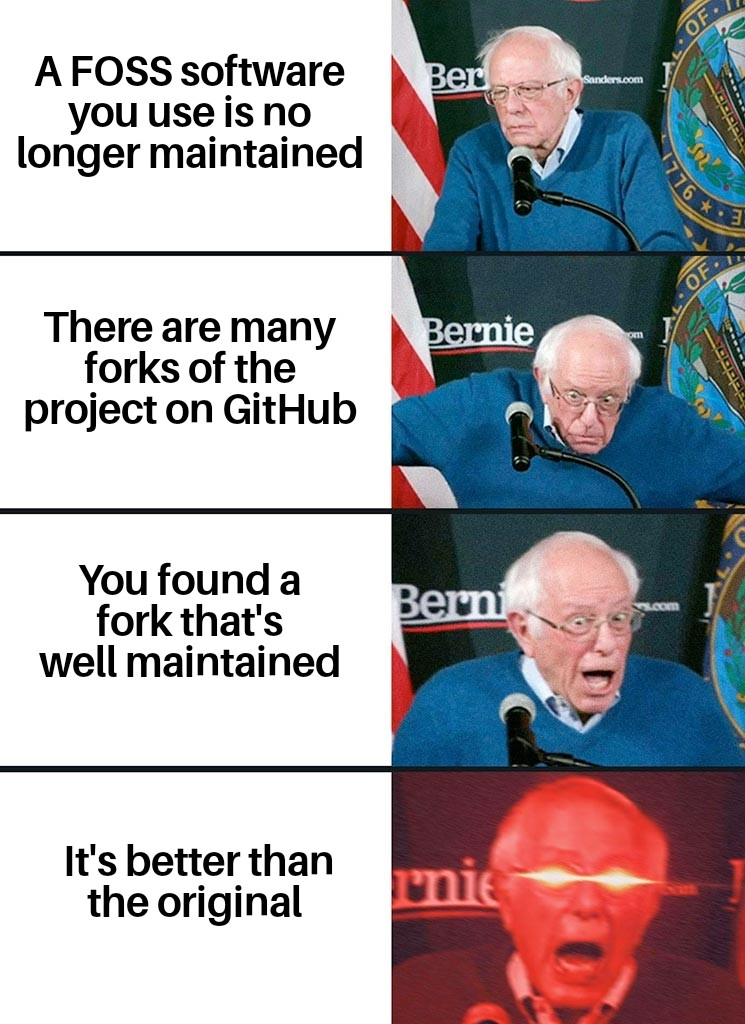

- cross-posted to:
- programmer_humor@programming.dev
- cross-posted to:
- programmer_humor@programming.dev
You must log in or register to comment.
Simplemobiletools --> Fossify is pretty epic
Yt-dl - > yt-dlp
It may be a game, but…
Pixel Dungeon -> Shattered Pixel Dungeon
deleted by creator
deleted by creator
I love the potential, I just haven’t found the right mods yet
deleted by creator
Keep in mind that software doesn’t have an expiry date. If a piece of software is unmaintained and doesn’t have an active fork but it still fulfills your use case and doesn’t have any major issues, there’s no need to replace it. Some of the software I use hasn’t seen any updates in five years but I still use it because it still works.
Edit: As an example, a lot of people still use WinDirStat even though the latest release 1.1.2 is now 17 years old.
I’d say that problems mostly come from the need to update dependencies in case of vulnerabilities being discovered. But not every software needs elevated privileges or can become a vector of attack, I guess
deleted by creator
Desktop - Linux - Yes, likely. If not, here’s a flatpak
Desktop - Windows - Maybe it still runs in a compatibility mode?
Desktop - iMac - Here’s an emulator, good luck.Mobile - PostMarketOS - Yes, likely. If not, here’s a flatpak
Mobile - Android - Maybe? Try it and see if you get permission denial
Mobile - iPhone - Fuck you, no.Windows is pretty good with backwards compatibility, probably the best out of anything. I can run Visual Basic apps I wrote in the early 2000s on Windows 11 and they still run fine. Some old 32-bit games work fine too. You can even run some 16-bit Windows 3.0 apps on 32-bit Windows 10 if you manually install NTVDM through the Windows features (it was never ported to 64-bit though)
Linux is okay for backcompat but I’m not sure an app I compiled 20 years ago would still run today.
Tell that to video games, which constantly need a compat mode enabled
The fact that a compat mode exists means that Microsoft put effort into backwards compatibility. Windows even emulates some old bugs for old popular apps that depended on them. I don’t think any other OS does that.
I don’t like Microsoft Windows at all, but you are absolutely right about doing a good job with backwards compatibility.
Linux isn’t so backwards compatible, but with much of it having open source code, you can often compile it again yourself—tho having been written in a language that offers good backwards compatibility also helps.
Wait, flatpak works on PostMarketOS?
Yep! It’s the default on things like phosh and gnome mobile for packaging apps
WinDirStat works but is super slow though. WizTree is a much better modern equivalent.
I do like Wiztree, but WinDirStat is still pretty common to see. The 2005 version of WinDirStat still gets around 60,000 downloads per week according to the Sourceforge stats. https://sourceforge.net/projects/windirstat/files/windirstat/1.1.2 installer re-release (more languages!)/stats/timeline
I was just using it as an example of old software that people still use :)
Isn’t WizTree a lot faster?
It is. I was just using WinDirStat as an example of an old app that people still use. The 1.1.2 release from 2005 is still downloaded 60,000 times per week according to the stats on the Sourceforge download page.
I use windirstat almost monthly and have never heard of WizTree. Keeping this in mind for next time I use it.
Though at this point, maybe I should just commit honestly
Gitea -> Forgejo, e.g.
Yeah Fogejo is amazing. Moved all my personal projects from GitLab to Codeberg recently. Wish I knew about it sooner
Gitea is still maintained though?
They got bought so people jumped ship, I haven’t heard anything bad personally
Yes as you say, I think they’re still pretty fine, though I do prefer Codeberg as a hosted solution myself and in turn Forgejo, especially for their federation plans
Gitea has federation plans too though?
Edit: and apparently had them as far back as January 2022
Oh, I wasn’t updated on that, I honestly don’t know which came first
Looking at the forgejo issue, the dev working on the federation tools for gitea had worked for 6 months (gitea issue opened Jan 2022) before opening the issue Nov 2022 with the initial goal being to merge into forgejo and then merge that upstream with gitea
Is that really the case? I selfhost gitea and am pretty happy with it.
They’re both pretty on par for the most part. If it’s too much of a hassle, there’s no real need to switch.
Now that Gitea is owned by a for-profit company, people are afraid that they’ll be making anti-user changes. This, Forgejo was born. It pulls from Gitea weekly, so it’s not missing anything. It’s also got some of its own features on top, but they’re currently pretty minor. Also, most of the features end up getting backported back to Gitea, so they’re mostly on par with each other. However, many features find themselves in Forgejo first, as they don’t have the copyright assignment for code that Gitea does. Additionally, security vulnerabilities tend to get fixed faster on Forgejo. They are working on federation plans, however, so we’ll see how that pans out.
Overall, there’s no downside of switching to Forgejo, and you’ll probably be protected if Gitea Ltd. makes some stupid decisions in the future. However, at the moment, there’s no immediate advantage to switching, so you can stick with Gitea if you’d like.
I thought gitea was doing federation too? Im pretty excited about that part, as I’ve wanted to move away from GitHub but the visibility it gives is just on another level. Users can’t register on my instance, therefore they also can’t open issues and PRs.
Is switching to forgejo more work than just changing my compose file a little? I hope my database can get transferred.
The developer working on federation plans to merge the changes into forgejo first and then from there into gitea but I’m not sure in how far the recent changes to gitea’s CLA have affected those plans.
Forgejo is a drop in replacement (they are committed to keeping it that way for as long as possible) so, as far as I know, simply changing the gitea image to the forgejo image is all you would need to do.
OpenOffice -> LibreOffice
Really, why? I don’t known OpenOffice, so I’m just curious.
Oracle happened to OpenOffice.
Sun Microsystems bought Star Division, the original creators of StarOffice, which was proprietary. Sun open sourced OpenOffice, with StarOffice still available with proprietary add-ons. When Oracle bought up Sun, they first reduced resources to OpenOffice and then shut it down altogether when LibreOffice came along, with trademarks and such assigned to the Apache project.
youtube-dl moment
The fork is yt-dlp
deleted by creator
I’ve kept away from some projects because it’s just a single dev doing 99.9% of the contributions.
it’s a wonderful feeling when that happens!
I don’t usually get my hopes up, but yes, it is a wonderfull feelling when it happens.
yea pls dont get your hopes up
Clementine -> Strawberry :)
What’s Strawberry?
Well, a fork of Clementine :) Both are great music players that have a playlist-centered approach to music. Have been exclusively using them on my computer since many years.
Amarok -> Clementine -> Strawberry
Even better when someone forked it away from proprietary, closed-source, publicly-traded, for-profit, US-based, account-required, training-AI-on-your-code-then-selling-it-back-to-you Microsoft GitHub forge/social media network often with vendor lock-in to some other forge without all that BS.
deleted by creator
only a matter of time until Microsoft gets sued
https://githubcopilotlitigation.com/ it’s been ongoing
no account is required unless you’re submitting code
it’s free
Submitting issues & discussions require an account. Using the search for code requires an account. On Lemmy this week there was also a post about viewing “Discussions” & “Wiki” being A/B tested or whatever with an account required to view. Which is to say, if submitting patches, issues, & or using some features requires giving up personal info & agreeing to Microsoft’s ToS to create an account, you have locked out users & their freedom isn’t respected if their autonomy to not create an account with a company known for predatory behavior cannot be respected.
lock-in
Users locked out sucks, but so does lock in. Sure you can set a non Microsoft GitHub remote & push to it, but I’m talking about the forge on whole rather than the tool that backs it. The more Microsoft GitHub features you rely on, the more the existance of a
./.githubdirectory’s or otherwise gets cited as being too hard to move. As more features get locked behind authentication, so will the APIs that allow some ability to migrate. GitHub were the popularizers of the “pull request” model too which is severely limiting but is the only way you can operate on their site (no stacked diffs, mailing patchsets, etc.) which eliminates alternating review methods (while you could use a third-party, due to MS GitHub’s ingrained workflow to too many, I’ve seen alternatives being considered as “too hard” rather than “different” (even if could be “better”)). I’ve also witnessed some communities like Elm freeload on the “free” hosting & require all community packages be upload to only MS GitHub or you can’t publish & by proxy participate in the community (or in their case even refer to other remotes, VCSs, tarballs for packages (even private ones) but that is due to Elm having a terrible default package manager).They’ve embraced a Git forge; they’ve extended the space with Codespaces, Sponsors, Actions, Copilot, even VS Code proliferation far beyond pre-acquisition GitHub; now we just await the extinguish part.
deleted by creator
But you’re willing to gloss over all methods of contribution (unless the project owner explicitly provided alternatives) require accounts to a proprietary service owned by Microsoft, not owned by your project? Or they way the Microsoft GitHub way is entrenched in the larger community via education & peer pressure to join the social media network.
I don’t see Microsoft with both its history & its shareholder obligations to maximize profit to do anything but try to extinguish—corporations always aim to monopolize.
deleted by creator
Everything you point to as ‘pros’ for Microsoft GitHub could be applied to GitLab, SourceHut, Codeberg, GNU Savannah, Notabug, Radicle, darcs hub, Smedeeree, Pijul Nest as far as hosting infrastructure where you don’t have to–and with the exception of GitLab being open core & a publicly-traded company, they are open source & not ran by corporations (some as for-profits, but indie, others, as foundations, others as community run). You’re conflating my (and many of our) distaste of capitalism/corporatism by rejecting Microsoft as if it means anti-access or anti-open source/anti-ethical source. Microsoft is 100% an enemy playing the long-con by vacuuming up all these developer adjacent services as megacorporations try to do (see their expanding portfolio of: WSL, Azure, GitHub, Codespaces, Sponsors, Copilot, VS Code, npm, Teams). I also believe it’s only a matter of time til they pull the plug on their APIs like Twitter & Reddit as the board of shareholders demand preventing migration (just like the “Search” is disabled).
There is also no shame in self-hosting these things & you can start hosting most DVCS with SSH + an HTTP server in front of the code even if it doesn’t have some web GUI to browse files so it doesn’t have to be that complicated. NixOS modules or similar can get you a cgit, GitLab Community, SourceHut, etc. all running without too much effort (
services.cgit.enable = true), or forming a local collective & sharing resources is cool too & doesn’t need to be each project self-hosting. You can still have ‘barriers’ like authentication if you need that require agreeing to your community’s terms of service instead of Microsoft’s ToS–which is the system used by KDE, GNOME, & many other big FOSS self-hosted GitLab forges.I’m also not against rejecting some of the tenets of “open source”–with OSI as its definitional gatekeeper–in favor of the copyfarleft, copy fair, Commons Clause, etc. that require corporations contribute code or finances as I don’t think it’s a difficult argument to say our current systems extract values from the Commons more than adding putting folks in positions of not getting to work on their valuable library that everyone relies on, but doesn’t want to help finance its maintenance (see Babel)… in which case, rejecting the corporations in favor of the Commons could be a greater goal than “open source is actually about”.
How can I learn more about alternatives to pull requests and other tools or processes for code review?
“PIN number”
vs.
“FOSS software”
Who’d win in a fight?
Personal PIN number.
Oh man, I want to use a longer pin for my card so badly.
From what I understand, the banks mostly support it, the problem is that not all point of sale does. Those terminals are frequently cobbled together with some pretty garbage software and if it’s hard-coded to four digits, whelp, good luck. I hope tap is working… Or NFC or something because otherwise, you’re SOL.
Try it out. You may find out that your bank supports much longer pins, but only uses the first four digits anyway.
Truncation is not a good look.
For being an institution that is supposed to be trusted to hold all your money, their security has me scratching my head most of the time.
Y u no COBOL?
Synergy -> Barrier
Does it have Wayland support yet?
No, but Lan Mouse does! https://github.com/feschber/lan-mouse
I actually paid for synergy because I was using it extensively back in the day (probably about 10 years ago? Maybe less? IDK. Long enough that I don’t care to remember when); and after an update I realized the windows service portion had a bad memory leak. I don’t reboot my PC very often, so I kept getting memory errors despite having more memory than the average (I believe it was 24G at the time, when 8G was considered “good” instead of it being the bare minimum that it is now)… I couldn’t even always fix it by restarting the service, since it was some kind of memory mapped file or something that was causing the problem, so it didn’t register normally that the process was consuming the space. The only way to fully resolve the problem was to disable the service (or remove the software) and restart. So I abandoned synergy for a long time because I wasn’t sure when they would actually recognize the problem and fix it.
I got a notice late last year that synergy had updated and my license was going to be given a free upgrade so I could use the newer version at no extra cost, so I figured it would be a good time to try it again, and I had a situation come up in December (ish) where I actually wanted to see if I could get it working; I couldn’t. Now that I’m running exclusively multi monitor setups, synergy’s configuration doesn’t actually give you the option of setting where your screens are connected individually or anything, it just shows each PC as a single display, and for the life of me, not only could I not get it right, but I couldn’t even find the trigger point that would move my mouse and keyboard controls to the other system. Even if I managed to get them over there, I had no idea how, and I had no idea how to get back.
So I disconnected it entirely and I’m back at square one. I bought a multimonitor KVM to fix another problem and it reduced or eliminated my need to use synergy… But I still want synergy to work (or something like it). Is barrier more robust?
Paperless -> Paperless-ng -> Paperless-ngx
Slic3r -> PrusaSlicer -> SuperSlicer
Although I’d love to agree superslicer has sadly nowhere near the development power of prusa behind them - and feature parity is rarely given, basically any release of the two has “oh I want both of those!” (don’t know if it’s spelled correctly but arachnid mode for example was hyped to a point I checked back with prusa after a few months).
I just want to point it out in case people expect a “prusaslicer” but better in every regard :)
Oh yeah, I find that it’s easier to get fine control of the outcome in SuperSlicer because it’s less refined. User-friendly features are nice when you’re getting started but a hindrance when you have more experience. I tried to use Cura awhile back and it felt like the Fisher-Price version of a slicer. SuperSlicer is probably less accessible overall, but it doesn’t hide controls from me.
I will borrow The fisher-Price phrasing, thank you for that! Fully agree on the cura part.