Baby talk overemphasizes everything, including repetitions, that makes it easier for babies to actually get what you want and what all those cues are supposed to mean.
So yeah, kind of important, even though it sounds stupid.
That being said, there is a point at which kids should be taken seriously and communicated with accordingly. Some parents talk to relatively old kids like with toddlers and that can’t be healthy either.
Well completely unrelated is maybe an overstatement.
English and Chinese is the common example of unrelated "mama"s, but there is a non zero chance that they are distantly related - beyond the time depths accessable by the comparative method of linguistics.
It could be that “mama” or a very similar word dates back to like Ancient North Eurasians or some older population ancestral to both Chinese and English speakers.
If any one word could survive that long, some form of “mom” is a good candidate, but yeah the most popular theory is that something about the “m” sound makes it more likely to be in the word mama.


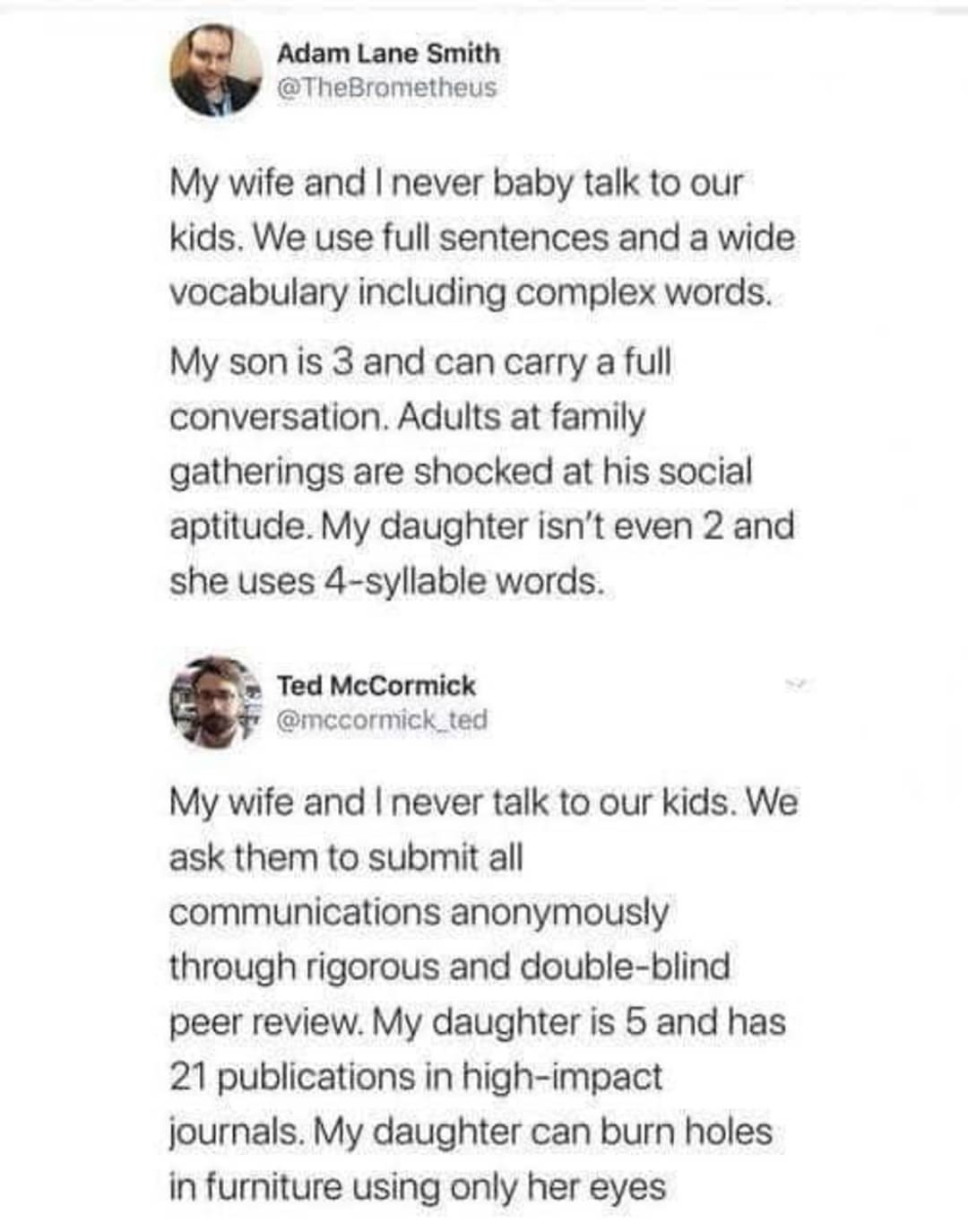
Baby-talk is a universal human phenomenal and almost certainly plays an important role in helping kids learn language.
The implication that not using baby talk somehow unlocks rapid development of language is simply not true.
Baby talk overemphasizes everything, including repetitions, that makes it easier for babies to actually get what you want and what all those cues are supposed to mean.
So yeah, kind of important, even though it sounds stupid.
That being said, there is a point at which kids should be taken seriously and communicated with accordingly. Some parents talk to relatively old kids like with toddlers and that can’t be healthy either.
Is it really universal though? I don’t recall that from my linguistics masters at all, in fact I think I recall pretty much the opposite…
I’m fairly sure that studies have shown that even birds do baby talk but it’s been a while since i read that
There’s a reason why “mama” or equivalent is such a common word for parents in completely unrelated languages
Well completely unrelated is maybe an overstatement.
English and Chinese is the common example of unrelated "mama"s, but there is a non zero chance that they are distantly related - beyond the time depths accessable by the comparative method of linguistics.
It could be that “mama” or a very similar word dates back to like Ancient North Eurasians or some older population ancestral to both Chinese and English speakers.
If any one word could survive that long, some form of “mom” is a good candidate, but yeah the most popular theory is that something about the “m” sound makes it more likely to be in the word mama.