

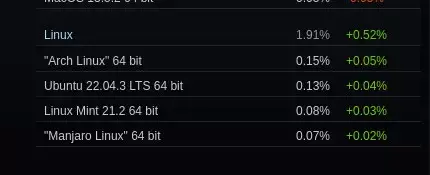
Can we talk about the definition of a “surge”, please!
What percentage increase do you feel is required for surge to be a reasonable definition. A 35% increase feels surge-y me.
The council planted a new tree on my road, trees surged in population from 1 to 2 yesterday
That’s why we’re talking about relative percentages.
In your example we would need to know how many trees existed on your road/city before. If there were less than 3 or 4 trees in your city before this, saying there was a surge is likely fine.
I gave you that information, I said “from 1 to 2” and added context of “a tree” (singular)
My terribly made point is that although technically correct when talking about relative increase it’s dumb as fuck to say trees “surged in population” after adding just one more on one street. It’s a drop on the ocean.
I feel like the term surge respects the final total relative to what its maximum could be as well as the relative increase. But obviously language is regional and up for interpretation
I’m super confused by your point.
In this case we’re looking at Steam.
I have no clue how many people submit to the steam survey, but I’ll assume it’s representative.
A quick google suggests steam has about 120 million active users.
Linux went from about 1.4% to 1.9%.
Rough math says Linux went from 1.7 million to about 2.3 million.
Or an increase of 600 000.
That a lot, both in relative terms and in real terms.
Here’s a counter example for you.
You own stock in banana company. Over one day the price increases 2x. All the news agency’s are talking about how banana surged in price today. Will you then suggest that banana didn’t surge in price because it only makes up 1% of the overall stock market?
Given the sheer amount of Steam users, it’s still not a bad increase.
Sergei?
Small number random samples in big data sets have huge error margins. You need to smooth this over time to see the real trend.
Click bait media
I’m guessing this is because of more sales of the Steam Deck, haven’t got myself one yet but I’d love to as everyone that has gotten ones has said it’s worth the money as well as is a great way to get through your games on the go.
Add the article says, the surge is entirely thanks to the Deck. There was a 35% surge in overall use but 43% of that use is the Deck so PC/laptop use has actually dropped.
It’s been pretty good. So long as you stick to verified and playable games your experience is going to be pretty solid.
That and Emudeck.
The most seamless retro gaming setup I’ve used yet.
How many are there? I always see more games getting added
6 of the top 10 are verified or playable or 43% of the top 1000 games. But verified and playable is only a subset of the games that work, quite a few unsupported games do as well. If you go by medals the 7 of the top 10 are silver ranked or better (minor issues but generally playable) and 88% of the top 1000. So there are a lot of games that are playable that are still listed as unsupported on the deck.
You can see the numbers for various different things at https://www.protondb.com/ as well as different reports for all the games (including some tips on how to get things to work or work better).
deleted by creator
Same, I’m not a big multiplayer person so most of the time it works out. My latest has been Lethal Company, my first new multiplayer game this year 😂. Been a blast.
I just removed Windows from my desktop and went straight Linux after seeing how well things ran on my Deck.
Tell me why “market share” of commerical, proprietary games is important to Linux again?
Because of Valve, Linux is finally my main OS. I’m a PC gamer and it was a pain in the ass to dual-boot between Windows and Linux.
If you are a Linux user and like commercial games, you probably would prefer them to work on Linux.
“Market share” on Linux aligns the vested interest of game makers and Linux game players. If the company thinks it can make money, it will do more to allow games to run, or at least do less to stop them.
That’s what many people miss. I know Value is doing a lot but I was hoping for some other large companies to get into the space.
There’s high potential overlap between the profile of a PC gamer (who is often also a PC builder and general computing DIY hobbyist) and an OS like Linux that extends your tinkering ability massively on the software side.
PC/laptop users are a shrinking demographic nowadays thanks to the advent of mobile devices, but they’re a high quality demographic made up of professionals and hobbyists with above average computer savvy. So lots of companies are trying to appeal to them because the choices they make in software and hardware can translate into many other IT fields.
deleted by creator
Yup, a big excuse I used to see a lot was
I would like to run Linux, but I want to game more so will stick to Windows
And this has changed a lot with what valve has done which opens Linux to a much larger market of people that can now use it for their usecases.
market share leads to demand, demand leads to supply
this benefits you