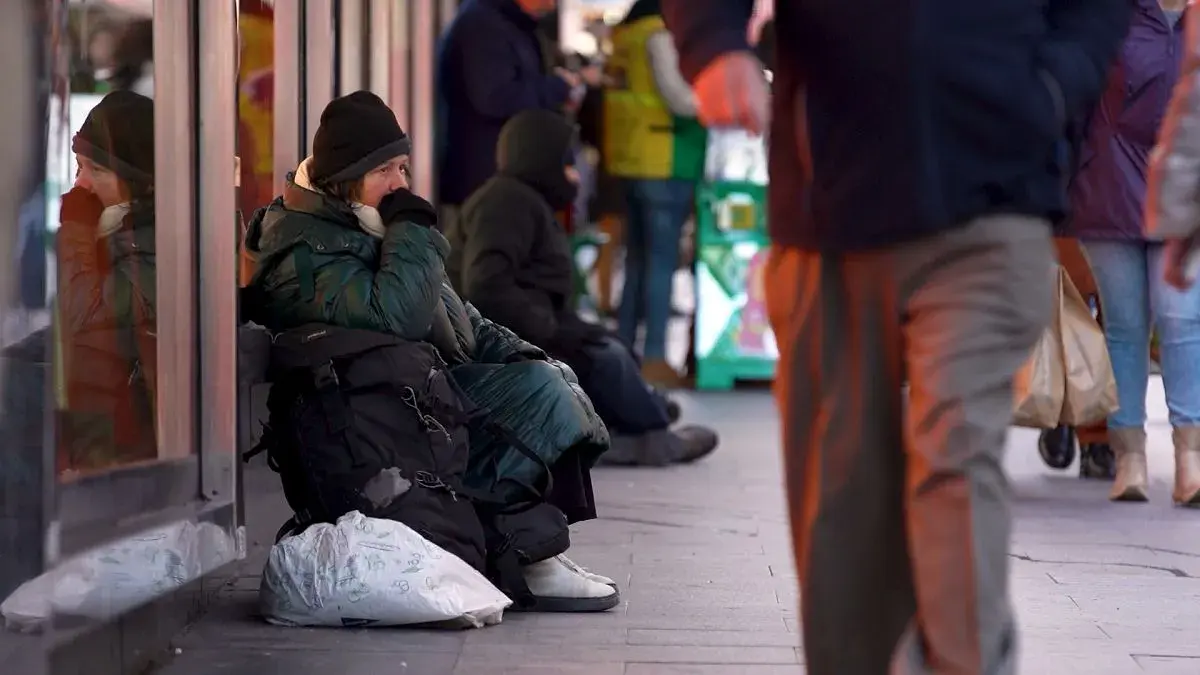
First developed in the US, the initiative known as Housing First, is being adopted increasingly in Europe. Unlike traditional approaches, it doesn’t require individuals to meet certain criteria before receiving housing assistance. The idea is that homeless individuals have a higher chance of creating a brighter future for themselves if they first have a roof over their heads.
Carlos Martínez Carrasco lived rough for several years before a Housing First initiative provided him with a flat on the outskirts of Madrid.
He told Real Economy that the flat has changed his life in every way: “I no longer lack the things that you do when you’re on the street and I can cook. I don’t have to find a way to wash clothes… I can go out with the peace of mind that I have a place to come back to. I am very happy today.”
Society always pay for the homeless, regardless if the homeless are given homes or not.
Don’t give them homes … society gets to pay for more policing, more security, more judicial, more emergency health, more social problems.
Give them homes … No it doesn’t create a Utopia but with the money saved in less policing, less security, less judicial, less emergency health, the savings are used to pay for a home.
So go ahead be a right winger or a left winger, no matter how you cut it, we all pay for the homeless no matter what we do. It’s just that one solution is compassionate and one is not.
If you want to argue the Christian way, than …
‘Truly, I say to you, as you did it to one of the least of these my brothers, you did it to me.’”
- Matthew 25:40
Wow. That Jesus had quite an ego.
Some people dont have homes. Give them homes. Everyone has homes🤯🤯🤯
Rocket science
deleted by creator
My concern would be that individuals would abuse the provided homes and either trash them completely, or use them as a trap house. There’d have to be some kind of rules.
Edit: see below, people who have never spent time around homeless communities
deleted by creator
believe it or not, most homeless people aren’t hard drug users
But a lot of chronic hard drug users are homeless.
All I’m saying is I agree it’s not simple, and there would need to be a system in place to mitigate those complexities. These are the types of concerns that voters on these projects would have.
Do you think it is easier to adress drug abuse, when people on top of it lack a home and the basic safety and comfort it provides?
No, and I never claimed that was the case.
deleted by creator
I agree it’s not simple, and there would need to be a system in place to mitigate those complexities. These are the types of concerns that voters on these projects would have.
deleted by creator
And when residents refuse those services? When they simply want to take the free space and be allowed to continue whatever pattern in their life led to their current circumstances?
A lot of the times that wouldn’t be an issue- people using the resources available to uplift themselves(the majority, I’d argue) will stay for the time they need, and move on when they’re back on their feet.
It’s the ones who have no interest in getting back on their feet that would be the source of problems, and there has to be a way to deal with that.
The worst case scenario is that over time, each residence will eventually be filled by someone who takes it for granted and does not use the opportunity to improve. And all the while they’re there, there could be another individual that could use the same housing and actually progress their lives.
Seriously talk to anyone who actually works with the homeless or in social services, these are the pragmatic problems of public services.
deleted by creator
Most chronically homeless are though. Somewhere around 80% in the US. Although a lot of that is self medication for mental illness.
deleted by creator
It’s not, though.
deleted by creator
No, a large portion of the chronically homeless are addicts, those with severe mental illness, or both.
Please note the “chronically” part. I’m not talking about all homeless people.
There was a project in my town where the city build a bunch of cabins on an otherwise unused lot of public land close to but separate from the city.
It was mostly junkies who ended up there. Now, instead of sending cops, the city send social workers to check up on them. The point was to give them a safe place and get in contact with them so at least those who were willing could be sorted out.
The homeless people who weren’t junkies didn’t go there, because they disliked that whole thing and mostly wanted to be left alone.
So the city opened a hotel where anyone can check in for a night free of charge. There were two rules. No drugs and no questions asked. Again there are social workers available for anyone who do want to talk about why they checked in. It’s mostly homeless people and boozers who go there. They run a café too, so if the users wanted breakfast they could go there and that’s were the connection was really made. People talk over breakfast. The café is run mostly by ex-alcoholics, who themselves use it as a step out of the bad habits, but who can also get in touch with those who don’t want to talk to the social workers.
Anyway, I’m not sure if the success is measurable in any way but at least all the homeless and junkies are offered a roof when it rains and someone to talk to if they want. Leaving the problem on street solves absolutely nothing.
So junkies get a house, everyone else maybe gets a hotel room?
That doesn’t sound like success.
The cabins were just log cabins with no electricity or water. They had a shared port-a-potty outside. They seem to be gone now when I look at google maps.
The hotel still exists, and the rooms are singular beds and a table. I think our prison cells are better.
Anyway, the point is that there’s no reason not to offer a bare minimum for the homeless people, because it helps you help them help you getting them off the streets.
I will say that from what I’ve read your city sounds like they’ve struck a good balance and I’m glad there’s positive and effective programs out there
And this right here is the problem I’m trying to get the keyboard warriors in this thread to wrap their heads around.
In my city, all the people who are too problematic for the social housing get sent to this compound near the airport. So, they get to do their drunken shouting away from residential/commercial areas.
It’s kinda like a gated community with social workers and police on standby. Doesn’t work for every case but it seems perfect for a lot of the folks who end up there.
Yaknow that doesn’t sound like a terrible compromise
This is the best summary I could come up with:
In this episode of Real Economy, Euronews Reporter Paul Hackett discovers how providing the homeless with housing as a starting point rather than an end goal, is transforming lives and fast becoming a long-term solution.
Carlos Martínez Carrasco lived rough for several years before a Housing First initiative provided him with a flat on the outskirts of Madrid.
Two NGOs, Provivienda and Hogar Si, co-manage several Housing First initiatives in Spain, including the one that gave Carlos a home in Madrid.
Every EU member state has committed to spend at least 25% of its ESF+ resources on tackling social inclusion and at least 3% on addressing material deprivation.
The European Platform on Combating Homelessness is also working hard to bring about change while the Housing First Europe Hub, established in 2016 by Finland’s Y-Foundation and FEANTSA, seeks to give every person living on the street a home.
Progress in the current economic context won’t be easy, but evidence shows with the right policies and incentives, change is possible.
The original article contains 516 words, the summary contains 167 words. Saved 68%. I’m a bot and I’m open source!
That’s a good idea for me to have a home for real since the taxes, low salaries, high living costs makes it impossible. I will become homeless, thank you.
That reminds me of giving everyone a car instead of funding public transport.