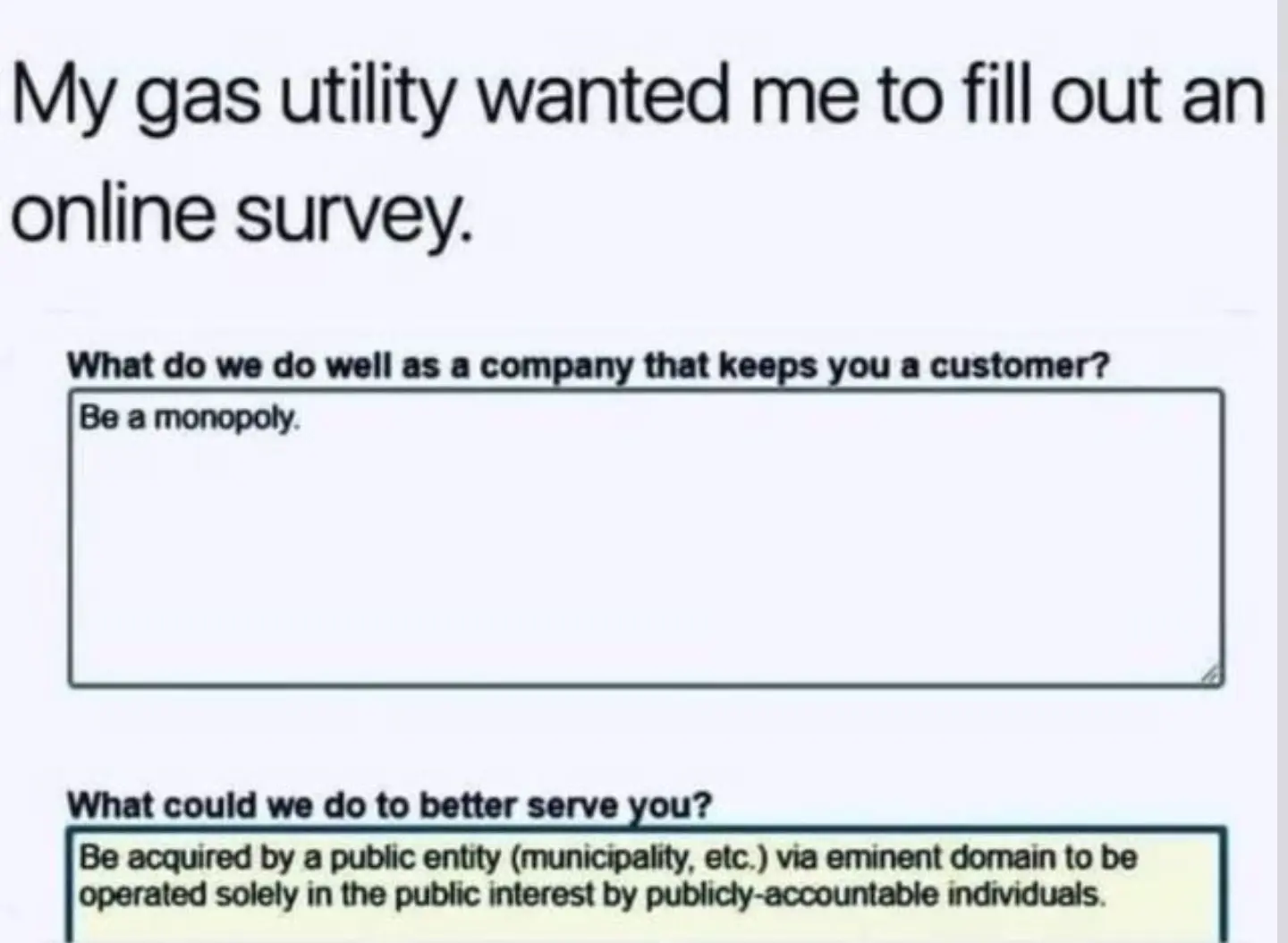
Oh sorry we’re going to have to triple your rates. What? No not for anyone else just you. Nothing to do with your feedback though, we value that!
We believe that feedback is a conversation
Would be nice if we could unfuck the US, also if we could take a bit of money from the military to get heat pumps and induction stoves, and just skip the gas
The correct answer to #2 is
‘Make it easier to tap the lines safely and steal gas without putting anyone at risk, then die in the revolution.’
Look, I get it, but maybe don’t give a warning?
Wow, maybe some of us think honesty is important, and they were kind enough to ask.
It is what it was, before the whole privitization thing
deleted by creator
A monopoly run by the government can operate at a loss no problem. Why? Because their job isn’t to make a profit first but to serve the people. Can any private business operate at a loss? And IMHO, utilities are the prime example of what should be owned by the government.
If the state is run by the workers, and in the interests of the workers without the profit motive, it is soley directed towards providing a service. A capitalist monopoly is directed towards profit alone, and can price control.
deleted by creator
Yes. Services like gas and water are natural monopolies - it doesn’t make sense to roll out two or three separate lots of distribution pipes, so you always just have one service available to you. The best option is to have them as government owned services.
deleted by creator
And yet, I can choose from dozens of different energy companies for electricity and gas.
You’re choosing from vendors to deal with the regional vendor. You’re just paying someone to pay the company in your area. The company you pay in this scenario literally offers you zero value. They simply exist to extract money from you.
Alternatively, these services could be provided to you at a lower cost as part of your annual tax bill under a collaborative cooperative.
You’re choosing from vendors to deal with the regional vendor. You’re just paying someone to pay the company in your area.
That’s not how it works.
The price you pay has 2 main components: a fixed component for network costs. This part is always the same and only depends on the type of hookup you have (e.g. an industrial power connection would cost more than a residential one). It goes to the owner of the physical power network (this depends on where you live) who uses it for things like maintenance (and of course a little profit). The network operator does not provide power themselves.
The variable component is based on your usage and goes to the power company. The power companies provide the actual power to the national grid. While it may be true that the power coming out of my outlets wasn’t produced by the company I’m contracted with, that doesn’t really matter. Electricity is electricity. What matters is that each power company has to provide the amount of energy used by their customers to the national grid. Say company A has 100 customers that on average used 1 kilowatt-hour each, and company B has 50 customers that used the same amount on average. Then company A has to provide 100 kilowatt-hours to the national grid and company B has to provide 50 kilowatt-hours.
How they provide that power is up to them, and usually varies. The larger energy companies have their own power plants, wind and solar farms. Smaller companies may buy energy in bulk from the larger ones and try to sell it at a profit to consumers. Energy companies may also buy or sell to/from other countries, depending on capacity and demand.
Point is that they don’t just forward you the bill from a local company, they actually have to provide the power and outside of a few small ‘virtual’ energy companies they do produce that power.
Um… I’m perfectly OK with a “monopoly” for my fire fighting services. Why would I feel differently for my utilities services?
deleted by creator
Please enlighten me on how I can start a utilities company? Make sure you give me details on how I can maximize profits to my shareholders while fucking over my customers.
Or maybe I should start a non-profit utilities company, and the cost of your services is subsidized by taxpayers’ money. That way, I don’t have to constantly chase capitalism and make life better for my community instead of my shareholders.
deleted by creator
Insightful.
Put a solar panel on your roof.
If the government decides to privatize utilities like electricity/gas or whatever, then sure it is freedom for some rich business owners to open up new businesses. However, this also results in those utilities becoming profit driven (as opposed to being for the public), and literally everyone in the country having to pay much more than they were paying previously.
My country had electricity privatized around 4 years ago, and in result we have to pay a lot more, not to mention about numerous fraud cases that were all over the news during and after the privatization period.
If you think that rich business owners being able to open up a couple of business at the expense of fucking over the public is a good thing and being against it is some weird hexbear delusion, then I’d advise you to get out of the libertarian bubble and look at the real world instead.
It’s not the people in the solarpunk community (because of federation posts get federated throughout the fediverse) but rather people not noticing the community
Freedom to be enslaved is negative freedom.
Operated solely in the public interest by publicly accountable individuals
Ohio separates distribution from supply. You can’t select the distributor who connects your home to the gas mains, but you can choose from dozens of suppliers who put gas into those mains.
We do the same with electricity.
Same in the EU. Or at least I think so, it’s the case over here and it’s EU-wide for electricity providers. Water, sewage and garbage disposal are municipal responsibility though there’s no network/provider separation there.
What’s actually missing is a municipal-level telecom monopoly – again, with separate providers. The last-mile network is just as much a natural monopoly for telecom as it is for other wires or pipes.
In Australia, you can’t choose the suppliers. All the gas comes from the same place.
You can, however, choose the billing company. And it’s the same story for electricity.
Having government owned gas I can tell you it’s also a monopoly but one enforced even further by law
And when government fucked up those management, you as a citizen should held your government liable. People shouldn’t be afraid of their government, the government should be afraid of their people. Also, the government’s main priority is NOT to make a profit but rather serve the people. So there is a (theoretical) obligation for the government to make sure every citizen has access to their service even if at a loss.
A government monopoly run by the workers, not for profit but to provide a service, is far better than a private monopoly.
Easy to say living in a first world country
First world countries tend to not be run for the benefit of all. Not that third world countries are either, mind you, but generally removing the profit motive from basic necessities seems to have very positive results on levels of freedom and social mobility.
Except when corrupt officials just pocket the money and invest nothing into infrastructure
Monopolys aren’t good either but living in a third world country I can tell you you can find worse problems with state controlled systems than with private companies that at least have to keep you as a client somehow
Sounds like a problem with how democratically accountable it is, not with it being state run. Privately, this is how it’s supposed to work, haha.
In my experience government operated facilities are only accountable to the current government so any political wants or ideologies come first.
In a for profit situation without a monopoly the company at least has to try to keep you as a client so there’s some give and take.
Taking a monopoly from a company and putting it in the hands of the state is just as bad in my opinion
Some problems don’t have a nice for all solution sadly
Again, sounds like a government structure issue.
deleted by creator
deleted by creator