
- cross-posted to:
- programmerhumor@lemmy.ml
- cross-posted to:
- programmerhumor@lemmy.ml
cross-posted from: https://lemmy.ml/post/14869314
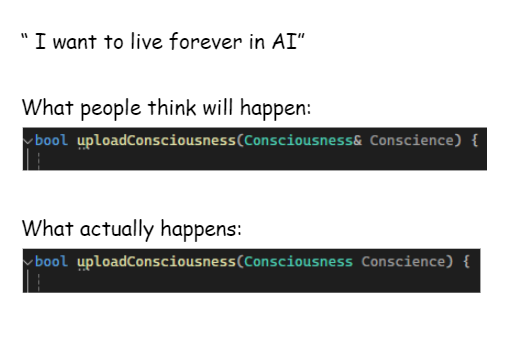
“I want to live forever in AI”
You must log in or register to comment.
Even if it were possible to scan the contents of your brain and reproduce them in a digital form, there’s no reason that scan would be anything more than bits of data on the digital system. You could have a database of your brain… but it wouldn’t be conscious.
No one has any idea how to replicate the activity of the brain. As far as I know there aren’t any practical proposals in this area. All we have are vague theories about what might be going on, and a limited grasp of neurochemistry. It will be a very long time before reproducing the functions of a conscious mind is anything more than fantasy.
Counterpoint, from a complex systems perspective:
We don’t fully know or are able toodel the details of neurochemistry, but we know some essential features which we can model, action potentials in spiking neuron models for example.
It’s likely that the details don’t actually matter much. Take traffic jams as an example. There is lots of details going on, driver psychology, the physical mechanics of the car etc. but you only need a handful of very rough parameters to reproduce traffic jams in a computer.
That’s the thing with “emergent” phenomena, they are less complicated than the sum of their parts, which means you can achieve the same dynamics using other parts.
I’d say the details matter, based on the PEAR laboratory’s findings that consciousness can affect the outcomes of chaotic systems.
Perhaps the reason evolution selected for enormous brains is that’s the minimum necessary complexity to get a system chaotic enough to be sensitive to and hence swayed by conscious will.
PEAR? Where staff participated in trials, rather than doing double blind experiments? Whose results could not be reproduced by independent research groups? Who were found to employ p-hacking and data cherry picking?
You might as well argue that simulating a human mind is not possible because it wouldn’t have a zodiac sign.
We don’t even know what consciousness is, let alone if it’s technically “real” (as in physical in any way.) It’s perfectly possible an uploaded brain would be just as conscious as a real brain because there was no physical thing making us conscious, and rather it was just a result of our ability to think at all.
Similarly, I’ve heard people argue a machine couldn’t feel emotions because it doesn’t have the physical parts of the brain that allow that, so it could only ever simulate them. That argument has the same hole in that we don’t actually know that we need those to feel emotions, or if the final result is all that matters. If we replaced the whole “this happens, release this hormone to cause these changes in behavior and physical function” with a simple statement that said “this happened, change behavior and function,” maybe there isn’t really enough of a difference to call one simulated and the other real. Just different ways of achieving the same result.My point is, we treat all these things, consciousness, emotions, etc, like they’re special things that can’t be replicated, but we have no evidence to suggest this. It’s basically the scientific equivalent of mysticism, like the insistence that free will must exist even though all evidence points to the contrary.
let alone if it’s technically “real” (as in physical in any way.)
This right here might already be a flaw in your argument. Something doesn’t need to be physical to be real. In fact, there’s scientific evidence that physical reality itself is an illusion created through observation. That implies (although it cannot prove) that consciousness may be a higher construct that exists outside of physical reality itself.
If you’re interested in the philosophical questions this raises, there’s a great summary article that was published in Nature: https://www.nature.com/articles/436029a
On the contrary, it’s not a flaw in my argument, it is my argument. I’m saying we can’t be sure a machine could not be conscious because we don’t know that our brain is what makes us conscious. Nor do we know where the threshold is where consciousness arises. It’s perfectly possible all we need is to upload an exact copy of our brain into a machine, and it’d be conscious by default.
The problem with this is that even if a machine is conscious, there’s no reason it would be conscious like us. I fully agree that consciousness could take many forms, probably infinite forms - and there’s no reason to expect that one form would be functionally or technically compatible with another.
What does the idea “exact copy of our brain” mean to you? Would it involve emulating the physical structure of a human brain? Would it attempt to abstract the brain’s operations from the physical structure? Would it be a collection of electrical potentials? Simulations of the behavior of specific neurochemicals? What would it be in practice, that would not be hand-wavy fantasy?
I suppose I was overly vague about what I meant by “exact copy.” I mean all of the knowledge, memories, and an exact map of the state of our neurons at the time of upload being uploaded to a computer, and then the functions being simulated from there. Many people believe that even if we could simulate it so perfectly that it matched a human brain’s functions exactly, it still wouldn’t be conscious because it’s still not a real human brain. That’s the point I was arguing against. My argument was that if we could mimic human brain functions closely enough, there’s no reason to believe the brain is so special that a simulation could not achieve consciousness too.
And you’re right, it may not be conscious in the same way. We have no reason to believe either way that it would or wouldn’t be, because the only thing we can actually verify is conscious is ourself. Not humans in general, just you, individually. Therefore, how conscious something is is more of a philosophical debate than a scientific one because we simply cannot test if it’s true. We couldn’t even test if it was conscious at all, and my point wasn’t that it would be, my point is that we have no reason to believe it’s possible or impossible.Unfortunately the physics underlying brain function are chaotic systems, meaning infinite (or “maximum”) precision is required to ensure two systems evolve to the same later states.
That level of precision cannot be achieved in measuring the state, without altering the state into something unknown after the moment of measurement.
Nothing quantum is necessary for this inability to determine state. Consider the problem of trying to map out where the eight ball is on a pool table, but you can’t see the eight ball. All you can do is throw other balls at it and observe how their velocities change. Now imagine you can’t see those balls either, because the sensing mechanism you’re using is composed of balls of equal or greater size.
Unsolvable problem. Like a box trying to contain itself.
We make a giant theme park where people can interact with androids. Then we make a practically infinite number of copies of this theme park. We put androids in the copies and keep providing feedback to alter their behavior until they behave exactly like the people in the theme park.
I see that’s certainly a different way of looking at it :) Of course I can’t say with any authority that it must be wrong, but I think it’s a flaw because it seems you’re presuming that consciousness arises from physical properties. If the physical act of copying a brain’s data were to give rise to consciousness, that would imply consciousness is a product of physical reality. But my position (and that of the paper I linked) is that physical reality is a product of mental consciousness.
Physical reality exists inside consciousness. Consciousness is the thing that can be directly observed.
Why would bits not be conscious?
deleted by creator
ChatGPT is not conscious, it’s just a probability language model. What it says makes no sense to it and it has no sense of anything. That might change in the future but currently it’s not.
And it doesn’t have any internal state of mind. It can’t “remember” or learn anything from experience. You need to always feed everything into the context or stop and retrain it to incorporate “experiences”. So I’d say that rules out consciousness without further systems extending it.
🥱
The only people with this take are people who don’t understand it. Plus growth and decline is an inherent part of consciousness, unless the computer can be born, change then die in some way it can’t really achieve consciousness.
deleted by creator
From a lecture by Roger Penrose
Wikipedia has an article and he has some videos on YouTube
https://en.m.wikipedia.org/wiki/Orchestrated_objective_reduction
Consciousness and conscience are not the same thing, this naming is horrible
This just makes it more realistic
Hey, just be glad I changed it from asdf_test_3, okay?
If anyone’s interested in a hard sci-fi show about uploading consciousness they should watch the animated series Pantheon. Not only does the technology feel realistic, but the way it’s created and used by big tech companies is uncomfortably real.
The show got kinda screwed over on advertising and fell to obscurity because of streaming service fuck ups and region locking, and I can’t help but wonder if it’s at least partially because of its harsh criticisms of the tech industry.
Just FYI content warning for Pantheon there is a seriously disturbing gore/kill scene that is animated too well in the first season. Anyone who has seen the show knows what scene I am talking about, I found the scene pretty upsetting and I almost didn’t finish the show. I am still a little upset that the scene is burned in my memory.
The show got kinda screwed over on advertising and fell to obscurity because of streaming service fuck ups and region locking, and I can’t help but wonder if it’s at least partially because of its harsh criticisms of the tech industry.
Okay so I can’t 100% confirm this, but the first season wasn’t popular because it was on whatever the fuck AMC+ is. Amazon bought it because of the writer’s strike to get something out.
Yes, I just finished watching Pantheon and absolutely loved it!
Totally agree that it deserved more attention. At least it got a proper ending with season 2.
Also, the voice acting talent they got was impressive. Paul Dano was fantastic as one of the leads.
The game SOMA represents this case the best. Highly recommended!
I already know I will never play this game, could you elaborate for me?
Soma is a wonderful game that covers this type of thing. It does make you wonder what consciousness really is… Maybe the ability to perceive and store information, along with retrieving that information, is enough to provide an illusion of consistent self?
Or maybe it’s some competely strange system, unkown to science. Who knows?
Provide the illusion to whom?
Self? Seemed pretty clear in their comment
I think the definition of consciousness needs to not be solely about abilities or attributes. It needs to account for the active process of consciousness. Like a hair dryer can burn things… but a fire is things burning. Without the active nature its simply not conscious.
Maybe consciousness is everywhere, and has nothing to do with mechanisms.
I don’t think anything gave me existential doom quite as much as the ending of that game.
deleted by creator
What if you do it in a ship of theseus type of way. Like, swapping each part of the brain with an electronic one slowly until there is no brain left.
Wonder if that will work.
If I remember right, the game The Talos Principle calls that the Talos principle
Sounds like the sort of the The Talos Principle would call that
The tv show Pantheon figures it will work, but it will be very disturbing.
Was looking for the Pantheon reference in this thread! Just finished that show and loved it. Of course it takes plenty of liberties for the sake of the storytelling, but still, at least it explores these interesting topics!
Anyone reading this thread, do yourself a favor and check out Pantheon!
would’ve made more sense if it was rust
(or is the copy intential here?)
Plottwist: consciousness is : Copy
It’s pinned and
!Unpin, and only has private constructors.Uploading is a matter of implementing
Clone
the plot of
spoiler
SOMA
in a nutshell?
Related book recommendation!!
Kil’n People by David Brin - it’s a futuristic Murder Mystery Novel about a society where people copy their consciousnesses to temporary clay clones to do mundane tasks for them. Got some really interesting discussions about what constitutes personhood!
Some of the concepts in this book really stuck with me, but I had no idea what the title was! Thanks!
“Some days you’re the original, some days you’re the copy” or something like that
Whats the difference between
void fn(Type& var)andvoid fn(Type* var)?I guess you ask for C++. There Type* can be null while Type& can’t be null. When it gets compiled Type& is compiled (mostly) to the same machinecode as Type*.
There’s a cool computer game that makes this point as part of the story line… I’d recommend it, but I can’t recommend it in this context without it being a spoiler!
There’s also a book with a similar concept. It’s not the focus until later in the book though. It’s called
Tap for spoiler
Ready Player Two
That’s why I’m going for brain in a jar.
deleted by creator
I saw a great comic about it once, one sec
Edit: more focused on teleportation, but a lot of the same idea. Here https://existentialcomics.com/comic/1
This could’ve sent me into an existential crisis if I hadn’t already had several where I thought the exact same things ;)
I will say, the point about murdering the person other people have in their minds of you is certainly an interesting one.
I know myself deeply enough to be totally fine with a copy. I’d be my own copy’s pet if it came to that. I trust me.