Some stuff you can def grow yourself easily and not have to buy at the store. I don’t have to buy tomato’s all summer just from a few plants. Never buy herbs. But yeah sustenance farming I am not. Support local farmers!
Local farm has a dirt cheap produce subscription. $40 a week for locally grown produce!
That’s super expensive… 40 a week for just veggies? I spend 40 a week on all my groceries at most.
Average is $270 per week in the USA.
That’s cool, I wanted to point out that saying cheap and then a price point without reference isn’t really helpful because price varies so much.
Also, 270 per week per person!?!? What the fuck, that can’t be true, that’s more than what I extrapolated it would cost me in the European expensive countries when I visited and went to random grocery stores. As always, the american dream seems to be a scam fetish xD.
I spend 1/3rd of that on all of my groceries combined per month. If I was spending that much per week I would be over 1000$ in debt after a single month. Is the average person really that rich? And what food are they buying that they need to spend that much?
This is baffling to me as a poor person.I’m thinking that price is per household not person. I hope that’s the case. But I’m seriously impressed that you can swing $90/mo for food. That’s amazing.
Where do you live? I’m in central Europe and hit the local currency equivalent of 60$ per person per week…
I live in a quite expensive Spanish area and we usually spend 50ish for 2 people’s worth of food. We do go out or order food on the weekend sometimes but being vegetarian we don’t spend more than 15€ on produce a week at most so 40 a week sounds a lot.
American grocery store produce is really expensive now. $40 for a week of veggies would be a good deal in my area. Plus you’re supporting local agriculture.
Sure, but they didn’t specify they were american, did they?
Wasn’t saying you should have assumed, just corroborating. But also doesn’t the $ imply he’s American?
It’s not you who said I should assume, it was them who didn’t specify, implying we should asume, sorry if I made you think otherwise. Canadians and Australians afaik aso use dollars, just not USD.
In any case, this was quite the small complaint I had, so I’ll just drop it haha. Have a great day.
Haha gotcha you too!!
Surplusable farming is literally the basis on which all civilization is built
Like the whole point of the way things work for us now is that you don’t have to be a farmer or a hunter or a gatherer to be able to have access to a consistent source of food.
People romanticize about the idealic agrarian past but human civilization was literally invented over how back breakingly difficult that kind of work is for people who aren’t built for it.
The Agricultural Revolution was a trap
Fun fact: IDK about like a backyard vegetable garden, but small family-sized farms are actually more productive per unit of land than big industrial agriculture.
The farming conglomerates like to enforce big farming operations because they make things easier for the managerial class, and let them be in charge of everything. But if your goal is just to produce food and have the farmers make a living, small farms are actually better even economically (and not just for like 10 other reasons).
This article about the study:
Aragón conducted a study on farm productivity of more than 4,000 farming households in Uganda over a five-year period. The study considered farm productivity based on land, labour and tools as well as yields per unit area of cultivated land. His findings suggested that even though yields were higher for smaller farms, farm productivity was actually higher for larger farms. Similar research in Peru, Tanzania and Bangladesh supported these findings.
And then the Actual Study HERE:
What explains these divergent findings? Answering this question is important given its consequential policy implications. If small farms are indeed more productive, then policies that encourage small landholdings (such as land redistribution) could increase aggregate productivity (see the discussion in Collier and Dercon, 2014).
We argue that these divergent results reflect the limitation of using yields as a measure of productivity. Our contribution is to show that, in many empirical applications, yields are not informative of the size-productivity relationship, and can lead to qualitatively different insights. Our findings cast doubts on the interpretation of the inverse yield-size relationship as evidence that small farms are more productive, and stress the need to revisit the existing empirical evidence.
Meaning the author is advocating for more scrutiny against the claim and against land redistribution as a policy stance with the intention of increasing productivity.
First, farmers have small scale operations (the average cultivated area is 2.3 hectares).
The definition of “small family farms” in this case is on average more than 5 acres, which would absolutely be under the umbrella of subsidized industrial agriculture in developed nations.
My god it’s like they’re deliberately trying to make their paper unintelligible to other humans. If I am reading this paper correctly, it is in line with other research on the topic, by indicating that smaller farms tend to have higher yields due to greater labor inputs. While I’m sure an economist would think this puts the issue to rest, being able to feed more people on a smaller land area might still be beneficial even if it requires more labor. Economists often assume that the economy represents the ideal allocation of resources, but I reject this assumption.
By the way, 5 acres is minuscule compared to conventional agriculture, at least in the US. So these aren’t backyard gardens but they are likely quite different from agribusiness as well.
If you think 5 acres on average isn’t subsidized or industrialized then I challenge you to try it out of your own pocket: fertilize with shovels, till with a hoe, water and pest control without anything but hand pumps or windmills, reap the harvest with a scythe.
I don’t know why you’re assuming small farms need to be worked with medieval technology—that’s not what I’m saying at all. What I am saying is that 5 acre farms are far smaller than typical for modern agribusiness, and the differences in management are enormous. And I’ve actually worked on a farm that was 8 acres and we did much (though not all) of the labor by hand.
The average US farm is just under 500 acres. It’s totally different to grow food on that scale.
You don’t know why Industrialized farming is Industrialized? Are you for real, right now?
I have no idea how this comment relates to what I was saying or what you are trying to communicate. I believe I do understand why industrialized farming is industrialized. Do you?
Industrialized farming is industrialized by definition as it involves the use of Machinery and Automation such as large vehicles. I’m sitting here in awe and disbelief at how stupid a person could be as to lecture others on this topic while not knowing why “[I’m] assuming small farms need to be worked with medieval technology” to be considered outside of the scope of Industrialized.
deleted by creator
Yeah, that’s why I included “per unit of land.” It is in practice a little more complex, and a lot of times the smaller farms are more labor-intensive.
My opinion is that modern farming is efficient enough that we can very obviously sustain the farmer, and sell the food at a reasonable price, and it all works – the only reason this is even complicated at all and we have to talk about optimizing for labor (certainly in 1st-world farms) is that we’re trying to support a bloodsucking managerial class that demands six-figure salaries for doing fuck-all, and subsistence wages for the farmers and less than that for farmworkers, and stockholder dividends, and people making fortunes from international trade; and if we just fixed all that bullshit then the issue would be land productivity and everything would be fine.
But yes, in terms of labor productivity it’s a little more complex, and none of the above system I listed is likely to change anytime soon, so that’s fair.
Who the fuck prioritized efficiency over quality in their backyard garden?
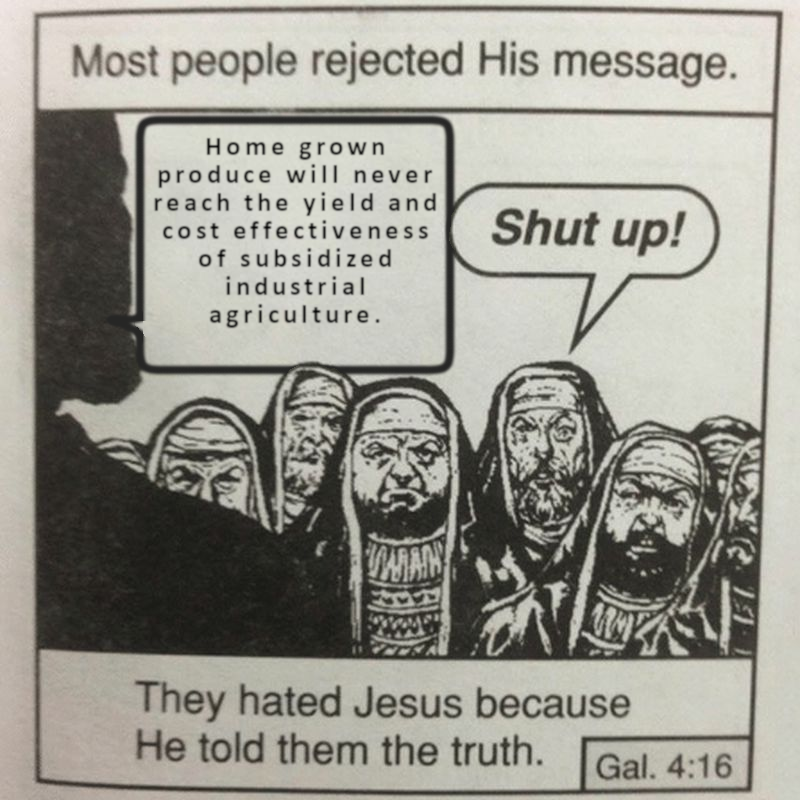
My handmade solid maple and walnut furniture will never reach the yield or cost-effectiveness as IKEA. I guess I’ll just have to burn my shop down
Who the fuck prioritized efficiency over quality in their backyard garden?
The Billions of human beings who rely on agriculture to live.
I think the imperative phrase here is backyard garden. They aren’t referring to a 40 acre field of wheat and potatoes, they probably are thinking a 10’x10’ raised bed.
Edit: operative not imperative
Yes but both in the comments and the post I’m comparing low yield home gardens to large yield industrialized farming. If anybody is trying to derail the conversation away from the topic of the discussion then that is on them, not me.
What exactly does homegrown produce mean for you?
counterpoint: industrial agriculture exists mostly to sustain animal products
That’s a really good counterpoint.
Crops like soybeans are mostly cultivated for animal consumption, but are you sure it holds for the entirety of the industrial agriculture?
You mean, compared to what goes to the market for people?
I don’t eat much of not industrial agriculture products, even local farms only produce fruits, and I would say they are also industrial (not sure where is the line)
Cows and other farm animals need a lot of food:
More than three-quarters of global agricultural land is used for livestock, despite meat and dairy making up a much smaller share of the world’s protein and calories. […] However, only half of the world’s croplands are used to grow crops that are consumed by humans directly. We use a lot of land to grow crops for biofuels and other industrial products, and an even bigger share is used to feed livestock.
As per the article two thirds of that ‘agricultural land’ is graze-lands, so like a 12.5% of that agricultural land is actually farmland dedicated to feed livestock.
I see, 25% is still not too little, I expected this to be less than 10% based on how you phrased the first comment. But you’re right, it’s possible to greatly reduce strain on land
That wasn’t me, but I found out about it relatively recently and I’m happy to share it.
Oh, true, sorry I’m a bit sloppy
Thanks for sharing, anyway ❤️
No worries :)
Not only that. But our agriculture is so centered around animals that we also have a huge surplus of manure (the animals’ feces, horn shavings, basically anything left of them) that we then use on all kinds of plant crops. It is so baked into the system that it will be a long way before we can really get a animal-free agriculture…
This is certainly true for our modern agriculture today. But is this really true for any possible industrial agriculture? Couldn’t we also have a plant based industrial agriculture leaving domesticated animals out of the equation altogether? Sure, we are a far way off from that. But I think it would be achievable and that we should aim for it.
The animal products are also just more industrial scale, subsidized farming, too.
Is probably true. However, one should question their world view if they measure everything as a minimization problem with respect to cost efficience and yield.
Why would home gardeners optimize for yield and cost effectiveness? They can’t deploy automation or economies of scale.
You garden at home because you enjoy the flavor, freshness, and variety. Those are the perks. Miss me with those mealy, flavorless grocery store tomatoes.
I came to the realization earlier today that there are an alarming number of people who theorize that they can just live off homegrown and composting. They think they can challenge big agriculture by “going off the grid” and that society would be better without subsidized industrial farming.
That’s why they would optimize for yield and cost effectiveness. They think they can compete.
EDIT: Also I’ve tried making tomatoes in colder climates before and they almost always succumb to disease. Huge success with zuccini and onions, though.
deleted by creator
Ok, I’m just curious, do you have a source for that soil antidepressants statement? Not being argumentative, legit want to read the source.
From a comment thread lower down:
permaculture.com.au/why-gardening-makes-you-happy-and-cures-depression/
deleted by creator
I would be cautious of statements like these. Because this way it is easy to get lost in your own idealization of community gardening. I mean, I agree that we should do more community gardening and that it would probably benefit most people.
But how do you know that industrial farming won’t ever be as nutritious/delicious as homegrown? How would you fall back on your own garden in case of a nuclear catastrophe? Wouldn’t your soil just be as contaminated? What are your arguments against GMO crops apart from all the obvious economic reasons? Wouldn’t be some genetic mutations be really good actually? I mean the food we eat is already heavily bred and mutated, even most homegrown stuff. Try eating a wild carrot or wild apple. Also, the article you shared regarding the antidepressant properties of soil makes some same mistakes. It is overly idealistic. The actual underlying study is much less ambitious and I’m not sure you can really claim that "working with soil has natural antidepressant properties ".
I love cooking and don’t really like eating out. But if a canteen/cafeteria is run well, it can sure cook much larger quantities of food that are just as delicious and nutritious. It just scales better. I would argue the same is true for agriculture. (Although we definitely would need to change agriculture by a lot!)
deleted by creator
Wow there, you assume I was arguing in bad faith but I was just genuinely curious to discuss this. No need in being so rude.
I think you still got a lot mixed up here. When I was talking about GMO plants I didn’t talk about all the awful practices of today’s capitalist corporations. But GMO in itself could be great for feeding many people in a world after capitalism. Glyphosat and other pesticides are really not the same as GMO. Do you actually know what GMO means and how it works? I’m not necessarily a fan of GMO and think we should be very cautious with it. But just dismissing it as obviously evil without understanding what it means is wrong imo.
Similarly I think it is not really clear what we discuss when er talk about industrial agriculture. In my mind it is solely the production of agricultural crops at a large scale and by means of employing machines. It seems like you think of it like our modern capitalist agriculture. This thread was originally about how to feed huge populations of people and I think we will need industrial agriculture. However, what we understand today under industrial agriculture is just one way of doing it. I obviously know that today’s conventionally farmed crops and monocultures are really bad for biodiversity and the environment. And I sure want to see then gone just like you. But even organic farming relies a lot on industrial agriculture. And I don’t think it is really true that homegrown crops in small community gardens are necessarily more nutritious or delicious than organically+industrially farmed crops.
And this was my overall point. Just because you feel like something tastes/looks better doesn’t mean it is actually better. That’s what I mean by idealization. I don’t think we get that far just claiming some practices are evil and others are good.
I’m gardening myself and sure it does help me with my mental health. But that is because I can choose to work in the garden whenever I feel like it. But if I had to work on a farm because we need all the people working the fields, it would certainly not improve but rather deteriorate my mental and physical health. But still, this has nothing to do with your claim that soil bacteria actually function as natural antidepressants.
And please seek help with your anger issues if you haven’t already. It is totally off to call someone “disingenuous bastard” if they just try to start a debate. (Just to be sure: I don’t mean this in a passive-aggressive way.)
deleted by creator
Wtf is wrong with you?
I’m telling you that some people think it can be a replacement. I’m explaining to you that this is an unfortunately common stance.
deleted by creator
Everybody knows the moon is made of cheese.
Like no cheese I’ve ever tasted.
(Just beware of vending machines with dreams of skiing.)
Absolutely you can compete my dude. Just not if you’re doing it commercially. If you have the space you can grow everything you need and save a ton of money.
The problem is everyone can’t do that. It doesn’t scale. To feed 8 billion you need the big ag machine. But you, yourself, if you want to focus your time and effort on digging in the soil instead of being a corporate cog, can absolutely support your needs for very cheap.
How northern are we talking? Our tomatoes didn’t so well last year in Northern Ohio, but the summer before i was absolutely drowning in cherry tomatoes!
47th Lat, so a fair bit further but the high winds of my region could contribute to hanging crops declines.
My parents are around 44 deg lat and their tomatoes do very well. It seems like something else must be limiting your success.
I don’t understand why anyone would argue against a garden. Should my yard just be grass? Why shouldn’t I plant something I can eat in it? It doesn’t matter if it’s less efficient than industrial farming, it’s basically unused land to start with.
That’s because nobody is arguing that. The argument is against people saying that industrial farming is evil and should be stopped, which is a bit of a past time hobby around here.
I don’t understand why anyone would argue against a garden.
I don’t understand why anyone thinks I ever argued against a garden.
They have to defend capitalism and the idea that overproduction is good, regardless of the waste.
They simply don’t care, about anything but money.
It may be true for ‘soldier’ plants. However there are thousands of plant species that can’t be both efficiently mass produced and shipped while still being of good quality. So you get a bad produce, very costly produce or both.
I can’t afford fresh Basil leaves, I maintained a plant in my kitchen in some of the apartments I lived in. The current one doesn’t have enough sun. It took 10 minutes of work to arrange and emptying left over water.
Also, if you never tasted cherry tomatoes straight from the plant you don’t what you are missing, and how shity is the produce in the market.
I can’t afford fresh Basil leaves, I maintained a plant in my kitchen in some of the apartments I lived in. The current one doesn’t have enough sun. It took 10 minutes of work to arrange and emptying left over water.
The basil plants you buy in grocery stores are designed to die after a while. It’s not lack of sun or water, it’s because there are just way too many plants in the tiny pot and basil does not like to be root-bound. They basically strangle themselves to death.
You can easily propagate the plant through cuttings or you can separate the grown plants and re-pot them in smaller groups.
Yea, I had Basil im some apartments. The current one has no sun at-all. Basil needs some. But when I bought plants my father guided me how to split them. Gifted my friends, don’t need more then one.
I used to hate tomatoes, then I tried home-grown and just realized grocery store tomatoes often suck by comparison. There are many plants that don’t store/ship well so you either can’t get them in stores (e.g. pawpaws) or they taste bad because of short shelf life/bruising.
TIL about pawpaws, thanks.
Okay but how does this feed 8 Billion People?
We don’t have a stable way to feed 8 billion people. The dependency on monoculture will cause many people to die under a changing climate.
Self gardening may:
- Increase food stability
- Increase access to nutrients rich food, GR while saving many, reduced food quality
- Be fucking tasty and cheap
I smoke a lot of weed. Always have. Last year I grew 4 plants in my backyard garden and this year I’ve saved thousands of dollars on weed. It’s not as strong as store stuff but you get used to to it quickly and there’s less paranoia with homegrown I find. I’m always gonna grow my own weed from now on. Only reason I didn’t before was that it was illegal. This year I germinated 3 seeds but only one took so I’ll have one super tall pot plant in my backyard haha.
While it’s still in the “vegetation” stage look up how to “clone” plants and you can make that one plant into as many as you can successfully clone!
I was wondering about this. Looked it up. Definitely starting a couple clones tomorrow. Thankyou.
Alright, I’d like to retroactively change my statement to have the amendment: “Except for Weed. You can easily be self-sustaining on weed.”
Agree, but also do plant something that you’ll use just a small amount from time to time, like herbs, spices, scallion, chive, and so on. Thing that you’ll want it fresh but you can never use it all before it compost. Don’t even need a garden, just plant it in pot.
I have screwpine leaf, lemon grass, coriander, and scallion in my garden, and i can harvest the onion when i need it.
Went to a local farmers’ market over the weekend. Everything was very good, y’all should give it a try
Yeah, a lot of farmers are good hardworking people.
no shit you can’t compete with something subsidized lol, how is that an impressive argument?
just… subsidize the homegrown produce if you want it to be competitive? big brain moment
Yeah like look up organopónicos in Cuba. Thanks to the collapse of the import market that fuelled industrial agriculture and government support of local growers, a good chunk of food in the country now comes from ecology-sound urban agriculture.
“Hi, this is Chett from the local government non-industrial agriculture office. We see that you grew 6 tomato vines this year and didn’t take advantage of our program to loan you the costs of 34% of maintaining the crop, as it isn’t your first year, would you like to be pre-approved for a $46.38 loan for next year? In return, we ask you to install flood barriers and have your soil tested regularly.”
Have you tasted store bought vegetables? Farmers market may be grown, may be store bought. I have 2 4x2ft planters full of veggies, out $200 this year setting it up. Next year just the price of seeds.
deleted by creator
Although I have certainly mentioned that 40+ acres are required to sustain a family agriculturally I believe that it is still worth it to grow food and herb and spices where one can. Just don’t expect it to change the direction of inflation.