- cross-posted to:
- climate@slrpnk.net
- cross-posted to:
- climate@slrpnk.net
You must log in or # to comment.

Yes but it’s not to late to stop the worse of it, if we keep our governments and companies accountable we can limit the worse of it.
That’s been working out so well so far.
The only way to keep them accountable while actually ensuring compliance is to burn them to the ground if they step out of line.
Uhh but didn’t they already step out of line? Lol
Yes, and we can see how well not burning them to the ground is going.
That was kinda my point lol
… Which was my original point…
Can we do something other than burn them? I don’t think the planet can handle much more CO2 output.
Good point.
So, sink into a subduction fault, or launch into the sun?
I vote for buried alive in a peat bog. That way, people in the distant future can discover their preserved corpses and put them on display in museums. At least they’ll finally give back to society.
I wish I had your optimism.
Don’t worry now we have AI stuff and it will solve all out problems
AI driven carbon sequestration Temperature reduction with neural networks deep learning
See? You can relax now, silicon valley tech and the invisible hand of capitalism will solve everything
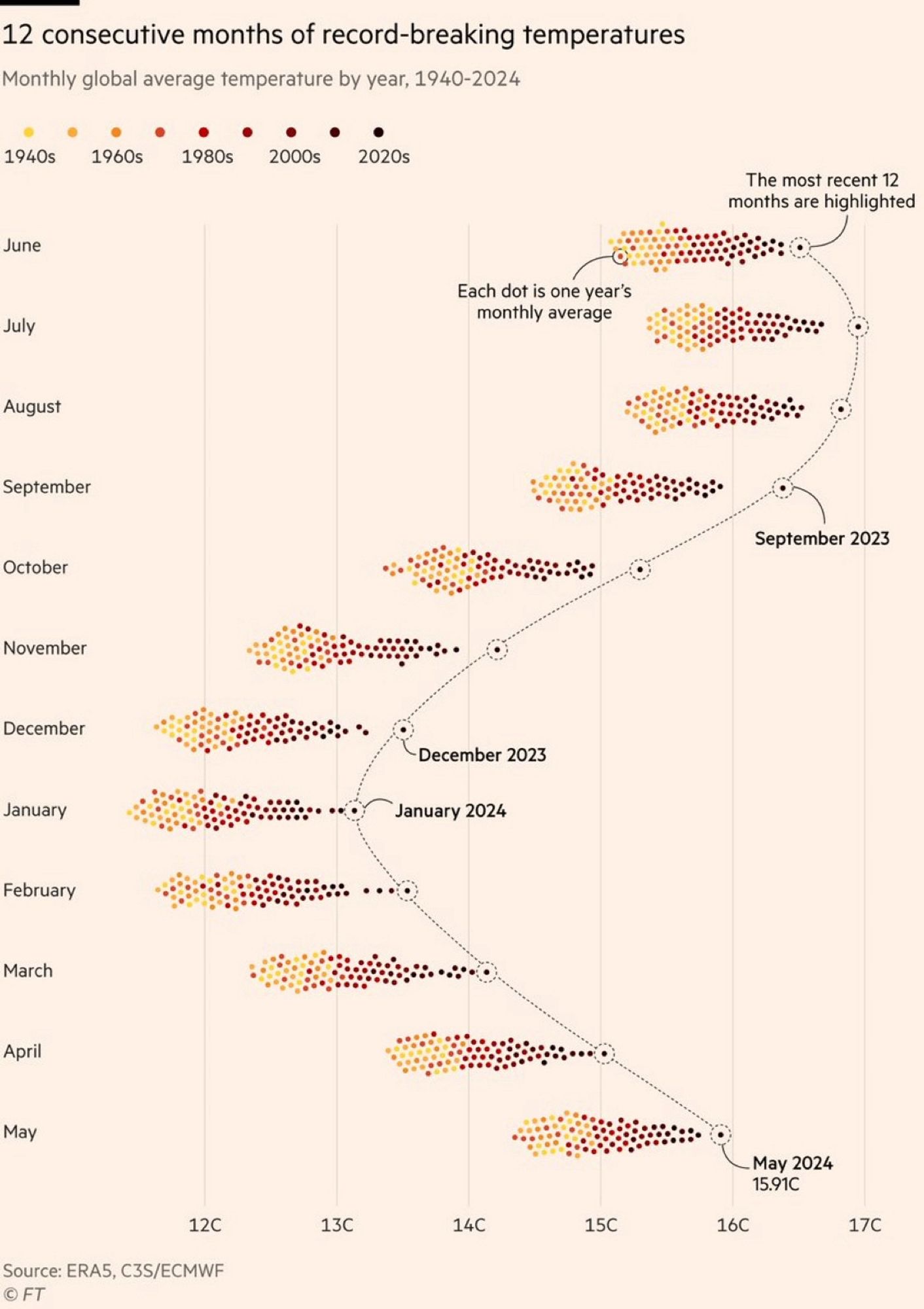
This is a really interesting visualization. I love the density of the data and the way it captures the year over year variability by month while allowing the annual variability to plainly stand out. This is really good.
If it was possible I would put quite some money on that geo engineering (like stratospheric aerosol injection) will be seriously discussed on a UN level within ten years. Climate change seems only to speed up and co2 emissions are still rising. At one point there is simply no alternative.
Greta Thunberg talks about it in her book - if the bathtub is overflowing in your house and water is spilling across the floor everywhere, step 1 for most people is to turn off the water. Yes sure it is fine to look for towels and buckets to try to contain the damage (and I don’t even disagree with you that it’ll be needed), but that also assumes that they’ll work and there will be political support to deploy them at scale, instead of mustering up the political support to turn the fucking taps down since at this point that’s clearly needed and is relatively speaking much much easier.
Exactly. The problem is that too many of the world’s leaders don’t want to upset the capital holders by limiting greenhouse gases.
These people are literally the people that Alfred told Bruce Wayne about: some men just want to see the world burn.
But at least we created some great shareholder value.
It’s honestly most akin to an AI model over optimizing for the trained outcome even when it turns out it was misaligned from the good outcome we wanted.
They certainly don’t want their grandchildren to inhabit a barely-livable hellscape instead of the paradise world they were born into, but they’ve been optimizing for money for so long that it’s baked in now, and it’s so so easy to just say, well it’s probably not a big deal, or I don’t think the science is really all that dire in its predictions, or oh well someone else will probably figure it out. And so, every year, we keep setting records for “production”.
I was more stating what I think will happen rather than wat we should be doing.
In terms of pure physics it is ofc easier to turn off the metaphorical tap, but in terms of power and politics we seem unable to transition to renewables. And I’m afraid once we switch on the geo-engineering button we still won’t transition. Only once oil is priced out of the market completely, be it fusion or abundant solar and wind (with energy storage), will we make the transition. But again I might be too pessimistic.
I also think that this is what will happen (not only discussed) but unless we master fusion it’s practically just fixing a symptom and we’d have to do that for quite a while and the oceans will probably become too acidic.
Fusion would solve a lot, but even if we invent room-temperature superconductors today, it would still take so much time to roll fusion out on a big scale and replace oil infrastructure with electric infrastructure.
I tend to be very pessimistic about climate change, but I hope I’m wrong.
Wouldn’t aerosols reduce solar irradiance globally, hence reducing the rate of photosynthesis globally…which further reduces natural CO2 capture? How would that help?
No. It can be localized (for large scales of localized).
Also, we are finding through putting solar farms on crop fields, sun light is not the limiter on photosynthesis for many plants. Many plants get too hot, loose moisture, and photosynthesis less.
There already is no alternative. The amount of CO2 released is going to stay high for a long time (centuries?). People are dying from the current weather.
For the expected response: We need to also stop making things worse. Humanity can do two things at once.
This graph alone conclusively proven global warming.
Took me more than a minute to realize that only 4 months of this year hold the record. Well, let’s wait for 2030
Edit: nope. Last 12 months indeed beat the records consequently . We’ll all soon die. The only good thing I can see from this graph is that the shift is even, meaning the seasons are still predictable.
What month of 2024 dosen’t hold the record?
April, March and FebHaha we’re doomed
We will probably be underwater in 2030.
I think that I should become a captain in a supertanker…
Fortunately it will take more than 6 years for coastal cities to start flooding that much. By the end of the century it is forecasted to go up by less than 2 meter worst case. In 2000 years it could rise as much as 20 years if the temperatures rise 5°C.
Additionally it is much easier to just move to higher ground.
Why does it seem like this is only the northern hemisphere and not truly “global”? Shouldn’t it be warm in the southern hemisphere when it’s cold in the north? So shouldn’t these groupings generally hover around an average between northern and southern hemisphere temps?
Because the northern hemisphere is mostly land mass and the southern hemisphere is mostly ocean. Land heats faster and cools faster than ocean, thus the seasonal effects are more pronounced in the data.
Same with CO2 patterns which gives a similar yearly ‘breathing effect’
What’s your source that there’s not warming in the southern hemisphere?
The temperature readings would look different because winter and summer are flipped, but they absolutely should be attributing a similar effect.
That’s what I thought… But if it’s winter in the north then it’s summer in the south, so you’d expect them to average in a way that you wouldn’t see such stark differences between say January and July. In July it’s winter in the south, summer in the north. Intuitively I’d assume they’d average. Temps would still be rising year over year, but you wouldn’t see a difference between months. A couple people have answered that it has to do with the earths tilt and the fact that there’s more landmass in the north. Seems plausible I guess.
Huh… So it does. Interesting.
The way earth rotate around the sun is not a perfect circle, but more like an ellipse, that plus the earth rotational axis makes the summers and winters of the global north and south don’t correspond exactly. This is why there’s a difference of ~4 Celsius between average January vs average July.
Ladies and gentlemen, we’re royally fucked.
This is graph of economy doing better than ever.
Well I prefer it being warm in the end times than cold. :)
Heating up is easier than cooling down
I prefer to cancel the apocalypse.
Or if there must be an end times there should at least be giant robots.
Nice graphic. Although probably you’d see more info with just a lineplot, separating north / south + land /ocean. What strikes me is how regular the gap is over the last year, and how it bulges most in July-December, which suggests the ocean (larger and less variable) dominates the numbers, with El Niño overlaid on steady warming trend. To get it back down quickly, we need more effort on short lived gases - mainly methane (tackling aviation-indeed cirrus might also help compensate for reduced ship-sulphate cooling ) .
There are layers of variability there that can’t be captured with a line plot. The data density is too high to even capture the decanal progression in a useful way, forget about monthly and annual variability . So no.