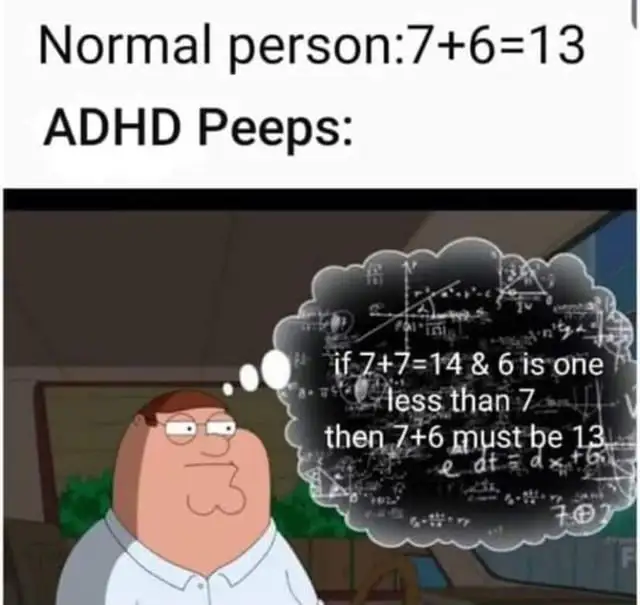

Edit: it appears that this is not exclusive to ADHD.
Posting this meme stemmed from my own efforts to explain my thought process when doing math and how it is similar to other people with ADHD doing math, while being different from every neurotypical person I’d talked to on the same subject.
While I didn’t make the meme itself, instead finding it in my saves and wanting to share, I did accidentally spread misinformation that I had only backed up with personal anecdotal evidence.
I’ll leave this up just so people can see the explanation below but this appears to not be ADHD related and just due to different people doing math in their heads differently…
uhhhh that’s not how everyone does it?
Nah, I’m down with the 9s. 9+6 is 15 so it must be 13
deleted by creator
It is. Some people find more common numbers easier to add, then just figure out the difference. People in this community love to call totally normal stuff “adhd logic.”
This has nothing to do with ADHD… mixing up stuff is just confusing people
This has absolutely nothing to do with ADHD
That’s the smart way to do math. I mean not with such small numbers but you’d do the same thing adding up large numbers, you break down the numbers and rearrange them in a way that’s easier to compute.
Algebra probably feels intuitive to you.
They’re also trying to teach that in math classes (it gets called “new” math) but the boomers are freaking out because “why can’t they just do normal additions like we used to, this is so complicated”. And the answer to that is, 99% of the time you’ll be doing algebra because we literally all carry a calculator in our pockets and sometimes on our wrists at all times and we never need to just do a long division. And that kind of thinking really makes it easy to break down formulas because your brain thinks in terms of moving stuff around in an equation.
They’re also trying to teach that in math classes (it gets called “new” math) but the boomers are freaking out because “why can’t they just do normal additions like we used to, this is so complicated”.
So, as a childless Xennial, I have to ask… is today’s “new math” the same “new math” that people complained about in the 60s?
If so, that’s an awfully long time for something to be shunned as “new.”
we never need to just do a long division.
Truth. I recently got a neuropsych evaluation and part of it was an unexpected (to me) IQ test. And staring me in the face, for the first time in ~30 years, was a few pages of arithmetic problems. Took me a minute to recall how to do decimal multiplication but it did come back to me. Long division? Nope. Had no freaking clue. Given that it was timed I just left blank anything I couldn’t work out in my head. Maybe if I had time for trial and error I could have eventually figured it out. But one thing is for sure… the odds of me ever needing that skill again are fairly low.
I had the same thing happen in grade 12. I had a shitty teacher for calculus, so I went to Kumon to try to get help with learning calculus.
They said I needed to do their placement test to figure out where I start on their program, even if I just wanted the calculus booklets. And on it they asked me to manually do decimal multiplication and long division. It took me a minute to remember how to do long division (I’d only done short division for many years, and even that was years ago at the time.) Because it took me so long to complete it, they had me starting on grade 5 math or something ridiculous.
It’s predatory what they’re doing, imho. A proper test should be to give students a practice version so they can refamiliarize themselves with the content first. Then they’d get an accurate assessment, but they’d rather start students too low so they can scare parents with how far behind their kids are, then rocket the kids forward with lots of easy successes on things they already know so they can show off how amazing their tutoring results are. What a scam.
isn’t the problem specifically that some people just can’t really do intuitive math for small numbers? like all through school everyone else just breezed through memorizing the multiplication tables and i just sat there manually adding numbers together and felt so fucking stupid and worthless in math class
Yeah, everyone pops at their own time. Not everyone gets it quickly.
My daughter is finding this right now; fluency with small numbers isn’t coming to her quickly, so we’re doing extra review at home to help. Not many parents are equipped to help with number fluency games, though, so it’s unfortunately not unusual for many kiddos to hit fractions (or algebra) before they have strong number sense and math hits then like a truck.
If it helps, anyone without significant intellectual delays can learn number sense and work their way back up the math ladder from there. You could go back and work on decomposition of 10, 20, and 100, skip counting forwards and backwards in this progression: 10, 5, 2 (even numbers), 2 (odd numbers). Then for the rest, start with 9, but then from learn from any number: 3/4, 5, 6, 8/9, 7. (You start learning the bigger ones by building off 2s: Skip counting by 3 is 2+1, 4 is 2+2, 8 is 10–2, 9 is 10–1, 7 is hard, but if you have fluency skip counting by 5 from arbitrary numbers, then it’s just 5+2.)
I hope that makes sense. A full mental math progression is explained in the Jump Math for Home books at the middle school level.
No, since 6+6=12, then because 7 is one more than 6, 6+7=13
7 + how much is ten? 3
How much is left? 3
Ten plus however much is left = 13i was gonna say, this is ADHD math? I just thought this was mental math in short lmao.
6=3+3, 7+3=10, 10+3=13
PS I had to edit this post because of typos.
7 is closer to 10 than 6 so we consider that 7 is really just a 10 with a size-3 hole in it and we fill that hole with 3 from the 6 giving a 10 with 3 left over which make 13.
Also not an ADHD thing.
That’s my strat too. Also confused what this has to do with adhd
I calculate percentage like this. If 100% is the value, then I know what 10% is, then1%, so I do increments of both until I get to the correct value.
It may sound stupid,but it does help me get a % fast enough.
Thank you! That’s pretty neat. I tried 27% of 65
I added two 10% increments (6.5+6.5)… but instead of adding 0.65 (1%) seven more times, I added a 5% increment (6.5/2 = 3.25) and then 2 increments of 1%
So 6.5+6.5+3.25+0.65+0.65 = 17.55
I still had to use a calculator to add those weird numbers (and also check my work), but it does seem really practical for easier numbers. I usually need percentages for pricing (i.e. discounts/tipping), and the percentages are normally in increments of 5%, so that’s pretty useful for figuring out a 15% or 75% of something real quick… or at least get me really close (when talking about something like $X.99)
Regardless, I appreciate the head trick!
Edit: I guess I could’ve done 30% and then subtracted 1% twice; but it’s the same issue (of adding weird numbers) with the same outcome anyway. So thanks again!
7+6=? 7+3+3=? 10+3=? 13=13 (Not ADHD)
Interesting, I make sets of 10. When I see 7 and 6, half of the 6 moves over to make 10 + 3. I say “moves over” because it feels like dividing tokens into sets in my head.
I always tell my children that Maths is finding the best way to cheat at a problem. Don’t solve the hard problem. Solve the easy one that’s kind of like the hard problem and then find the difference.
And judging by the school material that’s how they’re supposed to do it. But either the teachers aren’t explaining it that way or the kids aren’t listening.
This sort of math fluency is explicitly in the curriculum, now. Teachers are expected to teach lots of fluency skulls, including decomposition, reordering addition, and lots of other strategies.
I don’t think I have ADHD but I do it exactly this way.
deleted by creator