Of all the things that have changed since Reagan took office, it’s nice to see that ‘fiscal responsibilty’ still means massive unfunded tax cuts for the people who need them the very least.
MAGA voters be like: Red scary, ugh.
Honestly they’re hoping you only look at the bottom big numbers and ignore your actual insurance bracket.
Trump has a plan?
The heritage foundation has a plan. Why come up with your own when someone has already done the work for you?
Republicans making $35k a year: “but wHeRE is The iNcEnTiVE to bE sUcCeSsFuL!!!”
They also believe that Jesus might make them rich so best be prepared.
deleted by creator
It’s the tariffs I’m worried about.
But Trump said tariffs don’t impact prices and he’s a completely rational and trustworthy person who most certainly understands economics!
Wait. Who am I voting for based on this graph if I’m making 200k, and why?
This is purposely not clear.
Do you lack the ability to think of others when looking at the graph?
You couldn’t have just spent that time explaining it rather than being snarky? This graph either says Donnie is raising my tax or my income will go up more.
Not everyone is always on top of their game and the smartest person on the Internet…
Then your income will increase by a little over $2000.
According to this, those making 100k (33.6% of Americans) will be getting less money. The 66.4% of Americans will be getting significantly more.

Via zippa
As a programmer and my wife is a doctor, I’m in the upper brackets. But I don’t care. Also happy to see the millionaires losing even more money!
In my eyes, $3000 goes a long way for someone struggling!
It’s not losing, it’s sharing.
Same. Oh no I’ll have to cook at home a few more times per year. How will I survive.
Deleted.
I’m assuming you mean they will be getting a lower portion of the increases? The chart you have here looks more like how many people fall in a given bracket.
It makes plenty of sense to shift things to greater gains on the lower end. A while back there was a study that said somewhere around $75K was the point at which actual income gains start to level off as far as what improvements it makes to your life. At that point you can probably pay your bills and afford to eat without stressing so much over every decision. I forget if that was for a single person or what, but for where I live it would be doable to be sure. Lower than that and you need that extra boost to just meet the basic needs.
My guess is with inflation 75K is no longer the ceiling for the amount you make before you level off as far as happiness and comfort go. Still, billionaires don’t really need to exist either way. 🤷🏼♀️
The $75k figure is from 2010. The article seems to be https://www.pnas.org/doi/10.1073/pnas.1011492107.
You acknowledge $75k as a living wage in 2010. How would research from 2010 be used for wage suppression today? Was it wage suppression in 2010?
Actually I didn’t specify when. The measure of if a wage is livable is going to vary greatly based on where you are of course. Around here one of the larger employers handing out ‘just basic work’ level jobs starts off at around $40K which is roughly a $10K increase over the last few years according to their persistent hiring sign and it’s regarded locally as being decent pay.
Some very rough math would say that if you made $75K and took home say 60% of that after tax and insurance you would make about 3,750 a month. A rent or mortgage in the $1000-1500 space isn’t too abnormal here leaving $2K+ for your other needs, utilities, food, etc
It’s not a life of luxury level to be sure, but being someone who has gone from “milk to make mac & chz is a luxury” to actually having a few bits extra to buy some nice toys there is a cutoff out there where cash stops being the main stress in life. In my case it was somewhere around the point when I could just go buy a jug of milk without having to check if that was going to leave enough gas money for the rest of the week…
Perhaps poverty and a living wage are different. I often get caught up in the difference between one million and $75k.
What’s fifty grand to a — like me, can you please remind me? (A lot. That’s… a life-changing amount of money for normal people)
- “Ninjas in Paris” by Watsky
deleted by creator
deleted by creator
Sure, but is people making over $14m/year paying more taxes really a bad thing?
For them it is…
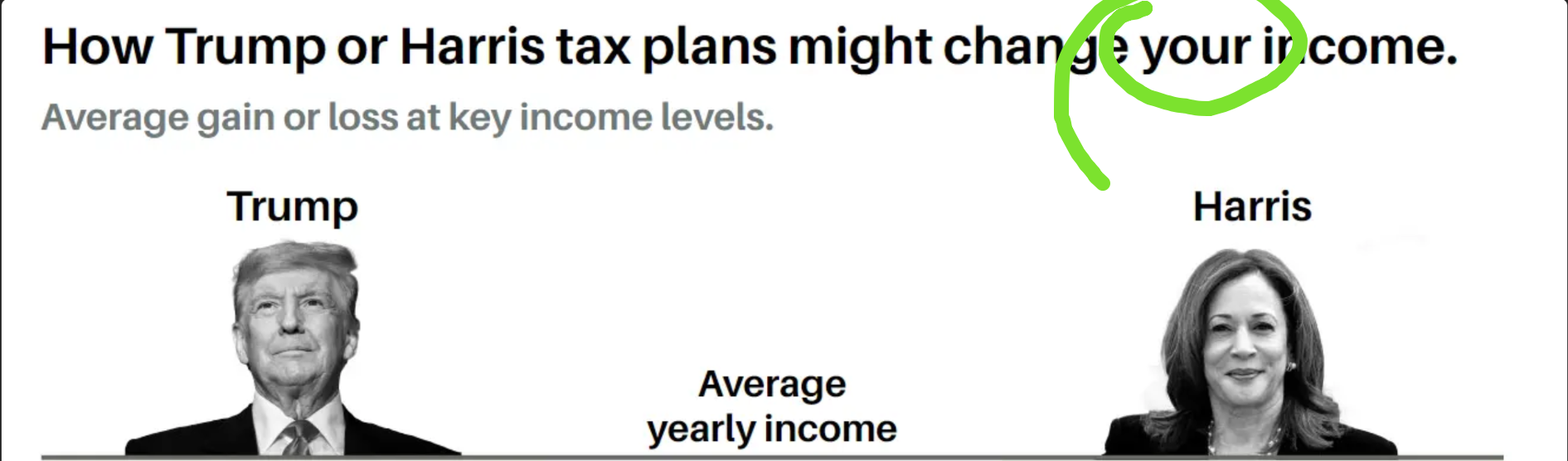
I’m sure the post tax income will still be enough to soak up the tears.
Fuck em.
Trump wants me to sell out my country for less than $50k?!? How is that money going to help me when living in the country becomes unbearable and my dollar is worth a fraction of what it does today?
EDIT: The problem is the suburban $139k bracket, living paycheck to paycheck and in debt up to their eyeballs. That $1000 difference might look real juicy to those guys.
How the fuck do you manage to spend 139k a year? People don’t make any god damn sense.
Oh man, it happens without you knowing it. I got caught in that once. Between my wife and I we were making close to $200k and we couldn’t survive two months without a paycheck. Mortgage, car payments, school loans, credit cards payments and taxes for start. Then you want to make yourself feel better because your job and traffic to and from work are sucking the life right out of you, so you start buying shit and decorating so you can have a sanctuary, all the while you are strengthening the chains around your neck.
A slave with a nice car and house is still a slave. They just are less aware of it…until they want to quit and realize that they can’t.
Huh, being raised poor I hardly ever buy anything for myself. I generally fill out my I-9’s with zero dependents so that I get more tax taken out throughout the year and get a little back at tax season. We buy used cars rather than paying interest on car payments. Never had school loans because I knew I wouldn’t make enough in the real world to pay for it. Never had debt on a credit card other than a few periods of unemployment, but paying those off when possible was always a priority.
Never had much support from my parents, and I’m naturally good with numbers and statistics, so I tend to think in terms of value gained for purchases.
But I also could pack everything I own onto a pick-up truck and drive off with it, still wear clothes I bought at my frist job at Sears almost 20 years ago.
Just accepted from an early age I was going to be poor, and really leaned into it.
So was I. My wife and I grew up poor. Imagine then what happens when you go from celebrating a $200 bank account balance to $200k/yr in two years. We got caught up in the typical life of endless debt that was suburbia during the dot-com boom. After I lost my dot-com job (technically the company stopped existing) and we realized how trapped we were, we got our senses back and we haven’t had new debt since. If I can’t buy it cash, then I can’t afford it.
Yeah it can be a hard lesson to learn, glad you are able to grow and overcome!
I thought the top 0.1% was more like $3 million. Either way it’s still an incredibly large amount of money for 1 in 1000 people to be making. With 131 million households that’s 131000 households making more than $14 million per year which is WILD. One in a thousand isn’t that uncommon, yet I’d never guess who were making that kind of money. They must just be living in completely separate spaces.
I think nearly 10% of the US population is millionaires (by wealth, not income) and the percentage is even more if you take home equity into account.
Say what you will about the country, but there isn’t a prosperity problem, only a rampant inequality problem.
Millionare in assets is vastly different than $1 million per year in income. It’s pretty much a requirement to have $1 million in assets to be able to retire lately and assuming years of compounding growth in the market this is pretty easily attainable by retirement for most (I know this is a big assumption but our whole economy is built on it).
“Millionaire in assets” is even less impressive when you factor in someone’s home value. Like, Zillow keeps telling me my condo is worth $350k. I guess I am worth that on paper, but it’s not liquid or “walking around” money.
Unless your mortgage is totally paid off you aren’t necessarily worth that much on paper.
Oh boy 2000 extra dollars. That’ll really turn things around for me…
Changing taxes levied on income doesn’t change the income itself. Do they mean remaining income after tax?
Are you guys taxed at the source or where does this confusion come from?
deleted by creator
Oh shit, trump would benefit me? Thanks for this I’m switching sides.