Ah hahahaha!!!
Windows! Some dumbass put Windows on a supercomputer!
Prob Microsoft themselves
Ironically, even Microsoft uses Linux in its Azure datacenters, iirc
They use a mixture of Windows and Linux. They do use Linux quite a bit, but they also have a lot of Hyper-V servers.
True. Never meant to say they use Linux exclusively; thanks for clarification anyway!
Good point.
But still, the 30% efficient supercomputer.
Heh. I don’t think that number was ever official, but I heard it as well.
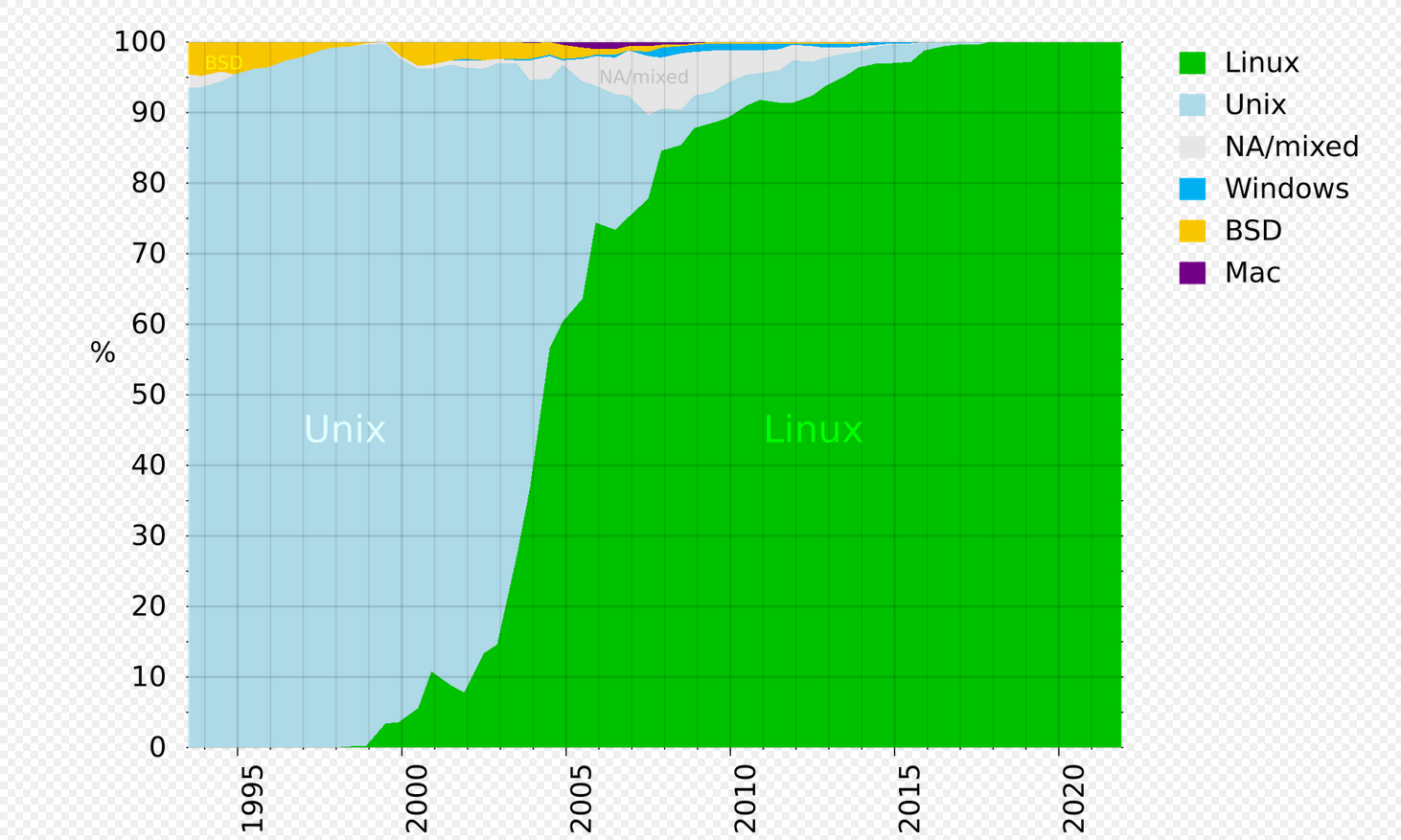
I don’t think either of the chart’s axes list efficiency?
Heh. I don’t think that number was ever official, but I heard it as well.
Oh that was hyperbole, I didn’t expect to be taken literally!
Lol. Well good guess.
I’m not a primary source or anything, of course. Your comment just matches something I heard once in office gossip.
deleted by creator
Surprised to learn that there were windows based Supercomputers.
Those were the basic entry level configurations needed to run Windows Vista with Aero effects.
Wow, that’s kind of a lot more Linux than I was expecting, but it also makes sense. Pretty cool tbh.
Linux is just the unix flavor that replaced the others.
Linux isn’t a UNIX flavor. It’s UNIX-like.
Maybe windows is not used in supercomputers often because unix and linux is more flexiable for the cpus they use(Power9,Sparc,etc)
Plus Linux doesn’t limit you in the number of drives, whereas Windows limits you from A to Z. I read it here.
You can mount drives against folders in windows. So while D: is one drive, D:\Logs or D:\Cake can each be a different disk.
What in the world? I don’t think I’ve ever seen that in the wild
It’s common in the server world. KB article on it is here.
For people who haven’t installed Windows before, the default boot drive is G, and the default file system is C
So you only have 25 to work with (everything but G)
G can be mapped after boot (usually to removable drives)
Almost, the default boot drive is C:, everything gets mapped after that. So if you have a second HDD at D: and a disk reader at E:, any USBs you plug in would go to F:.
Why do you copy the boot files from C and put them in G during install then?
I don’t think anybody does that, honestly.
You can have a helper script do it for you (the gui) but it still happening in the background
The boot files go into C:, not G:.
Windows can’t operate if you did that, it doesn’t let you.
Ok that would make sense tbh
That’s certainly a big part of it. When one needs to buy a metric crap load of CPUs, one tends to shop outside the popular defaults.
Another big reason, historically, is that Supercomputers didn’t typically have any kind of non-command-line way to interact with them, and Windows needed it.
Until PowerShell and Windows 8, there were still substantial configuration options in Windows that were 100% managed by graphical packages. They could be changed by direct file edits and registry editing, but it added a lot of risk. All of the “did I make a mistake” tools were graphical and so unavailable from command line.
So any version of Windows stripped down enough to run on any super-computer cluster was going to be missing a lot of features, until around 2006.
Since Linux and Unix started as command line operating systems, both already had plenty fully featured options for Supercomputing.
More importantly, they can’t adapt Windows to their needs.
Yep the other reason.
Now the real question is what package manager are they using? apt or yum? Lol
they specifically built it to only use snaps
They’re all Ubuntu distros lol
Also, Gnome or KDE?
It’s probably mostly cli
Yeah, but gterminal or konsole?
edit: apparently people didn’t realise this was a really obvious joke
That’s a terminal emulator
thatsthejoke.jpg
TTY
yes
Slackpkg or slackpkg+, without a doubt.
Portage (Gentoo)
I saw the thumbnail and thought this was a map of The Netherlands
One of the Top 500 supercountries
Technically accurate
Aw thanks!
“Is your UNIX Linux compatible?”
This looks impressive for Linux, and I’m glad FLOSS has such an impact! However, I wonder if the numbers are still this good if you consider more supercomputers. Maybe not. Or maybe yes! We’d have to see the evidence.
There’s no reason to believe smaller supercomputers would have significantly different OS’s.
At some point you enter the realm of mainframes and servers.
Mainframes almost all run Linux now, the last Unix’s are close to EOL.
Servers have about a 75% Linux market share, with the rest mostly running Windows and some BSD.I wonder if the numbers are still this good if you consider more supercomputers.
Great question. My guess is not terribly different.
“Top 500 Supercomputers” is arguably a self-referential term. I’ve seen the term “super-computer” defined whether it was among the 500 fastest computer in the world, on the day it went live.
As new super-computers come online, workloads from older ones tend to migrate to the new ones.
So my impression is there usually aren’t a huge number of currently operating supercomputers outside of the top 500.
When a super-computer falls toward the bottom of the top 500, there’s a good chance it is getting turned off soon.
That said, I’m referring here only to the super-computers that spend a lot of time advertising their existence.
I suspect there’s a decent number out there today that prefer not to be listed. But I have no reason to think those don’t also run Linux.
Just need to do a dnf update on them all…
Can we get a source for this image?
Sure. Added it to the post.
deleted by creator
Any idea how it’d look if broken down into distros? I’m assuming enterprise support would be favoured so Red Hat or Ubuntu would dominate?
The previously fastest ran on Red Hat Enterprise Linux, the current fastest runs on SUSE Enterprise Linux.
The current third fastest (owned by Microsoft) runs Ubuntu. That’s as far as I care to research.deleted by creator
Because all the Arch consultants were busy posting on the internet.
Suoer-computing is a pain-in-the-ass, so my guess is some combination of SUSE picking up top talent that left other Linux vendors as IBM has been purchasing them, and SUSE just being willing to put in the extra work for the added brand recognition.
I can’t imagine Supercomputers to use a mainstream operating system such as Ubuntu. But clearly people even put Windows on it, so I shouldn’t be surprised…
They do use Ubuntu, Red Hat and SUSE mostly.
But for customers like that, the companies are of course willing to adjust the distro to their needs, with full support.
Microsoft uses their own Linux distro now.
Interesting how the tiny BSD fraction had a lead over Linux in 1995
deleted by creator