Social murder (German: sozialer Mord) is a concept used to describe an unnatural death that is believed to occur due to social, political, or economic oppression, instead of direct violence. Originally coined in 1845 by German philosopher Friedrich Engels, it has since been used by left-wing politicians, journalists and activists to describe deaths they attribute to larger social forces.
Lowkey hilarious that the English Wikipedia cites the original German name of this concept but there isn’t even a German page for it
hmmm interesting observation! why do you think that is? /gen
my guess is maybe the leftists who adopted the term from Engels are primarily english speakers (could be wrong)
It could be that, but probably it’s mostly related to the fact that German Wikipedia, while big, doesn’t match the English one in size. Some more obscure topics just aren’t on there for no reason other than that it just didn’t happen.
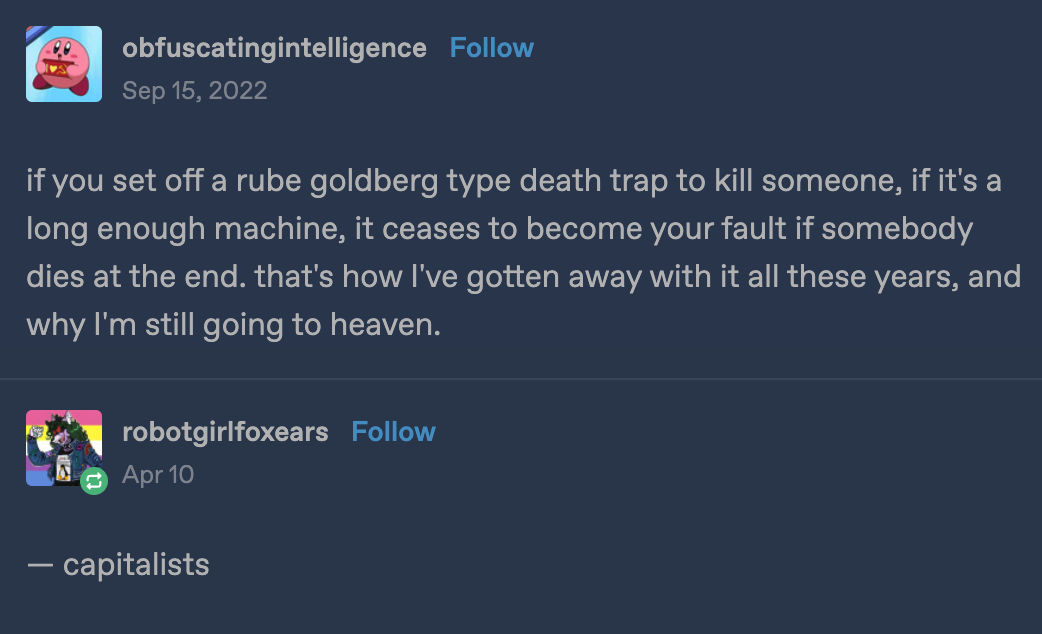
As long as your primary goal was to make money, not to kill people, then killing people is fine.
If you kill someone for a reason other than optimizing your business model, that’s a crime.
It’s disturbing how true that is.
You kid, but moral philosophy is full of examples like that.
If I leave a rake on the ground and it rusts over 5 years and then someone contracts tetanus is it my fault? If it is my fault is it just counter-factually? If it’s my fault because counterfactually I could have put the rake away and prevented the death, am I blameworthy? If I’m not blameworthy do I have any obligation to right the wrong?
I know this isn’t critical to your point (which is a good one), but since tetanus is deadly, I feel obligated to mention that tetanus and rust are unrelated: https://www.discovery.com/science/Tetanus-From-Rust. Make sure your vaccination is up to date even if you aren’t dealing with rusty metal.
i’ve had better luck illustrating the point with a less abstract case: the 2000’s called and it’s your turn for jury dury. the case for today is that of a single mother who downloaded some Disney movies off Limewire for her kids to watch so she could get some time to herself to take care of chores.
should the jury find her guilty, you suspect that the judge will fine her $250,000 and cancel her home internet connection. you think such a punishment would do more net harm than good. but you don’t get to decide the punishment (that’s for the judge to announce after the jury deliberates), you just decide the guilty/not-guilty verdict.
you look at the evidence: the mother definitely downloaded those files. what verdict do you deliver the judge?
in my head, there’s a direct causal chain:
- the court presents me with the accusation and the evidence.
- i declare if the evidence supports the accusation.
- the judge declares a punishment in response to that verdict.
- law enforcement delivers the punishment.
if i believe (3) and (4) will function as stated, then it’s equally accurate to say that in step 2 i am deciding whether or not to confiscate $250,000 from this mother and cancel her home internet connection.
but a huge number of people i present this to refuse to admit that equivalence. there is some question about whether weakening the norm might cause more damage than mistreating the mother, but does that even weaken the point? the common answer from those who bring it up is “there’s too much uncertainty to say”: build a complex enough machine, and people are eager to deny the downstream effects of their actions.
(you can overcome most of the degradation-of-norms issue by making this a secret hearing, and still a lot of people will hesitate to admit the equivalence between their verdict in step 2 and the effects of step 3/4)
It depends, did you purposely leave the rake out knowing full well that it could result in someone’s death down the road?