I really wish that I was born early so I’ve could witness the early years of Linux. What was it like being there when a kernel was released that would power multiple OSes and, best of all, for free?
I want know about everything: software, hardware, games, early community, etc.
You must log in or register to comment.
Removed by mod
Remember the slow internet had to wait overnight for 40 megabyte game and finally finding out it didn’t work.
Removed by mod
Half of it because random disconnect happened in the middle and download did not resume.
In glorious 256 colors !
Up all night, and all you got to see was a boob
Sometimes a boob who spent the previous night compiling a custom webcam driver. :(
jad
You spent a few evenings downloading a hundred or so 1.44MB floppy imges over a 56kbps modem. You then booted the installer off one of those floppies, selected what software you wanted installed and started feeding your machine the stack of floppies one by one.
Once that was complete you needed to install the Linux boot loader “LiLo” to allow you the boot it (or your other OS) at power on.
All of that would get you to the point where you had a text mode login prompt. To get anything more you needed to gather together a lot of detailed information about your hardware and start configuring software to tell it about it. For example, to get XFree86 running you needed to know
- what graphics chip you had
- how much memory it had
- which clock generator it used
- which RAMDAC was on the board
- what video timings your monitor supported
- the polarity of the sync signals for each graphics mode
This level of detail was needed with every little thing
- how many heads and cylinders do your hard drives have
- which ports and irqs did your soundcard use
- was it sound blaster compatible or some other protocol
- what speeds did your modem support
- does it need any special setup codes
- what protocol did your ISP use over the phone line
- what was the procedure to setup an tear down a network link over it
The advent of PCI and USB made things a lot better. Now things were discoverable, and software could auto-configure itself a lot of the time because there were standard ways to ask for information about what was connected.
It wasn’t too early, maybe 1997.
I was like 12 or so and I had just installed Linux.
I figured out, from the book I was working with, how to get my windows partition to automaticallyount at boot. Awesome!
I had not been able to figure out how to start “x” though.
So I rebooted into Windows, for on EFnet #linux, and asked around.
Got a command, wrote it down on a slip of paper, and rebooted into Linux.
I should mention, I also hadn’t figured out about privileges, or at least why you wouldn’t want to run around as root.
Anyway, I started typing in the command that I wrote down:
rm -rf /.I don’t have to tell you all, that is not the correct command. The correct command was
startx.After I figured it was taking way too long, I decided to look up what the command does, and then immediately shut down the system.
It was far too late.
My pranks were less destructive …
/ctcp nick +++ath0+++… it was amazing how often that worked. 🤣Thats a new one on me. What did that do if I may ask? Best I have been able to figure out is that it’s probably IRC related but that’s it.
+++ath0is a command that tells a dial up modem to disconnect. I’ve never seen it used in IRC this way, but my guess is that the modem would see this coming from the computer and disconnect.This was back in the days when everything was unencrypted.
Yes, and encryption had nothing to do with it (though I suppose it would have prevented it in this case).
A properly configured modem would ignore this coming from the Internet side, or escape the characters so that they didn’t form that string.
Encryption would prevent it - that’s what I meant :)
I think the trick is to convince someone to send that string, so the modem sees it coming from the computer. Similar to tricking someone into pressing Alt+F4, or Ctrl+Alt+Del twice on Windows 9x (instantly reboots without prompting).
encryption would prevent the modem from seeing it when someone sends it, but such a short string will inevitably appear once in a while in ciphertext too. so, it would actually make it disconnect at random times instead :)
(edit: actually at seven bytes i guess it would only occur once in every 72PB on average…)
Explained nicely here: https://everything2.com/title/%252B%252B%252BATH0
Wow, a post from 2001 that’s still online today. You don’t see that often any more!
Before modularized kernels became the standard I was constantly rerunning “make menuconfig” and recompiling to try different options, or more likely adding something critical back in :-D
I totally forgot about the shift to modules. What an upgrade!

“Please insert Slackware disk Set A disk 3”
Removed by mod
Relevant xkcd’s

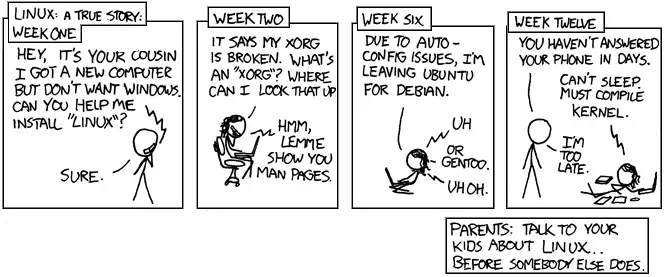
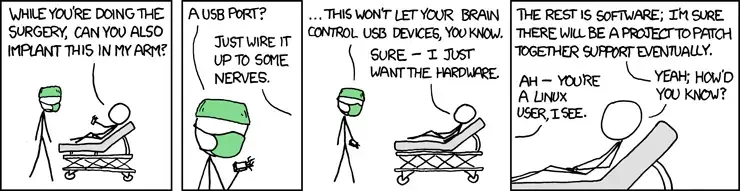
Do you have support for smooth full-screen Flash video yet?
I don’t remember if that ever got fixed. Even if it did, Flash was already on its way out by that point.
Removed by mod
deleted by creator
All my homies who were into it were like “everything is free you just have to compile it yourself”
And I was like “sounds good but I cannot”
Then all the cool distros got mature and feature laden.
If you were a competent computer scientist it was rad.
If you were a dummy like me who just wanted to play star craft and doom you wasted a lot of time and ended up reinstalling windows.
You got it from a friend on a pile of slackware and floppies labeled various letters. It felt amazing and fresh, everything you could need was just a floppy away.
Then we got Gentoo and suddenly it was fun to wait 4 days to compile your kernel.
Is Slackware just pirated software?
No, it’s one of the first Linux distributions
Thanks! The Wikipedia was an interesting read. It seems it was closed source? That’s an interesting Linux method
I tried compiling gentoo a bit later, upgraded from windows 95. Could never get to a login screen, I quit, and started using Linux later when it was easier to install
I remember I had over one hundred floppies to install it all. And those were just for the stuff I was interested in. This was circa 1996. I bought Red Hat 5.0 a year or so later. It came on 4 CD-ROM’s and was cheaper than that pile of floppies had been.
A real pain in the ass. It was still worth it to use for the experience, especially if you had an actual reason to use it. Other than that it was just an exercise in futility most of the time…and I think that’s why we loved it. It was still kinda new. Interesting. And it didn’t spoon feed you. Was quite exhilarating.
Contrary to other OSes, the information about it was mainly on the internet, no books or magazines. With only one computer at most homes, and no other internet-connected devices, that posed a problem when something didn’t work.
It took me weeks to write a working X11 config on my computer, finding all the hsync/vsync values that worked by rebooting back and forth. And the result was very underwhelming, just a terminal in an immovable window. I think I figured out how to install a window manager but lost all patience before getting to a working DE. Days and days of fiddling and learning.
Speaking of books, my only experience with Linux in the 90s was seeing the Red Hat books. I don’t know anyone who actually made it work.
I haven’t seen these until much later

Prior to the website rpmfind.net, installing software was to put it mildly, a chore. Due to package dependency, you’d start the compile, and it would fail due to missing libraries. You’d then go out and find those libraries, only to have them fail on compile…due to missing libraries…it would go on like until you finally were able to compile the original package - at this point though you compiled it out of sheer spite for the universe that put you in that position.
I rate the experience a solid 5/7
deleted by creator
And you needed to find out the scanlines of your monitor before X would even display anything, and then that was a black and white grid. Then you needed to spent another day or two getting a window manager working.
The danger of poorly configuring your XF86Config in a way that could irreparably damage your giant CRT monitor was thrilling.
XFree86 was such a tacky name
I got a very early version of Debian from a friend when I was in college. I had a very old computer gifted to me but couldn’t get Windows to install. I ran that badboy with no window manager, just text. I used elinks for my web browser and pine for email. VI was where I wrote my papers. Drivers were a problem, so I had to save papers on a disk to print from a computer at a library.
The only OS that was solid as a desktop OS back then, with good usability, was BeOS. Both MacOS and Windows had stability problems (although NT/2000 were much better, but lacked app/game compatibility), and Linux was a nightmare to update and run (lots of compiling too). So the OS of choice back then for me, was BeOS. I could do everything I needed with it too.
I never got to run BeOS (well…when it was modern), but it’s really depressing just how insanely better it was than the competition. Ditto Amiga.