


- cross-posted to:
- Europe@europe.pub
- europe@feddit.org
- hackernews@lemmy.bestiver.se
Every single UBI experiment has the same results, it’s wildly successful. The only reason it will never happen for most of humanity is capitalism.
Very interesting. Some actual data to go with all the political bluster surrounding the idea of a Universal Basic Income.
deleted by creator
The only reason the rich cunts try to tell us you ‘can’t just GIVE people free money’ is because they want all the free money for themselves.
There are two kinds of peer reviewed research I like. 1. The amazing wild nobody ever expected it sort of results that upset multiple fields of research. And 2. The gradual, incremental improvements of what we already thought, but now with even better data. The former is uncommon and exciting; the latter merely extends the sphere of knowledge in expected ways. This clearly falls into category #2, so Yay!
Every UBI study shows how successful the idea is, but it’s ultimately a bad system, because all it will ever be is another form of Capitalism. What makes UBI successful is that people no longer have to struggle (as much) to pay rent and feed themselves while pursuing more worthy endeavors. If you read between the lines of every UBI success story, you find that money is just a middle man, an unnecessary toll booth between people and progress.
The real solution here is to guarantee a standard of living to people that includes housing, food, education and healthcare, without involving the exchange of money at all, because as long as these things are commodified, Capitalism will always find a way to provide as little of them as possible while charging as much as possible for them.
I think the arena that a healthy capitalism excels at, is the creation and distribution of luxuries. Capitalism should solely be used for that aspect in a economic system, but society must provide all necessities by default. This would allow us to benefit from the good parts of capitalism, while preventing it from metastasizing into a cancer.
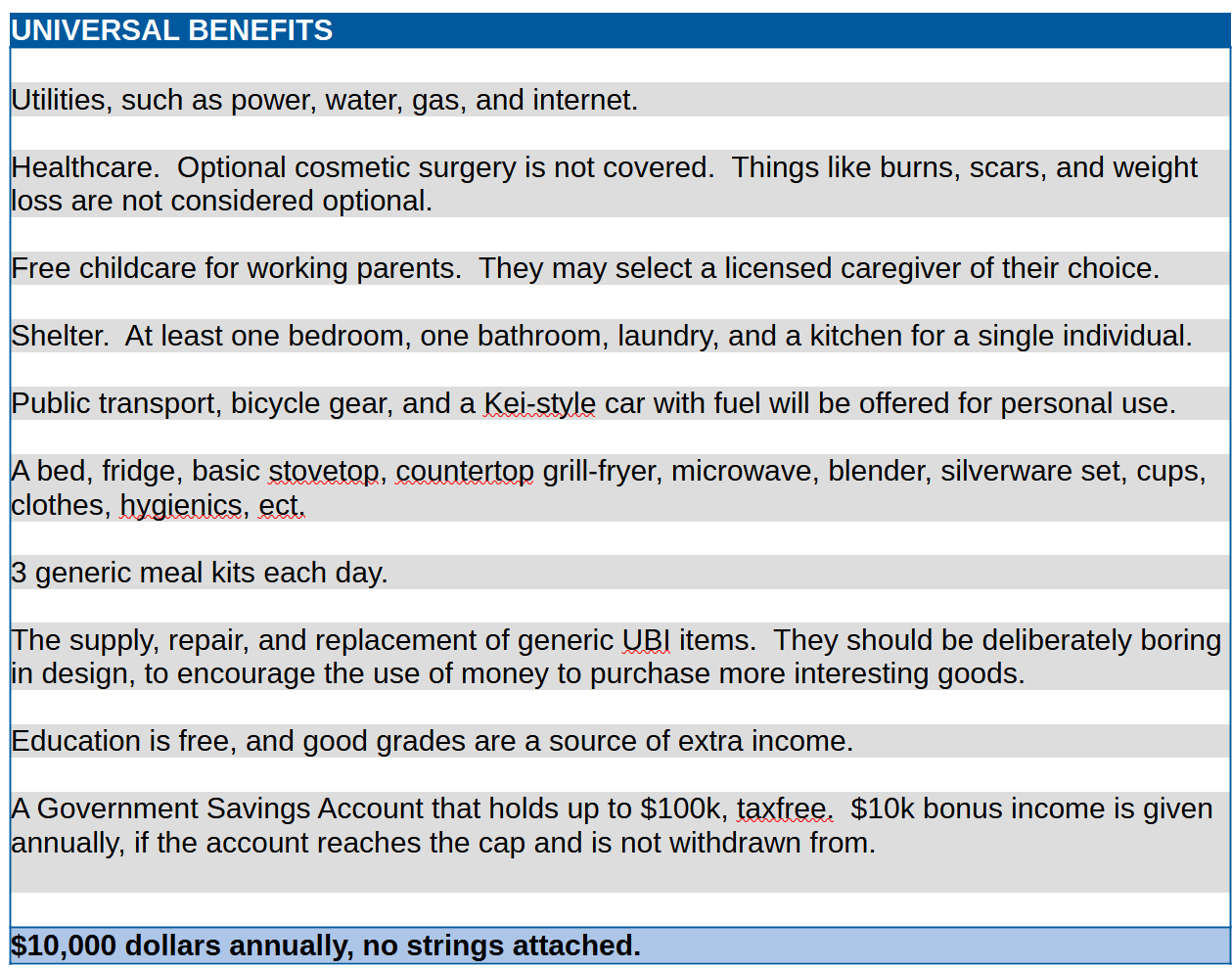
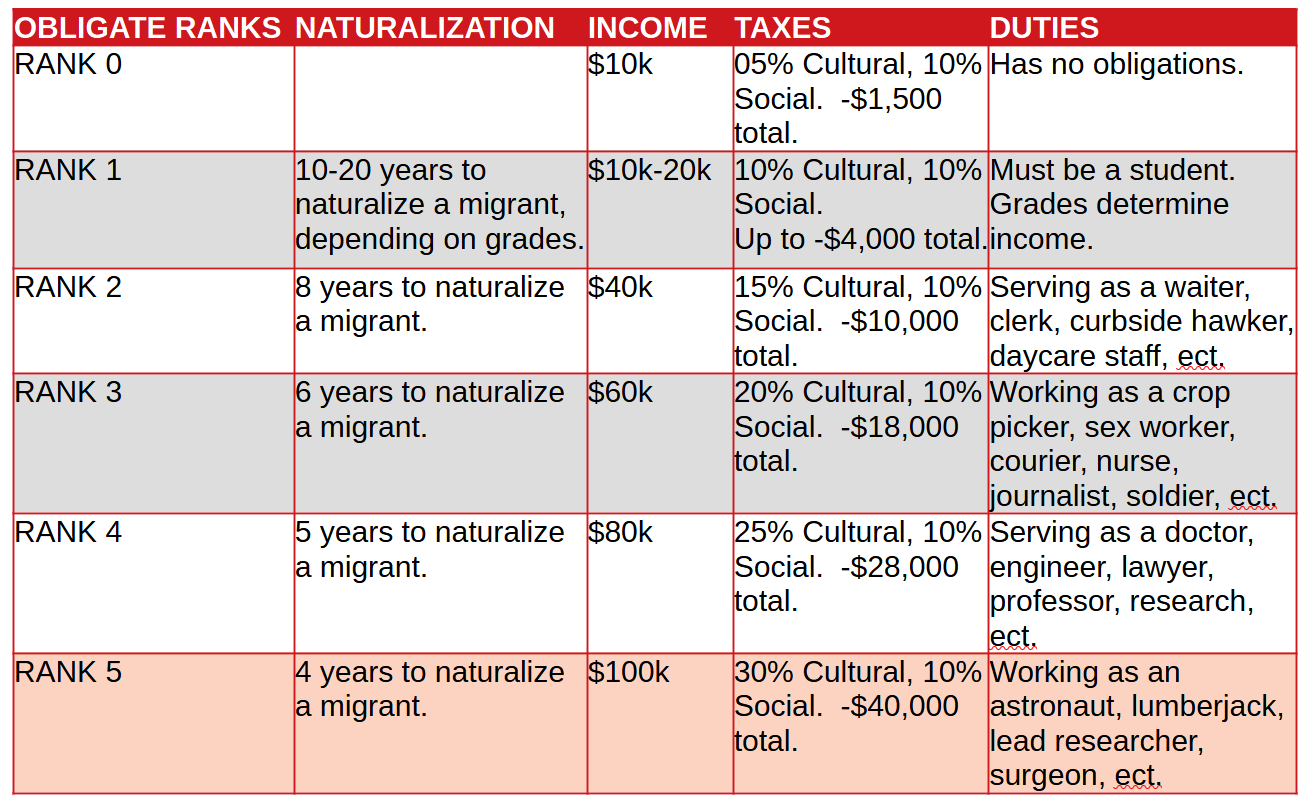
I think one way to implement UBI, would be what I call a “Universal Ranked Income”. Everyone gets universal benefits - shelter, utilities, food, transport, gasoline, healthcare, all of this for free. However, the items and services are very generic. This is where capitalism steps in: money is used for buying luxuries, such as a fast car, physical books, a nicer home, fancy takeout, and so forth. Capitalism is terrific for catering to an individual’s tastes, but is horrible at ensuring wellbeing. Thus, the separation of necessity from luxury.
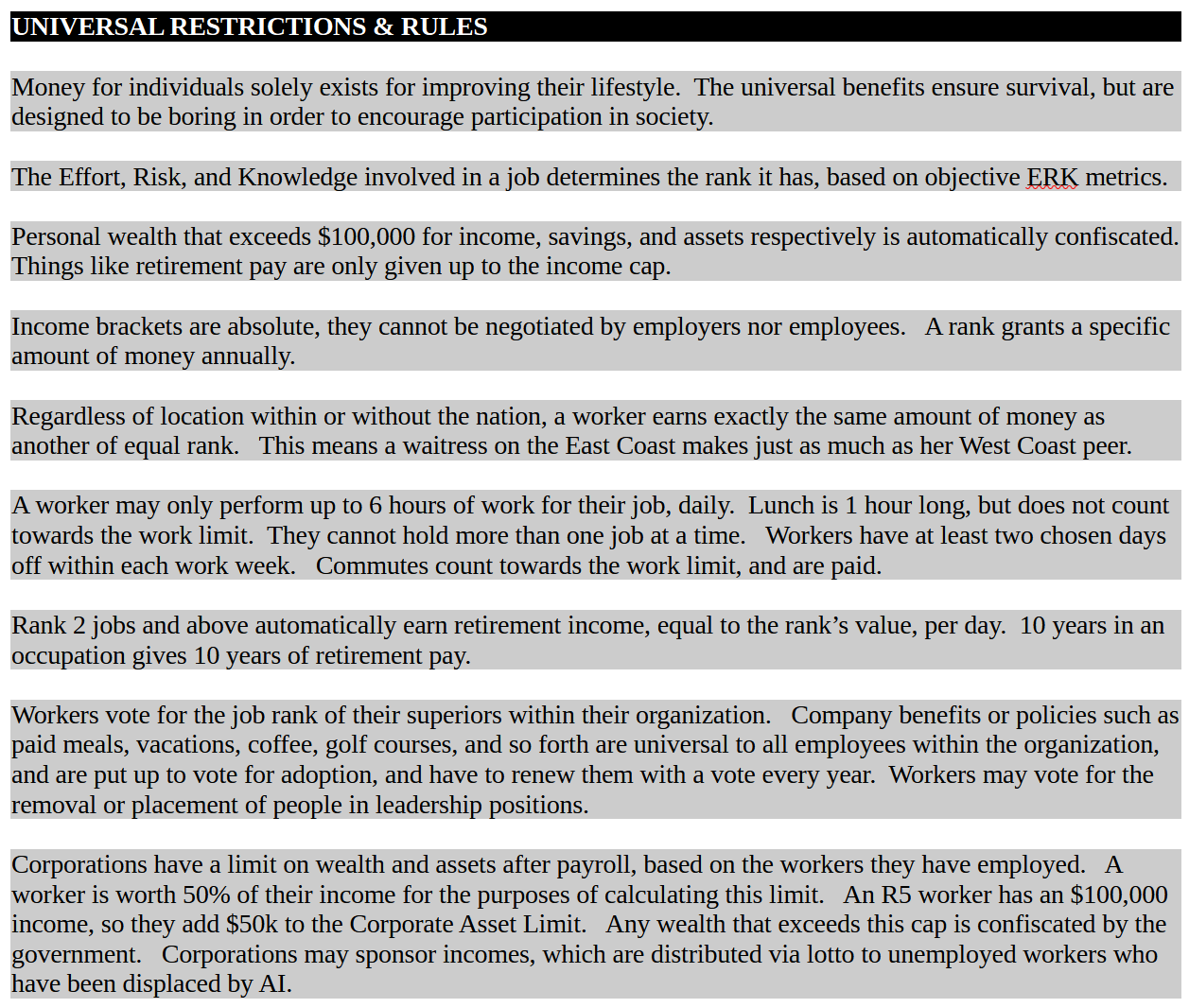
This permits people to strike or protest when they feel like it, since their survival isn’t at stake. They also can wait for suitable job opportunities, which would do much to punish abusive corporations. The amount of income a person gets is based on their job rank, with students getting an amount based on their grades, while higher tier workers get fixed incomes each year, regardless of experience or location.
Absolute floors and ceilings on wealth and income can also be implemented. That would prevent the accumulation of too much wealth by individuals and corporations. Corporations won’t be able to control the wages of their employees, which would also prevent inflation - people can’t be paid too much or too little for working, so pricing of goods will have be done according to what income bracket a seller wants to reach.
Yeah I’ll agree with the other commenters, you came up with some good and very detailed ideas, but they’ll need some honing and fine-tuning to the reality on the ground. Maybe think about joining a political party? At the local level, you can get quickly connected with the right kind of people you can bounce your ideas off of.
That is difficult for me. I am autistic, and more importantly, I was raised in a rural area without people. I am not exactly sure how socialization works, and certainly can’t afford “third place” activities. Still, I might be able to manage it in a couple years. If America enters a civil war, I may be able to find a steady job and like-minded people to discuss this stuff with.
In any case, you are very much correct that the concepts will need refinement and trial. I think if people were to experiment with economic models, a good place might be an EVE Online style MMO - several shards, each running on a different economic structure. After a year, those shards can be linked together into a single server, then we watch which economic faction has the most population the year after. That could be a relatively safe way to observe economics.
UBI works. They experimented with it in Canada in the 70s, but didn’t have the funds to analyze the data. Once they did (decades later) they found out that it worked.
More recently when they tried again, Canadian conservatives shut it down less than half way and simply declared (without evidence) that it does not work.
Conservatives are a bane on this planet.
I understand how this works in small groups, the price of bread isn’t going to go up if only a few people are richer.
I do wonder how this works for everyone.
I’m all for a more equal society, but I’m just not sure about UBI having the desired effect
Jeff Bezos spent $600 million on his wedding. I think that we as a society can afford to pay people enough that they don’t have to worry about starving.
I completely agree
The big thing about ubi is it does not require the bureaucracy around applying for it and further its there when you need it right away. Lose a job, reitire, become disabled ; you still have income coming in. You working a good job and you will be paying as much or more in taxes than its making you. One thing I encounter is folks who think this will be extra money for everyone but it really only become significant the less well you are doing. So if its iffy that your job can meet rent the ubi saves your bacon, you lookin to buy a vacation place and its not really doing much for you. In some ways it would be like social security for all.
So that’s an implementation I can understand: you only qualify for it if you really need it, and the more you need it, the more you are subsidized.
If everyone gets the same lump sum regardless of income, that’s the part I hold issue with
no you always get it as that is where you get the bureaucracy savings. Its just paid for with usual progressive taxes so at some point you are paying as much taxes as you get and eventually more than you get same as taxes work now. If you lose your job though your taxes will be lower so the payments become important. You get rid of standard deductions and such because the ubi comes in as non taxable so you can start at 5% for any earnings and then like 10% at 10k and over and so on just like the progressive system works now. Its important that everyone gets it though because again no paperwork to get it when you need it. Its there when you need it and at higher levels it offsets your taxes basically.
I don’t understand a lot of what you wrote, sorry
Evryone has UBI they receive it for being breathing. It covers your basics. You want more for some luxury? Go work get more.
That’s the most boiled down version I can come up with.
I thought that was the argument, but wasn’t sure. I can only really repeat that this looks rational from the perspective of the individual, but from the perspective of the retailer, what’s stopping me from raising my prices for basic goods if I know that more people have disposable income?
Your competor who will undercut your high prices to get your customers.
And you arrived to the most flagrant problem UBI has. Well done.
So everyone gets a check regularly, no qualification needed except citizenship, but its just enough to get by. As you are more successful you end up paying more taxes than you get. So if you can’t work you have just enough to get by. If you make just enough to get by with work you will pay some in taxes but with the ubi you will likely be able to live a bit better and not be right on the line. If you made enough to be living that bit better you are likely paying close to as much in taxes as what you are getting in ubi. If you make enough at work to be doing pretty well you will be paying more in tax than what you get and that will continue the higher you go. Rather than having forms and qualification and taxes paying for folks to decide if you deserve help you just let the progressive tax system handle it.
Thanks. I can understand from the perspective of reducing bureaucracy and that through progressive taxation that richer folks benefit less from it, but I still don’t quite follow how this will not lead to inflation.
Imagine, I’m a food retailer. My goal is to make money, and I basically own the market. All of my customers plus some new ones suddenly have way more disposable income. Why wouldn’t I gouge my prices up?
It’s not really “way more”. They’re still only going to spend what they wanted to spend before.
The money also isn’t created out of thin air, it’s obtained through taxes on higher incomes and businesses.
Why not do it anyway without ubi. They have no competition I assume given the scenario you give. People can’t shop somewhere else I assume under your scenario.
Basically ration it. Citizen #1346733 each month is allowed:
Standard Issue Credits are expected to cover the complete cost of the median citizen’s usage. Citizens can pool credits to afford larger houses, e.g., families of four would have 4x credits to spend.
This is extremely easy to implement with (evil, no good) blockchain, have government issue them, citizens spend them, merchants resell them back to government.
Agreed, but sounds more like socialism with authoritarian overtones. I don’t see why we’d need UBI
I agree with the socialism part, but I’m not picking up on the authoritarian overtones. I would want a system like this to be flexible to meet the basic living needs of each person and would view it as more of a stepping stone to a post-scarcity society.
The whole social credit thing sounds like something that could easily be taken away depending on your political beliefs
That’s where things like decentralized autonomous organization (DAO) and smart contracts could come into play. Maybe we could start implementing this without ever involving the government at all.
Removed by mod
Fair: government provides cheaper alternatives to food retailers and housing, forcing said entities to push their prices down to compete.
No credit needed, no single source for food or shelter.
That’s my whole solution.
One thing I often see skipped on in research like this is how the people that can’t manage their money are dealt with. Imagine i get UBI so i should be able to pay for groceries and rent, but I’m also an addict and spent all my money on drugs. This will still lead me to homelessness and starvation. I’m not saying this is a valid reason to not implement a UBI, I would even say it’s not a relevant argument for or against UBi. But groups like these will still exist and will still need help. Again, i feel like research like this only looks at the impact on stable people with a healthy mind. Will people still be willing to help out strangers if they expect the government pays for their rent and food? Or will the gap between the ‘smart people’ with normal lives and the ‘stupid people’ with broken lives only get bigger?
Everyone gets a chance. Just because not everyone uses it correctly doesn’t validate the current standard of no one getting a chance.
“Well, we could build a bridge but someone might walk across it to commit crime.” Is not a valid reason to cancel the bridge, it’s an aimless aside with no bearing on the conversation about how the bridge will help most people.
I agree
Awesome, I understand your reservations and I wish we could find a way to mass dispel them because it is a common perspective.
In my comment I never mentioned any personal reservations, I want to point out there is a lack of data on the effects it might have on the community as a whole. I feel I cannot be for or against UBI without knowing that, although seeing how big the positives are for individuals I am (and have been for a while) leaning towards being for it.
That’s also not what this study is about. And if you’re reasonable you can imagine how a more productive and happy society might be more able to take care of those who need social support
I know that is not what this research is about, it is why I start with ‘it is skipped on in research about UBI’, I would like what you believe is true to be actually true but there hasn’t been any research into that as far as I know. All research is about the impact it has on individuals and maybe their family but not on how it impacts social structures. If UBI turns out to be good for individual people but has a negative impact on how people treat each other, I might not want it. In the current system there are places where beggars earn more than an average wage and there are places were they’re neglected and basically starve to death if it isn’t for a few small organisations. If an entire country switches from individual benefits bases on their situation to a general UBI for everyone, that might have a big impact on the people who are on the bottom of society. It is naive to ‘imagine’ it will only bring good things. I’m not saying this because I don’t like UBI, I’m saying that because when and if it is implemented the government/society as a whole will have to deal with all effects, not only the positive ones.
That might also be an issue of culture. I suppose it would affect different people differently but I highly doubt that most people would become bad to each other when they are less stressed and have more stability.
That however, has been studied
True, but often as far as I know research like that is about how people respond to sudden changes and local crises, not necessarily how they would react in a different social system. But I do also expect people to treat each other better if the conditions of their lives are better.
The studies I happen to know about focussed on population density and resource abundance/scarcity. While not an exact analog I think they do give a decent estimate of this situation
It’s pretty wild you need a three-year study for this.
Yes, if people have steady and secure income, they will not have to take every shit job they come across because they don’t have to worry about being homeless or hungry next week.
I swear some studies are just stupid beyond imagination.
This is such a common gripe among non-scientists about science, and not only does it demonstrate 1. That you don’t understand the purpose of science, but also 2. that you’ve spent zero time attempting to understand why someone would want to study “obvious” things, because this complaint is so prevalent that numerous scientific communicators have put effort into explaining why this seemingly “common-sense” belief is actually counterproductive. So like, the answer you see is in front of your eyes. So then I ask, is this person making an effort to know or do they just want to complain and feel superior. Wanting to feel superior is very human, I can’t fault you for it, but consider spending some time trying to answer, “Why do scientists study obvious things?” next time, before deciding something is dumb.
That aside and onto a different point, some of the most fascinating results of science have been researching “obvious/stupid” phenomenon and getting surprising results. But… as stated above, all of that information is out there and you seemingly evaded it all this time, so I’ll stop there. I hope you’ll use this as an opportunity to seek out information next time instead of spending your time to construct a complaint, the world is a much more enjoyable place when you approach it with curiousity instead of judgement.
I wish you the best.
numerous scientific communicators have put effort into explaining why this seemingly “common-sense” belief is actually counterproductive
I agree with that if we’re talking about scientific fields. But this is a socio-economic field, not a scientific one - you could just have asked 500 people what they would do instead of spending a whole lot of money on a 3 year study.
“Why do scientists study obvious things?”
Tax money is tasty yum yum.
I hope you’ll use this as an opportunity to seek out information next time
If the study makes sense, I will. This study was a waste of tax money.
An expected response. You are someone who looks but does not see. Good luck.
This study isn’t meant to ‘sell it’ to the people receiving the money, it is about showing the results the people handing out the money. Governments want to know what would happen if they would choose for a system like this. They are not gonna try this with tens of millions of people at once and risk tanking the whole economy. I don’t think you realise the value of such results if you call research like this ‘stupid beyond imagination’.
Unfortunately some believe this will make people lazy
In no way, shape or form did I say people would become “lazy”. But people won’t work a tough fucking job for shit pay if they don’t have to worry about necessities. They’d rather pursue a job that is fun to them. Nobody has fun driving taxi, collecting garbage or delivering mail.
I did not say you did. I was clarifying why the study was needed for some people to understand