

cross-posted from: https://rss.ponder.cat/post/165736
At least in the U.S. and Canada, that is.
This was brought to my attention thanks to a Reddit post where a user (presumably a resident of Canada), had posted how Lenovo was shipping laptops with Fedora and Ubuntu at a cheaper price compared to their Windows-equipped counterparts.
Others then chimed in, saying that Lenovo has been doing this since at least 2020 and that the big price difference shows how ridiculous Windows’ pricing is.
Cutting the Windows Tax
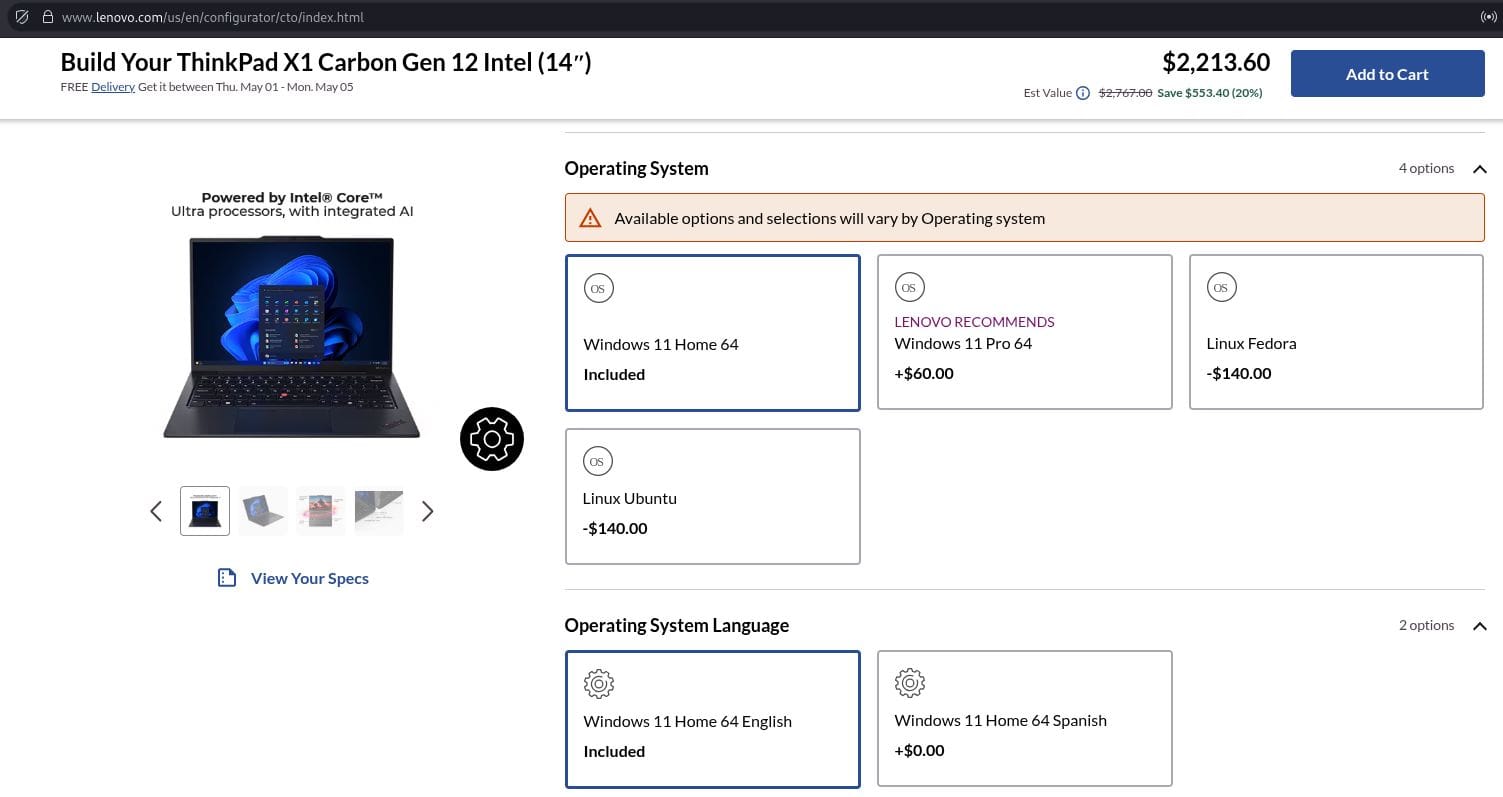
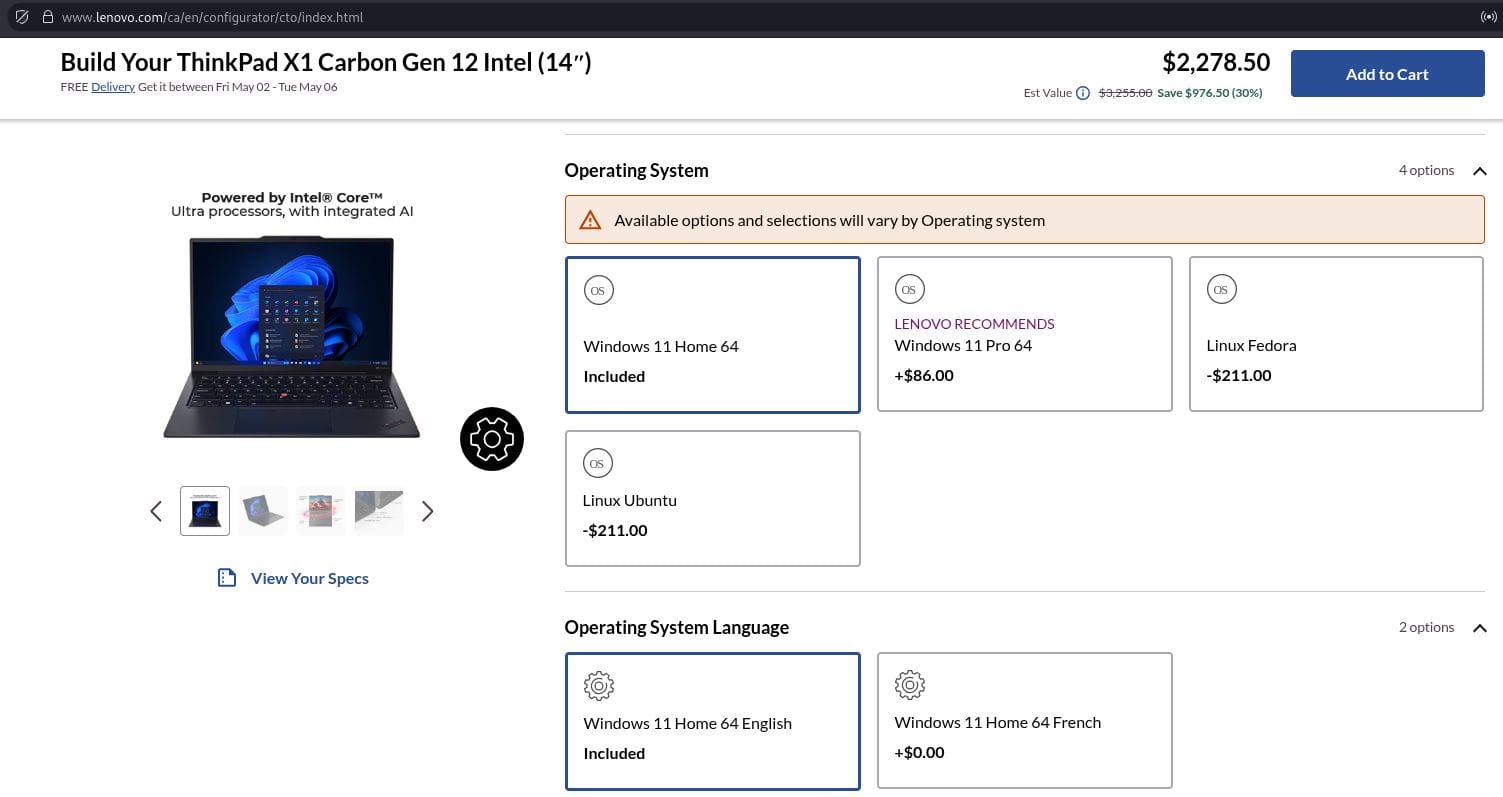
When I dug in further, I found out that the US and Canadian websites for Lenovo offered U.S. $140 and CAD $211 off on the same ThinkPad X1 Carbon model when choosing any one of the Linux-based alternatives.
US pricing on left, Canadian pricing on right.
Interestingly, while the difference in pricing is noticeable, your mileage may vary if you are looking for such laptops on the official website. Not all models from their laptop lineup, like ThinkPad, Yoga, Legion, LOQ, etc., feature an option to get Linux pre-installed during the checkout process.
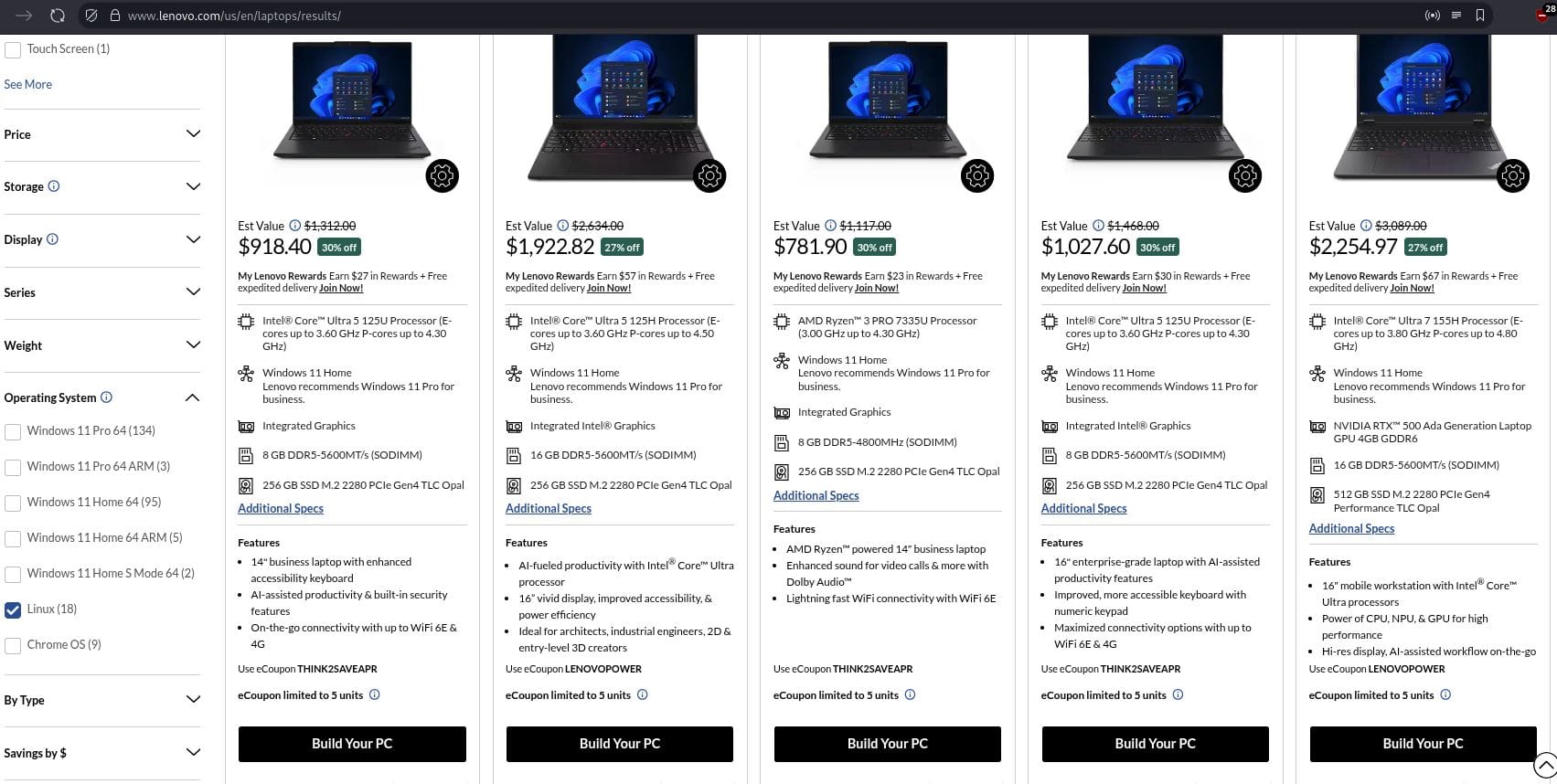
Luckily, there is an easy way to filter through the numerous laptops. Just go to the laptops section (U.S.) on the Lenovo website and turn on the “Operating System” filter under the Filter by specs sidebar menu.
Yes, it’s as simple as that. You can do the same for the various official online regional storefronts that Lenovo runs to see whether Linux-based operating systems are being offered on their laptops in your country.
Closing Thoughts
It is good to see that Lenovo is offering Linux in its laptops. In fact, there is another big-name laptop manufacturer, Dell, who also does something similar with its Ubuntu-certified laptops, but both have the same constraint of having limited options for buyers.
Also, as far as I know, Dell doesn’t reduce the pricing if you choose Linux instead of Windows. Correct me if I am wrong in the comments.
Nonetheless, I think these manufacturers could do a better job in marketing these Linux-based alternative operating systems to general consumers, showing them how they can save big when opting for these instead of the pricey and bloated Windows.
Otherwise, we might have to start observing Windows Refund Day again.
💬 Your take on this? Would mainstream users benefit from having Linux pre-installed on their laptops?
From It’s FOSS News via this RSS feed
This is awesome and I love it. Maybe they could even take a few more dollars off by not having any OS installed (bypassing the labor costs of imaging an SSD). I’ll be installing my own copy anyway, so I’m fine with a blank SSD.
Those manufacturers where you can select either Linux or no OS don’t charge extra for Linux.
I mean it’s like maybe a dollar or two for the labor costs, so that’s understandable. I’d still prefer just a blank SSD anyway.
The cost is actually negative given that they get to pre-install whatever software they want into it.
It kinda blows my mind that “no OS” isn’t the cheapest option
It’s the same reason that you have to pay more to stream videos without ads…
Yeah, smart TVs with no OS are way more expensive than the ones riddled with ads as well.
I changed to the projectivity launcher on my Android TV and it was night and day in terms of performance. No ads. The UI doesn’t change every other week to make me look at some new show I don’t care about. I can literally just hide everything I don’t want to see.
I should probably look into actual entire OS swaps available for my TV but I don’t have the time. Changing the launcher and using ADB (over lan) to disable updates and apply some optimizations was worth the day it took me.
Turns out the hardware on the TV is fine. The software was just complete garbage and got worse with every update.
Now if only I could fix the UI in the actual apps like YouTube. But still it’s a lot better. I’ll probably install the YouTube alternative app one day when I have time.
My wife started using the TV over her tablet after I changed it. She said she hated how slow it was to just turn on and start that she just would go to her tablet instead.
Yeah, out of the box experience is terrible. I wish we could’ve installed custom ROMs on TVs too but most of them are vendor-locked. Projectivity Launcher is a life saver. Default everything is just bad. I did a similar thing and removed many apps via ADB.
For Youtube alternative, SmartTube is the best. You can sideload it via ADB.
Nice. I don’t think I saw SmartTube before. Will check it out. Thanks.
Sometimes it might not work, and when that happens just check out a new update. It will also notify you when there is an update.
You’re welcome!
Stremio doesn’t charge me more. I dont know why anyone would pay to stream. Or not block ads.
Well, these services do require money to run. If everyone were as ‘clever’ as you are then we’d have little content indeed.
It would probably cost more to deal with the complaints that arise from shipping without an OS than they’d save on labor installing Ubuntu or Fedora.
2025 is the year of the Linux
desktoplaptop!I would really like to see broad support for TPM-backed FDE, which also requires secure boot to work to implement this properly.
For me, this is essential to have for feature parity with Windows on laptop.
other distributions should start having an option for this in the GUI installer, but it might be tricky for the average user
Arch Wiki has a guide on FDE using the TPM and it’s transparent in my everyday usage
some minor issues I see are:
- Secure Boot needing to be disabled then re-enabled during install for it to work as intended
- needing to write down a long backup passphrase, but this also happens on Windows and MacOS iirc
One major obstacle is third party drivers, specifically Nvidia, that forces building and signing your own kernel modules. It can be done, but it’s certainly more complexity than distributing signed binary drivers from the distro. I think Ubuntu has preliminary support for TPM-backed FDE, but only if you aren’t using such drivers. It doesn’t work in combination.
I don’t want to sign my own modules. I want them to shipped signed, so the key isn’t expected to be on my machine. If I were doing kernel development work, I’d have disabled secure boot entirely anyway.
I would love to have secure boot for a customized distro. it only really needs to attest the firmware and the bootloader because they can’t be encrypted, which would serve as a form of tamper protection
Since installing Linux, my battery life has more than doubled.
That alone is reason enough to switch to Linux
Yeah, while I don’t have a laptop myself, I installed Fedora on my desktop and it idles quieter. I suspect it’s not doing as much in the background as Windows was.
That’s great! - But. But, I hope some people check it out carefully. Some years ago, Lenovo middle-man’d the SSL root certificate on laptops so they could inject ads into Https web pages. (And spy on users? Steal passwords? Manipulate bank accounts? I hope not…)
I wonder what they could hide in an own Linux install?
Dell did the same thing - in the same year too.
You should always clean install your OS. Let the guys wanting to spy on you put some effort in.
Really?! Do you have a source? I’d like to look this up!
https://www.zdnet.com/article/how-to-remove-dells-superfish-2-0-root-certificate-permanently/
It’s actually called eDellRoot, not Superfish though.
You can safely assume that probably every manufacturer did or still does similar thing - whether they’re caught is another story though.
Oh, wow.
Do you have any reputable articles of this? I’m interested cheers
Thank you that’s appalling and I’m glad I build my own pcs
Here in Europe it was possible to buy almost all laptops and desktops from Lenovo without OS preinstalled since long time, saved a lot of money that way. It’s nice that they officially offer Linux now.
I thought OEMs only paid like $10 for Windows?
they tend to make money off it due to the bundle deals and commissions and what-not.
a major oem charging $140-200 is all profit.
I bought a laptop without a Windows license from Lenovo years ago. It came with FreeDOS, if I remember correctly. I wanted to install Linux, so I didn’t care. In some areas they’ve been offering this for a while now.
I got an ASUS laptop with FreeDOS back in 2015 for the same reason. Had to upgrade the HDD and RAM, but It still works like a champ.
Installing my own OS is half the fun of getting a new computer. Why would I want the manufacturer to install an OS?
a nice 140 usd discount sounds like a decent incentive
Oh, windows certainly isn’t an option. The options I’m weighing are “pre-installed Linux” and “tabula rasa”.
freedos ftw
you get the discount + you can reinstall it yourself/install a different distro + it shows the general market how much of the cost is due to a Windows license and other OS alternatives, creating more informed consumers
i see it as a benefit
But why not “blank drive”?
probably just not worth the additional logistics
Easy enough to do that ourselves really, this is just for normies.
Good way to check that all the parts are working before putting whatever you want on it.
majority of consumers don’t even know how to decline cookies on websites, let alone how to install windows, or that other thing that’s called limix… or what
deleted by creator
Now they need to make the BIOS updates installable from Linux or ability to flash them from the BIOS. But I like this move, hope more start doing so.
It already is, via https://fwupd.org/
which is integrated into the app store on fedora, at least
kde’s discover app store supports it too
i figured, but since i wasn’t 100% sure i didn’t wanna spread misinformation
I can confirm this too for kubuntu.
I’m very new to Linux and a very casual user but I’m really loving it. I also can’t afford the existing Linux laptops, and I am on the market for a new machine. So yeah I’d buy a cheap laptop that ships with Linux. If it comes with a discount, that’s even better!
The new framework 12 starts at $700. Cheaper if you BYO RAM and storage.
Oof I’m too much of a casual to install my own RAM on a laptop, I’m too scared to break something! As the other user commented, a good second hand laptop is probably better anyway.
Cheaper? Yes. Better? No. Recent years have yielded massive advancements in many areas but very specifically, efficiency, meaning less noise, more power and better battery life. That’s fine if those things aren’t important to you.
I would personally get a second hand cheap laptop off ebay or a local 2nd hand electronics store, and then just install the distro of your choice on it. Can’t really think of an instance where a computer would come with an OS and I’d just use it as-is rather than installing my own, but I guess if you want a fairly generic eg Ubuntu, Fedora, Debian, Mint, etc setup then it could work. But definitely don’t limit yourself to preinstalled laptops, since installing an OS only takes an afternoon if you pick an OS with a more fine-grained install like Arch or Gentoo, and about the same time as installing user software for distros that have more streamlined installs.
Yeah also from a sustainability point of view that would be my preferred option. Thanks for the reminder that I don’t need new shiny things to be happy :D
Removed by mod
Then they will unironically call it the freedom OS
Removed by mod
The system that should not be named!
Computer companies tried that for a while like 15 years ago, too.
The timing here with compatability getting better could be a huge difference maker.
Absolutely. I’m just saying its not a novel idea.
Year of the Linux desktop is here! /s
I’m in the UK, and last year got a Lenovo ThinkPad laptop with Linux pre-installed that was cheaper than the Windows equivalent. I had a choice of RAM, SSD, display and OS. Ubuntu was the only choice of Linux, though.
Fantastic development. I got the “last year’s” model of a Lenovo Legion gaming laptop for work a few years ago bc it was one of the few affordable models that I could find at the time with a second m.2 slot. Expandable memory was a nice bonus. Love the keyboard, too. Been really happy with it. I run Kinoite on it.