

Thing about listing vampire the masquerade is that the various areas of the world of darkness are different enough that only looking at the vampires is rather limited. Some glaring absences are star frontiers. They have traveler for space but man star frontiers is a lot like looking at old school dnd. Then both the marvel and dc games each had a take that is so influenced by the way the world stories read. Marvel with its levels of success and DC using a logrithmic type scale to deal with the massive power differences of superman and robin. Then what pathfinder has done with its second edition should not be missed especially since it can be looked over for no cost at archives of nethys and pathfinder society play itself is interesting to see how its organized.
VTM illustrates all of the pros and cons of the Storyteller milieu. It is still the game that people talk about, even more than WoD.
I’d definitely study the evolution of the hobby using books like The Elusive Shift (Petersen), Role-Playing Game Studies: Transmedia Foundations (Deterding, Zagal) and Designers & Dragons: A History of the Roleplaying Game Industry (Appelcline). Once the students had a grounding in the history I would suggest a unit on Dice and Probability, the Mechanics and influence on settings.
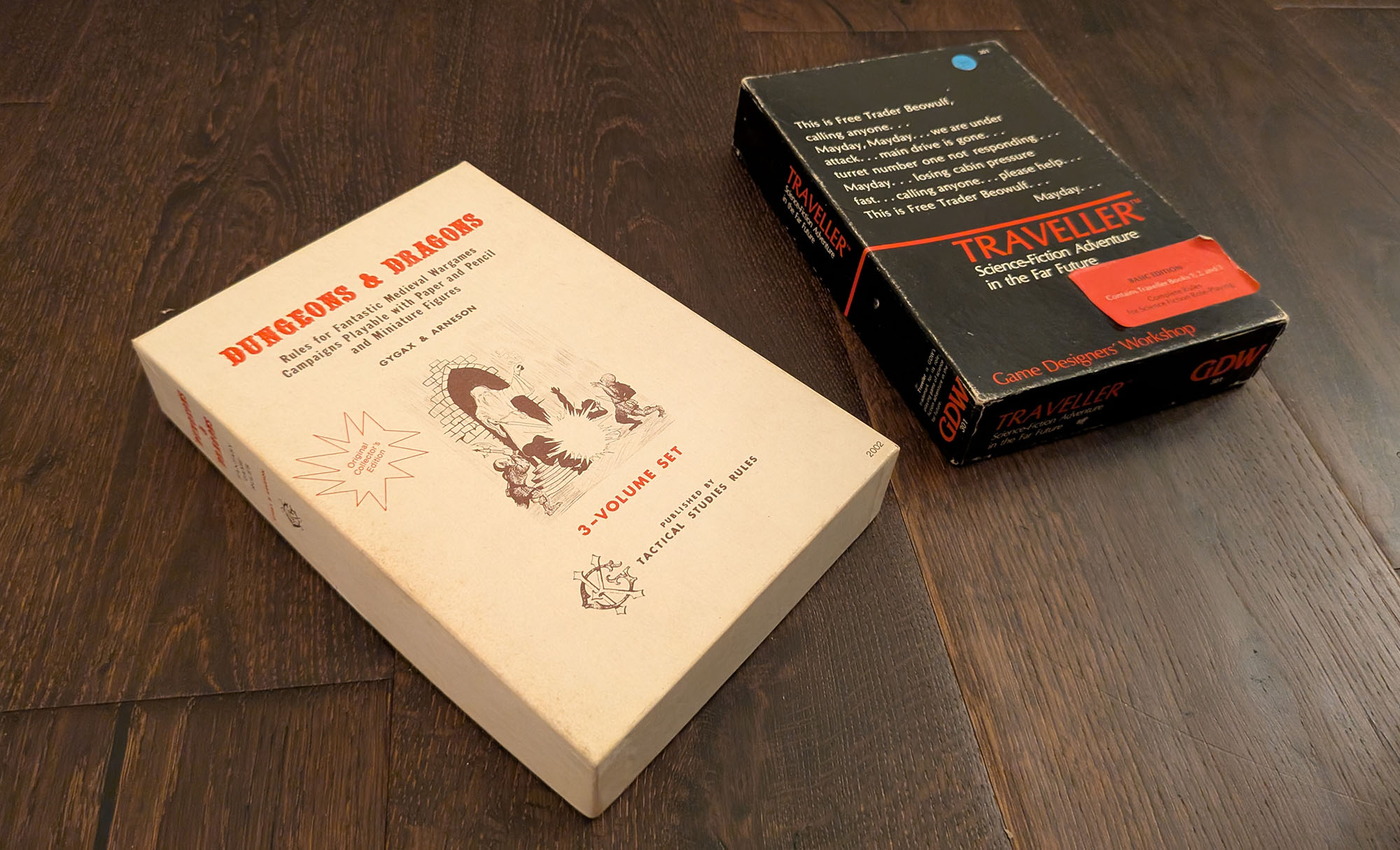
- D&D for level and progression, and contrasting that against Palladium’s approach.
- Traveller for the lifepath concept as well as the developing of universal setting.
- Hero System and the rise of point based mechanics, contrasting with GURPS.
- Interlock (Mekton, Cyberpunk) and the emergence of Unified Game Mechanics, maybe contrast with Atlas Games All Flesh Must Be Eaten, et al.
- Vampire, and the development of Dice Pools and the rise of “splats” as a business model.
- Over The Edge and Amber Diceless as differing approaches to non-traditional RPGs.
- Sorcerer, indie games, The Forge, and the story game movement. See also gamist/narrativist/simulationist as styles of play.
- D&D 3.0 and the OGL explosion.
- Apocalypse World and the New Wave of RPGs as a reaction to OGL. (one man’s opinion).
 2·11 months ago
deleted by creator
I would assume the fact that the group of player characters, the crew, has mechanics like a character. Interaction with other crews becomes the faction game.
