
You must log in or # to comment.
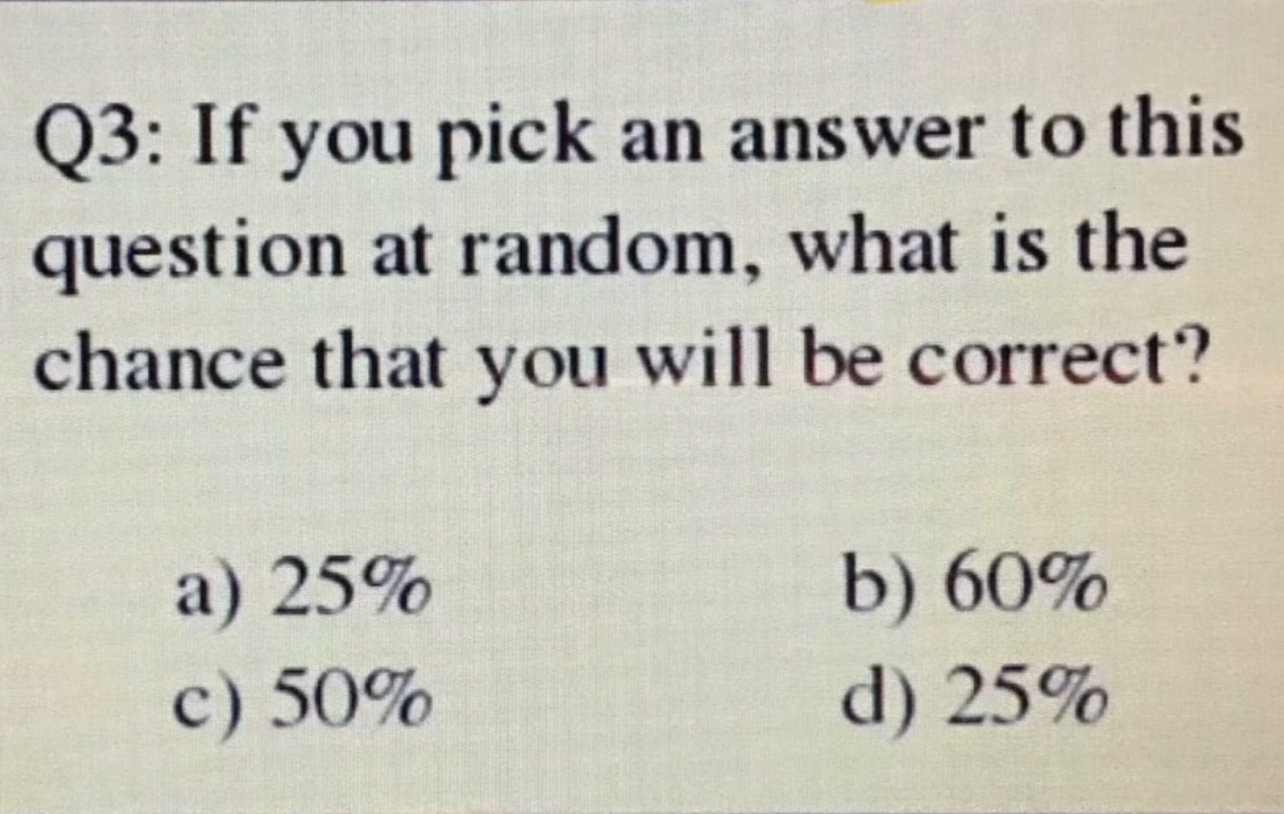
This is a paradox, and I don’t think there is a correct answer, at least not as a letter choice. The correct answer is to explain the paradox.
deleted by creator
Having been to school I know a teacher did not read this question so tge answer is probably A, B, C, or D. Chosen randomly of course. But you will get credit for 3/4 answers as long as you take the time to talk to the teacher during office hours.
deleted by creator
lol chill out there buddy it is only self-referential once. maybe twice.
I’m not certain, I think it’s an infinite loop.
I.E. If the answer is 25%, you have a 50% chance, if the answer is 50%, you have a 25% chance, if the answer is 25%, you have a 50% chance…
Yeah, that’s right. https://en.wikipedia.org/wiki/Paradox
The only way out is to choose 60% to accept defeat
Haha, I think they should have made that option 0%, to further the paradox
It’s 0%, because 0% isn’t on the list and therefore you have no chance of picking it. It’s the only answer consistent with itself. All other chances cause a kind of paradox-loop.
Correct - even if you include the (necessary) option of making up your own answer. If you pick a percentage at random, you have a 0% chance of picking 0%.
This can also be used a great example of proof by contradiction: There is no correct answer in the options. Proof: Assume there was a correct answer in the options. Then it must be either 25%, 50% or 60%. Now we make a case distinction.
(A) Assume it was 25. Then there would be two of four correct options yielding in a probability of 50%. Therefore 50 must be the correct answer. -> contradiction.
(B) Assume it was 50. Then there would be one of four correct options yielding in a probability of 25%. Therefore the answer is 25. -> contradiction.
© Assume it was 60%. Since only 0,1,2,3 or 4 of the answers can be correct the probability of choosing the right answer must be one of 0% 25% 50% 75% or 100%. -> contradiction.
Because of (A), (B) and ©, it cannot be 25, 50% or 60%. -> contradiction.
Cheeky answer - the correct answer is a superposition of 25% and 50%, thus you answer it as a multiple choice question
©
because of copyright?
My client renders this as ( c )
It’s probably graded by a computer, and a) or d) is a fake answer, since the automated system doesn’t support multiple right answers.
I’m going to go with 25% chance if picking random, and a 50% chance if picking between a) and d).
If it’s graded by a human, the correct answer is f) + u)50/50, you either guess it right or you dont
C, which means A or D, which means C, which means…
Thanks for making me laugh all alone in my car before heading in to work. I wish I could give you an award. Cheers!
42
If you suppose a multiple choice test MUST ONLY have one correct answer:
-
Eliminate duplicate 25% answers
-
You are left with 60% and 50% as potential answers to this question.
-
C is the answer
If you were to actually select an answer at random to this question while believing the above, you would have a 50% chance of answering 25%.
It is obvious to postulate that: for all multiple choice questions with no duplicate answers, there is a 25% chance of selecting the correct answer.
However as you can see, in order to integrate the answer being C with the question itself, we have to destroy the constraints of the solution and treat the duplicate 25% answers as one sum correct answer.
Do you choose to see the multiple choice answer space as an expression of the infinite space of potential free form answers? Was the answer to the question itself an expression of multiple choice probability or was it the answer from the free form answer space condensed into the multiple choice answer space?
The question demonstrates arriving at different answers between inductive and deductive reasoning. The answer depends on whether we are taking the answers and working backwards or taking the question and working forwards. The question itself forces the inductive reasoning strategy to falter at the duplicate answers, leading to deductive reasoning being the remaining strategy. Some may choose to say “there is no answer” in the presence of needing to answer a question that only has an answer because we are forced to pick one option, and otherwise would be invalid. Some may choose to point out it is obviously a paradox.
-
This seems like a version of the Liar paradox. Assume “this statement is false” is true. Is the statement true or false?
There are a bunch of ways to break the paradox, but they all require using a system that doesn’t allow it to exist. For example, a system where truth is a percentage so a statement being 50% true is allowed.
For this question, one way to break the paradox would be to say that multiple choice answers must all be unique and repeated answers are ignored. Using that rule, this question only has the answers a) 25%, b) 60%, and c) 50%, and none of them are correct. There’s a 0% chance of getting the correct answer.
This only produces a paradox if you fall for the usual fallacy that “at random” necessarily means “with uniform probability”.
For example, I would pick an answer at random by rolling a fair cubic die and picking a) if it rolls a 1, b) on a 2, d) on a 3 or c) otherwise so for me the answer is c) 50%.
However, as it specifies that you are to pick at random the existence, uniqueness and value of the correct answer depends on the specific distribution you choose.
What’s the correct value if the answer is not picked at random but the test takers can choose freely?
It was only the next day that I returned to this post realising that “this question” isn’t even defined.
100 **** percent, i’m all in!