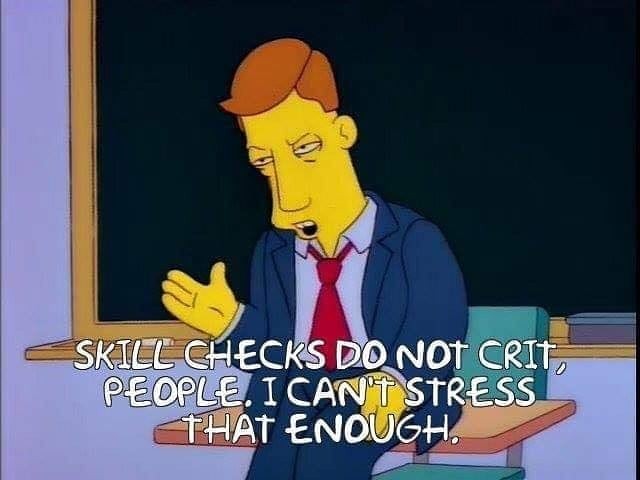

(in D&D at least)
It’s technically homebrew, but basically every table Ive played at will give you a little bonus if you roll a 20 for a check and a little negative if you roll a 1. But we still kept that a 20 does not necessarily mean an auto success and a 1 is not necessarily an auto failure. You still need to beat the DC
They absolutely do, and the bonus effects are listed in the description of each skill action. Oh. you mean in D&D. washes hands
D&D has all the money in the entire hobby, basically, and they still make terrible design decisions like this.
Rolling a nat 20 and getting a crit is the jackpot of d&d mechanics. Don’t design a system where sometimes you hit the jackpot but don’t win anything. That’s an objectively bad choice to make.
I 90% agree. I think most of the opposition to this comes from people exhausted with habitual boundary-pushers who think that a nat 20 means they can get away with defying the laws of reality.
Like, no, a nat20 persuasion does not convince the merchant to give you half his stock and all the money in the register… He would go broke and he’s got a family to support, along with his own survival that your nat20 does not also convince him to stop caring about.
But at the end of the day, a lot of GMs who are sick of that need to be sent the dictionary page for the word “no.” The occasional use of it really does improve the quality of the game, and I’m sure plenty of players will appreciate not letting aforementioned boundry pushers continue to waste time on impossible pursuits that do nothing to move the game forward.
I’ve seen this easily solved by assuming the 20 succeedes but the DM decides how exactly.
“Okay. The dragon loves you know. They realize you have their old lover’s eyes. You remember this too. Old tales in your family that you thought were a joke. You are apparently related. And they do love you now.”
If you can’t trust your players to act like adults and show some basic maturity. That’s a different issue.
This is also a great way to handle it; malicious compliance/monkey paw. Makes for some humorous moments.
And yeah, if a player is constantly having to be told no, a talk may need to be had, and if it can’t be resolved, they probably need to go. It’s also a reason why Session 0’s are so important; talking out what’s expected of the campaign both on the part of the players and what the GM has in mind.
Having that 1 player being stalked by a horny dragon for the rest of the game, just in case.
You need to qualify this statement with what you believe should happen on a nat 20.
what you believe should happen on a nat 20.
Consistency.
My point is that setting up the expectation of a moment of triumph and then diluting it with exceptions is going to create moments of disappointment at the table.
If a nat 20 is going to be a big win it should always be a big win. That’s so intuitively true that most people just play that way despite the rules.
Well DnD consistently doesn’t have criticals outside of attack rolls and death saves.
Like the person you replied to asked, what would you even expect to happen on an ability crit? If the DM only lets you roll on things that would be possible for you, then you would succeed on a 20 anyway. If the DM lets you roll on impossible things, then you have a 5% of doing the impossible. Neither option is good.
I absolutely let a 20 or 1 have extra effect whenever it makes sense and feels right. But having it be a core rule would be a PITA.
Not to mention that it would make skill checks even more driven by randomness, which is already a problem.
what would you even expect to happen on an ability crit?
Extra information, owed a favour, make a friend, get a small reward, get a clue to a larger reward, impress someone important, uncover a secret, get forewarning of a danger, hinder a rival, gain advantage on something, opponent is exhausted/confused/embarrassed and must pass a saving throw to act…
Skill check crits would be just like combat crits except there’s way more scope for fictional as well as mechanical benefits.
That’s still not clear what you mean, all of those things are typically the results of a success. Do you mean nat 20 should always succeed? Do you mean nat 20 should always be a success with extra benefits? Do you mean nat 20 should always give you a side benefit even if it fails? You need to be more clear.
D&D is that way, though. Every time you see a natural 20 for anything that isn’t an attack does not automatically succeed unless people are using homegrown, which they often are.
Ok, but if the 20 doesn’t succed, why did you let them roll in the first place?
deleted by creator
Yep, those are all great responses. I learned a lot.
Funwise, it seems like a good solution would be “failure… but!” approach.
So the player have at least some reward for doing the best they can even if it’s not enought to clear the chalange completely.
Because I don’t have everyone’s modifier for every skill, ability, saving throw, and attack memorized off the top of my head, nor do I have magical foresight into whether or not they will choose to use abilities that would add more additional points on top of those modifiers.
Why the hell not? You’re the DM. Why do you not have copies of your player’s character sheets?
I regularly play in groups with eight player characters, Kolkani. Do you want me to check all eight of their sheets and all their abilities that could possibly modify their scores or just ask them to make a Blah (Foo) check check and see what the result is? It’s gonna be way faster for everyone to just ask them to roll.
How do you create fair encounters without knowing your player’s character’s stats? 🤨
deleted by creator
Just because I have a sense of what modifiers are and might check during encounter building doesn’t mean I have them all memorized. That’s genuinely like over a hundred numbers to have memorized. Plus I can look at a sheet while building an encounter and not waste anyone’s time.
I never mentioned having them memorized. I specifically said you should have a copy of their sheets. lol
Do you want me to check all eight of their sheets and all their abilities that could possibly modify their scores or just ask them to make a Blah (Foo) check check and see what the result is? It’s gonna be way faster for everyone to just ask them to roll.
I never said I didn’t have the sheets. You keep trying to make this about access to sheets.
You should at least have a general idea of your PC’s skillsets. As in, don’t let the country bumpkin make Arcana checks about monsters he’s never seen, or let the stick figure try to punch down a wall. If you look at a character in a situation and think, “there’s no way that could succeed,” then they shouldn’t be making a check.
Think of it from their point of view though. They want to try and do something. For me to just flat out tell them “no, there’s no possible way” is discouraging and robs them of autonomy. Obviously for crazy extreme circumstances I won’t let them, like “let me convince the king to abdicate to me!” type things. But if I think the DC should be 25 or something I’m not gonna bother wasting my time calculating what the theoretical maximum could be for the roll because I genuinely cannot know. The player can always do things I don’t expect or use other players’ things to help. For reasonable but implausible things I’ll allow rolls even if a nat 20 wouldn’t work because I’m not calculating what a nat 20 could theoretically be.
Plus, I often give people little flavor benefits for nat 20s even if they don’t have mechanical success.
don’t let the country bumpkin make Arcana checks about monsters he’s never seen
Why not? It could be fun! Of course non-critical rolls would be useless, but on a critical failure they could convince the whole party that dragons can’t see movement, and on a critical success they could buy mere chance figure out where its voonerables are (it’s a million-to-one chance, but it might just work!)…
or let the stick figure try to punch down a wall
Again, why not? All rolls, they take a bit of damage; critical failure, they break their arm or hand, and manage to dislodge a brick which starts a comically unlikely and extremely noisy Rube Goldberg chain reaction which ends up waking up and alerting all the guards; critical success, they hit the hidden button that opens the secret door (in another wall), starting a whole new subquest.
Sometimes, it’s about sending a message.
I… Don’t? Is that so magical?
Like, if something would need a DC 25 Acrobatics check, I ask the player “Wait, how high is your character’s Acrobatics? +3? Ah no sorry, you can’t do that.”
Because I don’t know what their max roll might be and it achieves them something, they gain knowledge that something is impossible for them.
They do if the DM says they do, y’all get way too hard for the rules as written.
Not to mention which game you’re actually playing.
They do in PF2e. And it rocks
deleted by creator
Just because a Nat 20 isn’t necessarily the cause, doesn’t mean that skill checks don’t crit.
You are technically correct, which is the best kind of correct.
*in the core rules.
If you want to homebrew it then go for it.
Rule of cool
If something sounds fun it’s happening at my table.
If you roll a 20 on persuasion or something we’re going to have fun, but I’m not turning characters into literal gods (though that did happen one game)
On page 242 of the Dungeon Master Guide 2014, it describes crit successes and fails as an optional rule.
As optional as multiclassing and feats.
They do at my table. Because it’s more fun, god damn it!
Taking a 10 is a strategic choice. You can automatically succeed because the DC is >10, or you can roll for it and try to get a critical success that comes with a random fringe bonus (such as extra XP, or making an action more permanent; like you crit a lockpicking check which just breaks the lock so it can’t be relocked) but also with the chance of critically failing (you broke the lock and now it can’t be unlocked!).
It also allows you to maybe succeed even if your stats would not let you. The DC is 50. With your bonuses, even a 20 would not beat the DC. But maybe fate intervened and you got lucky as fuck. Disco Elysium uses this a lot. Hell, there’s a whole sidequest locked behind a door that can only be opened if you roll a double 6.
2 things:
1: I’ve gotten disco Elysium, and Ive only played a few minutes, but I don’t remember it having rolls like that? How does one know what one is rolling? I played like 20 minutes of it 3 months ago, so maybe I’m misremembering.
2: that’s how my brother DMs. I once critfailed a lock picking so badly that my character broke his finger. My brother laughed his ass off
A lot of dialogue points and other actions will bring up a thing that rolls 2 D6s. Snake eyes is a critical failure, double sixes is critical success. The earliest point in the game where you can make one of these rolls is in your hotel room. Either by attempting to get your tie out of the ceiling fan, trying to piece together what happened with your shoes by analyzing the broken window, or by using the mirror and trying to stop making “The Expression.”
Many of them can be re-rolled later once you get more skill points. Others are one and done unless you reload or start a new game.
Many of them can be re-rolled later once you get more skill points.
It calls these white checks. Specifically they’ll unlock again (supposing you failed them) once you level up the skill or stat they’re associated to.
You can also find or buy dice that’ll unlock some of them.
Others are one and done unless you reload or start a new game.
It calls these red checks. And they’re often much more fun than white checks, especially when you fail them.
You can also find or buy dice that’ll unlock some of them.
Those actually do something? :O
They do! Each one reopens a different set of white checks, and reduces their difficulty! :D
Fuck you, Im dm so I get to pick what does and doesnt crit >:(
The problem with DND¹ is that it’s a wargame cosplaying as a role playing game.
We’re not recreating historical battles. Let the players (and the DM) have fun.
1.— It boggles the mind that one of the early failed experiments at making role playing games (by slightly modifying the rules of pre-existing wargames) is still somehow the standard.
Sure, it was one of the main inspirations for the genre… but there’s a good reason we’re not still driving Ford Model Ts.
put bards in garbage can. hm makes sense.
Depends what system you’re playing
They do if it’s funny. Fails too.