- cross-posted to:
- pulse_of_truth@infosec.pub
- cross-posted to:
- pulse_of_truth@infosec.pub
You must log in or register to comment.
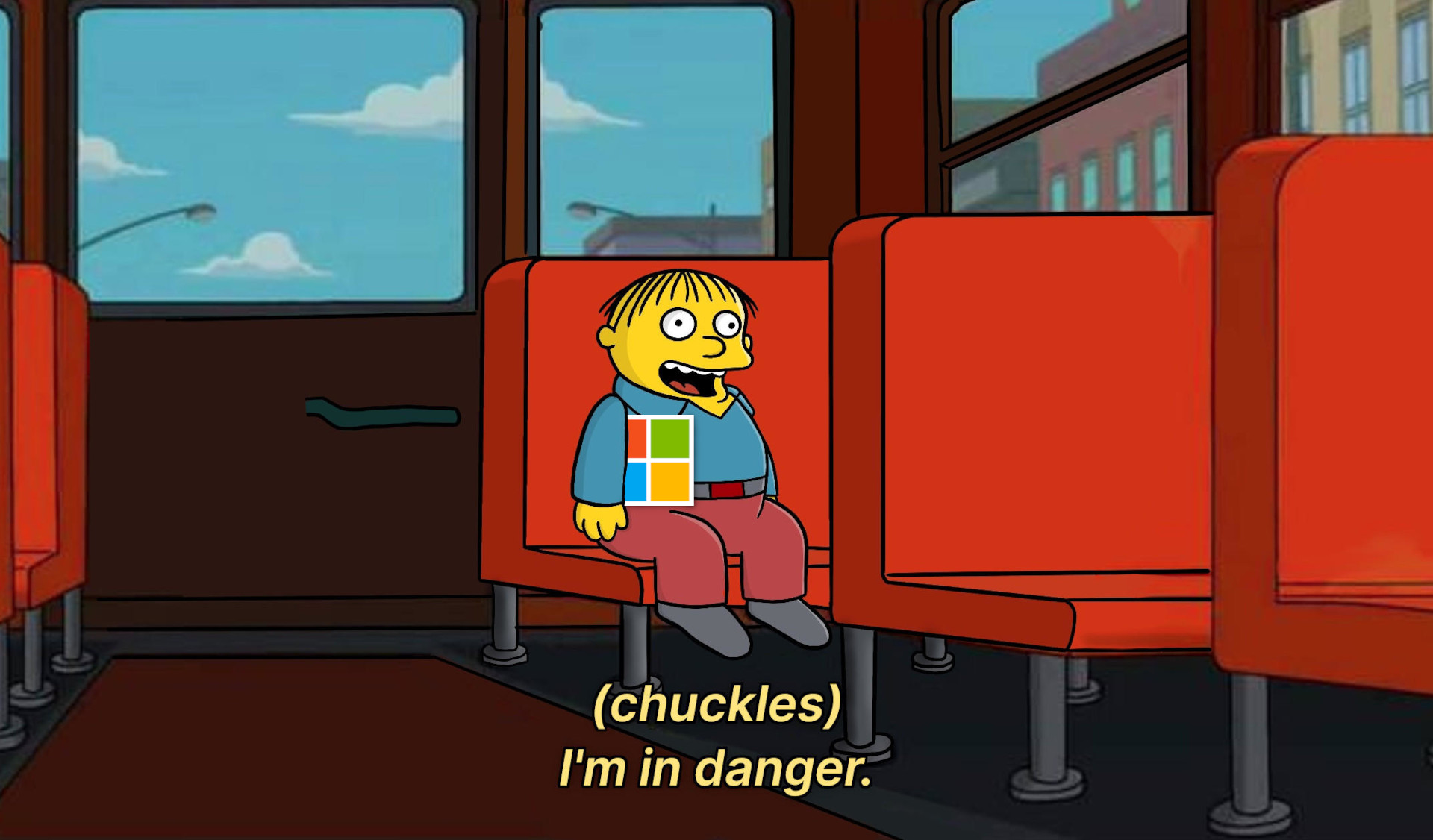
This time I want the credit, so I’m posting my prediction publicly while everyone still thinks it’s ridiculous: I predict that within 15 years Microsoft will discontinue Windows in favor of a Windows themed Linux distribution.
People have been joking about a Windows DE atop the Linux kernel for a while now buddy, too late for you to call dibs
I call dibs! I predicted a free (as in beer) windows OS 20 years ago!

“…Vista is overpriced…”
Ain’t that the truth
Joking? Or the ideas of a mad genius? (h/j)
Giving a specific time range and making this prediction in earnest is well worth receiving some credit if it pans out.
Has been predicted for almost as long as the year of Linux on desktop.
Windows NT kernel was never an issue, Microsoft would encounter exact same issues they’re facing now since the pressure to monetise remains.
Removed by mod
It would be in line with their usual EEE, so totally not surprising.
They don’t give two shits about brand loyalty as long as line go up.What standards would Microsoft EEE in this case? POSIX?
they might ship a proprietary lib with their os, encourage developers to use it, then license it out of being distributed
I imagine it’d be more like Android/iOS. Lock down bootloader so you can’t tamper with the OS, enforce notarisation requirement so that apps have to go through them. But Microsoft can’t do that, they don’t have any users vendor-locked to their application store. Valve on the other hand is in a much better position to do this.
The whole OS and user base.
That’s not what EEE is.
By all means do nitpick the specific meaning of EEE, might be amusing to others.
I just don’t like people throwing around terms they don’t understand, leads to weird outcomes like people saying Meta would EEE ActivityPub back when every instance decided to defederate Threads.
@0x0 @codeinabox it wouldn’t be EEE in this case. Because a Linux distribution is built up around thousands of packages from hundreds of various open source projects.
For EEE to work, the entire base OS stack would need to be extended with features not becoming useful outside Microsoft’s use. Such changes would first of all have a really hard time being accepted in upstream projects. And if they did, these projects would be forked if the last E phase in EEE is triggered. And then Microsoft would be alone with their Frankenstein distribution monster while the majority of the Linux users moves on to something better.
With Linux, there is no single instance of control or power. If a project takes a path people don’t like, it get forked. EEE requires Microsoft to cease full control of all the related pieces and components and kill the open source aspects of it.
That’s the advantage of open source licences. Once the source is out in the public, you can’t retract the source code afterwards, then it just forks.
Ever heard of android?
It’s called Microslop. Won’t you ever forget it
“A Windows themed Linux distribution” can’t really be “Windows themed” without some closed-source blobs and maybe even some backdoors sparkled here and there
Android is a Linux distribution like that and once notarisation requirement is implemented it’ll be indistinguishable from iOS. SteamOS will also likely become gradually more like iOS to appease creators of popular multiplayer games.
@mmmm @codeinabox Sure it can.
Microsoft can distribute their Windows Desktop Environment for Linux in a repository they control. And that repo can even contain just the binaries, with their own proprietary licence. These packages can further have dependencies to other open source packages.
If Microsoft ends up with their own Linux distribution or just mirrors an existing distro (like what Alma/Rocky does with RHEL, or Ubuntu with Debian) … That depends on how much control they want over the Linux distro base OS.
But they certainly have the possibility to add a Windows experience as an alternative to GNOME, KDE, Cinnamon, XFCE, etc, etc, building on top of a shared base OS layer. As well as providing WINE like layers to make existing Windows programs run in that environment.
If they dont use wine, they’ll sell you a subscription to a cloud machine running legacy Windows to run your legacy apps in. They already have this product Windows cloud pc is a thing
A little crazy, but not a lot crazy. ARM adoption may provide the spark necessary to ignite this fire.
Not what I want to happen though.
I want them to release Windows as free and open source software. Windows is on a purely technical level not a bad OS. If it were FOSS, we would get dozens of excellent distributions of it.
There are some good ideas in there (the main one IMO is structured objects as the main form of IPC, instead of text), but the execution is really bad after XP and maybe 7. They stuck to a lot of legacy garbage in the name of “compatibility”, but in the end it’s an inconsistent mess of dozens of frameworks, and yet many old programs run worse than they do in WINE on Linux. Now with the advent of vibecoding the core components, it’s pretty much over unless they literally start over from an old checkout.
I think if they were planning this at all, we’d see linux support for maui. currently their linux use has been very focused on only for devs and servers
Watch them be the ones to make Loss32
deleted by creator