

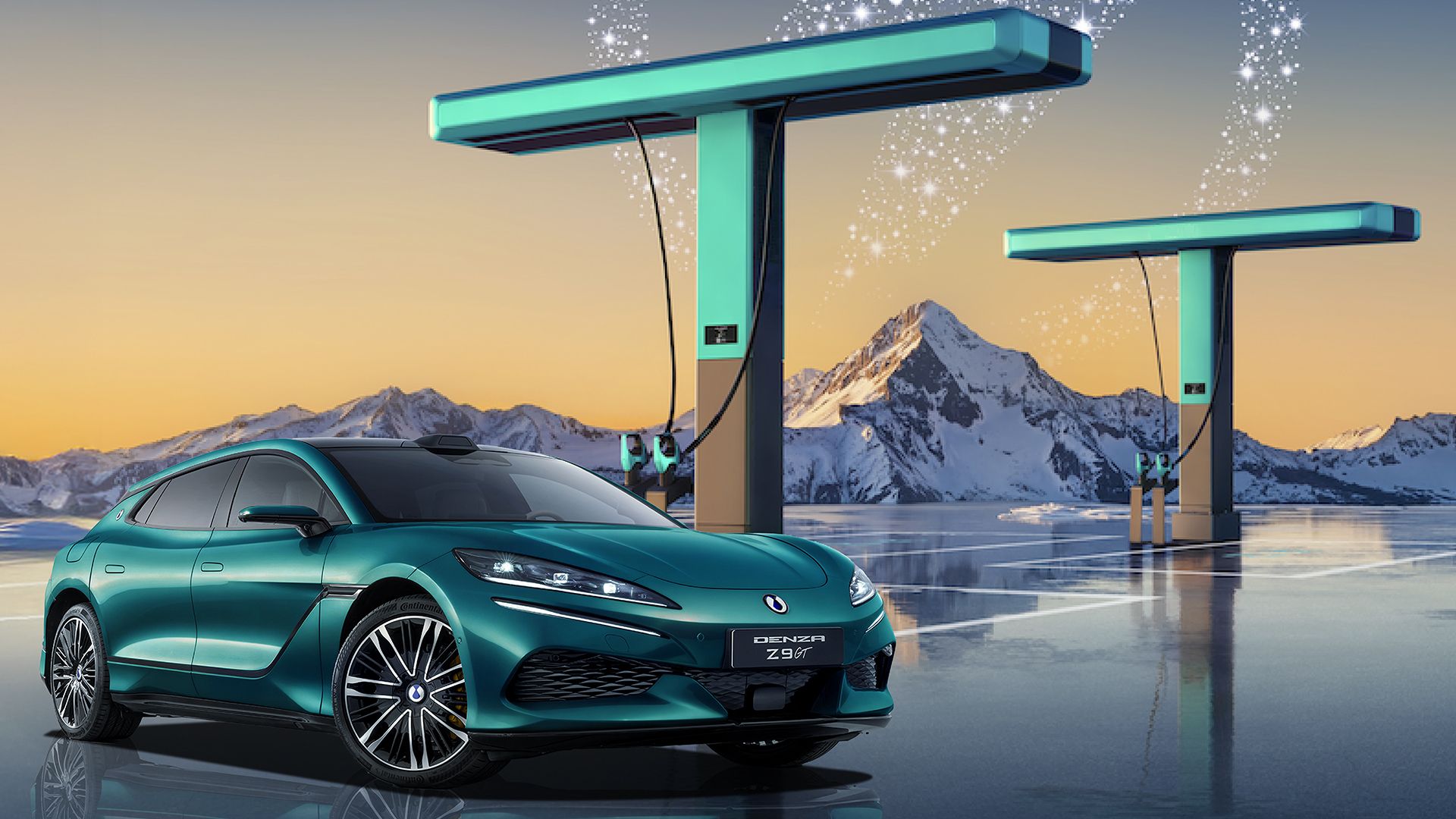
"In China, BYD is currently building 4,000 1.5MW charging stations across the country, with plans to roll out 20,000 by the end of this year.
Although not quite as ambitious, a BYD spokesperson for the European side of the business told me that the company is targeting 2,000 1.5mW Flash Charging stations across Europe before 2026 comes to a close."
I’m fascinated by the economics of this. How does BYD make money on this? Do they run the chargers at a profit? How much will this work out per km for drivers compared to diesel or gasoline?
People think of BYD as a budget car marker, but this to support its luxury brand Denza. The Denza Z9 GT EV has a range of 1,036 km (644 miles) on these chargers. I’m guessing having the best charagers is going to be seen as premium/luxury too.
1.5 Milliwatts? Are these meant for ant cars?
ROFL a typical marketing stunt.
Here in Germany that won‘t work as the bottleneck is the connection to the power grid. Especially when it comes to high power demands. You need thick cables for those power volumes. And those cables do not just arrive over night magically.
The specialists for those connection are rare and we have a hige waiting queue until 2030 for solar parks, battery parks, and some new electricity stations. Was the high demand foreseeable? Yes. Unfortunately in capitalism scarcity increases value which is good for the stakeholder/ doormen of utility companies.
The way I read it is that it’s the dedicated charging stations in public areas, as opposed to charging points running off a domestic energy supply in the driveway.
With that, most of the CCS T2 tethered chargers have big chonky boi cables, so much so that they’re quite unwieldy without the gantries holding some of them up.
Fast chargers are brilliant mind. I use a 75KW charger on a trunk road next to a coffee shop, and it’s generally gone from 30% to 80% in 25-35 mins - enough time to get a coffee, read some text messages, get into the headspace of hitting the road again and disconnecting it. Thing is, the fast chargers aren’t far off petrol prices at 70-85p/KWh.
Something like a five minute charge would be quite something, perhaps makes long distance EV travelling more comfortable.
Something like a five minute charge would be quite something, perhaps makes long distance EV travelling more comfortable.
Or the batteries are getting bigger (which they do). But in this scenario there won’t be a business and money to earn. Many people would fuel their car with cheap solar power produced by theirselves.
Yes, but it is already difficult connecting a new EV charging installation with a good number of 350kW chargers in busy places. Your domestic electricity supply is probably about 60A at 230V, meaning a maximum of 13.8kW per home. 1.5MW is the total maximum electricity demand of about 100 homes, but the actual average usage is more like 300W power home, so 1.5MW is more like 4,900 homes - a small town.
An installation at a service station with a modest 6 chargers would be 9MW, which is more than the power capacity of the median power plant in the UK (which is 5-6MW)
Feels like you could potentially partially mitigate that by having on-site batteries that “slow charge” from the grid, and then fast charge the cars.
That is what they do for solar farms. Due to low volume connection issues and its financially more attractive to feed power in the evening/ sun down as prices are higher at those times.
I‘m not sure how viable this is for loading stations. They volume a truck needs is quite massive. However, Im still not sure if you ever need a truck full charge. Typically, long distance trucks stop at night for a sleep. This 8 hrs can be used for loading the battery.
For sure, but in this case the batteries are not primarily for storage, just to act as a super capacitor (or maybe that’s actually what you need, super capacitors) so you don’t have to support massive cabling from the power station to the charging station, just from the on-site batteries to the car.
the company is targeting 2,000 1.5mW Flash Charging stations across Europe before 2026 comes to a close
Wow 1.5 mW, I wonder if they use 1 cm^2 solar cells to feed them.
But seriously how did nobody catch this.
Well, 1.5 milliwatts doesn’t sound a lot… But seems like for TECH(sic!)radar somehow it does.
Yes, it should be 1.5 MW. I corrected the headline.
I want to believe BYD. But my Civic is 20 years old and still idles like a purring cat. I would like 1 year/£1k spent and I don’t have faith im getting that in a BYD. 20k for a Dolphin Surf is a minimum 20 year car, and I just don’t see it.
Granted my Civic wasnt bought new, it was brought for £1300 a year ago and I could probably get another 100k miles out of it. Im almost certain that the new market is outside £1k/year budget, bunch of old Leafs around though.
I’m not sure what point you’re trying to make, other than “used cars are cheaper than new cars, and I won’t buy a new car until that changes”.
Sure. My point is that I don’t believe BYD makes cars that will last as long as I would want them to last.
I want to believe BYD. But my Civic is 20 years old and still idles like a purring cat. I would like 1 year/£1k spent and I don’t have faith im getting that in a BYD. 20k for a Dolphin Surf is a minimum 20 year car, and I just don’t see it.
Dolphin Surf is 20k, for me I would like it to last 20 years. My current car has already survived 20 years, so I don’t think that’s an unreasonable expectation. I don’t believe the dolphin surf will last 20 years.
I could have been more clear.
That’s fair.
They do seem a bit more on the discount side, quality wise. But then again, lots of the usual discount cars, also don’t make it much past 10-15 years. My Nissan Micra is 11 years, and there is no way it’ll still be driving in 9 years, might not even survive the next 2.
£1k/1y is both an easy and challenging target to hit. It’s really easy to hit at the bottom end, bouncing from £500 lemon to the next. Occasionally finding a gem that’ll last a few years.
Nearly impossible to hit on a new car though I think. 20 years for 20k I don’t think is findable beyond winning the lottery on a well made car, from a well designed model, from a reliability focused manufacturer, and giving it an easy life.