I mean it seems the more complex solution in deployment for sure, but its design could still have use in low heat industrial uses (sub 250°C, e.g. food prep, textile, sanitation etc.) where it is used heat -> heat rather than heat -> electricity -> heat. Maybe these replace thermal collectors eventually.
But that is not the point of this meme at all, just my thoughts.
Solar thermal has some distinct advantages when you start talking about really big instillations. Especially when considering power storage, molten salt systems can store heat and allow the generators to keep working even at night. Much cheaper than batteries at very large scales.
Thermal solar systems are generally very efficient when the goal is heating something, not just generating power. So say, you want to run an ammonia plant without burning natural gas, or if you want to melt down metals for recycling. There are so many industrial applications where it’s a better way of doing it than using an electric heating element.


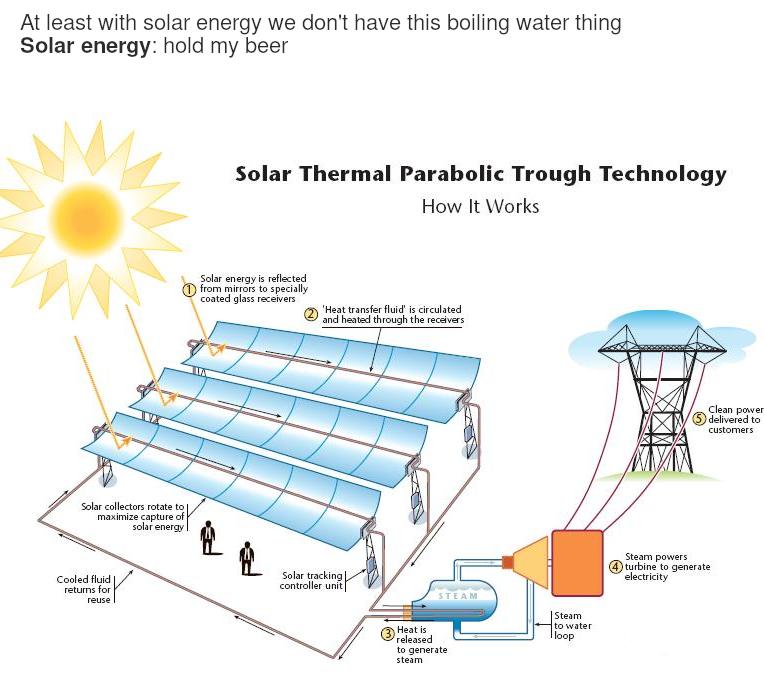
Solar thermal is kinda obsolete I thought, now China is churning out PVs for pennies.
I mean it seems the more complex solution in deployment for sure, but its design could still have use in low heat industrial uses (sub 250°C, e.g. food prep, textile, sanitation etc.) where it is used heat -> heat rather than heat -> electricity -> heat. Maybe these replace thermal collectors eventually.
But that is not the point of this meme at all, just my thoughts.
IDK, heat pumps are basically multiplying the electricity they use.
Only with small temperature differences, the higher the difference the lower the COP.
Solar thermal has some distinct advantages when you start talking about really big instillations. Especially when considering power storage, molten salt systems can store heat and allow the generators to keep working even at night. Much cheaper than batteries at very large scales.
Thermal solar systems are generally very efficient when the goal is heating something, not just generating power. So say, you want to run an ammonia plant without burning natural gas, or if you want to melt down metals for recycling. There are so many industrial applications where it’s a better way of doing it than using an electric heating element.
For heating I’d guess it can still be relevant. As a means of producing electricity though? Yeah