
- cross-posted to:
- solarpunk@slrpnk.net
- cross-posted to:
- solarpunk@slrpnk.net
You must log in or # to comment.
And STILL I hear dumb shits in the US say “solar isn’t feasible”
Motherfuckers then why does literally every other country have tons of solar plants, rooftop installations, balcony installations and some packed away they can pull out when the power cuts out? Why do major companies put massive solar farms next to their new factories? Why are people interested in fossil fuels spending so much goddamn money telling people solar sucks? If it sucked, people wouldn’t use it.
Because oil people don’t make money from solar.
They do make money from solar. Just not enough to their liking.
Returns on investments in fossil fuels typically range between 10-20 percent, while for a renewables project, 5-8 percent is the norm, Reuters reported in June 2023. “It’s also about the volatility of profitability,” Christophers says. Meanwhile, if the price of the feedstock falls, that usually means fossil fuels are cheaper – and thus the level of profitability can still be maintained. Renewable energy projects in contrast must contend with costs which are largely upfront and have to be met regardless of fluctuations in electricity prices. That makes investment riskier – and therefore costlier, cutting profitability. (source)
I just let them spout off for as long as they want. Then I calmly tell them I haven’t paid an electric bill for over five years. Whatever their argument was is moot.
Looks cool as hell
Plant some more trees and rooftop gardens and you’ve got an official Solarpunk setting
Quite frankly, trees inside cities are decorative. If you truly care about ecology and the ecosystem, you look at the forestry on a national or regional level. Theoretically, having the densest and hence the smallest cities possibles would be the best for the overall ecosystem. When I see a park in a city I am thinking “they force the city to grow its radius by that much”.
I’d rather have a very dense urban seed surrounded by natural reserves than a chill cityscape with a few scattered parks that are not big enough to sustain a full ecosystem.
First of all, “merely decorative” has a big impact on our physiological and psychological well-being; urban greening appears to be able to improve things from respiratory difficulties to stress, anxiety and depression .
Second, “merely decorative” isn’t even true. Trees lower both surface and air temperature in cities in a meaningful way (on the order of a couple of degrees on a well-treed street – that can be the difference between “ah, it’s a nice day for a walk” and “holy crap it’s hot out”.
Yes, I was a but cynical also for the sake of conciseness, but there is indeed and interesting point in green cities, that’s one question on which ecologism and environmentalism differ. The question is whether you are trying to preserve the whole ecosystem or an environment in which humans feel good.
To be honest, I don’t want to live in a concrete jungle. I think inhumane to live in a super dense city totally disconnected to nature. But I also would like that we collectively accept that this is a preference that is harmful to the ecosystem and that it is sometimes okay to have such preferences, if we manage to make them sustainable.
20 years ago a urbanist I was working with, when we were doing city simulations to help offset CO2 footprint told me “you know, the ugly truth is that if we want to lower our CO2 emissions to the max, we should all live in skyscrapers on top of a school, supermarket and incinerator.”
Thing is, we need to recognize the tension between an enjoyable environment, wildlife preservation, human health, the ecosystem’s health… And we need to see further than the current, petty, political compartimentalization of these questions. I wish one day we start consider these questions a bit more seriously
Unfortunately, this is more likely pushed by acute necessity than anything else.
Hopefully, we all won’t require a massive war to figure out solar should be invested into.
Hopefully, we all won’t require a massive war to figure out solar should be invested into.
The Iran war is kinda doing just that, though renewable was going up pretty steadily even before it.
deleted by creator
as unreliable as ERCOT?
Oh hey, something not completely depressing!
all hail the sun 🖐️☀️🖐️
Impressive, thank for sharing this amazing picture 😳👍
Look at all these teeny tiny humans with their teeny tiny solar panels. All that just to catch the occasional stray photon. What are they compared to the sun almighty?
In Google maps you can use satellite mode to look at their roofs. There are some panels but nothing like this.
edit: satellite mode is out of date, see further conversation below.
Google Earth has data up through June 27, 2024. Check around the Salloum Hospital and Syrian Arab Red Cross Hospital. That area around the hospitals and to the NNE looks like nearly every roof has panels. Could also be a more recent picture and more panels may have been installed in the past year or two.
My Google Maps says 2026 on the bottom of it.
I’ve highlighted the solar panels I could see, around Salloum Hospital:
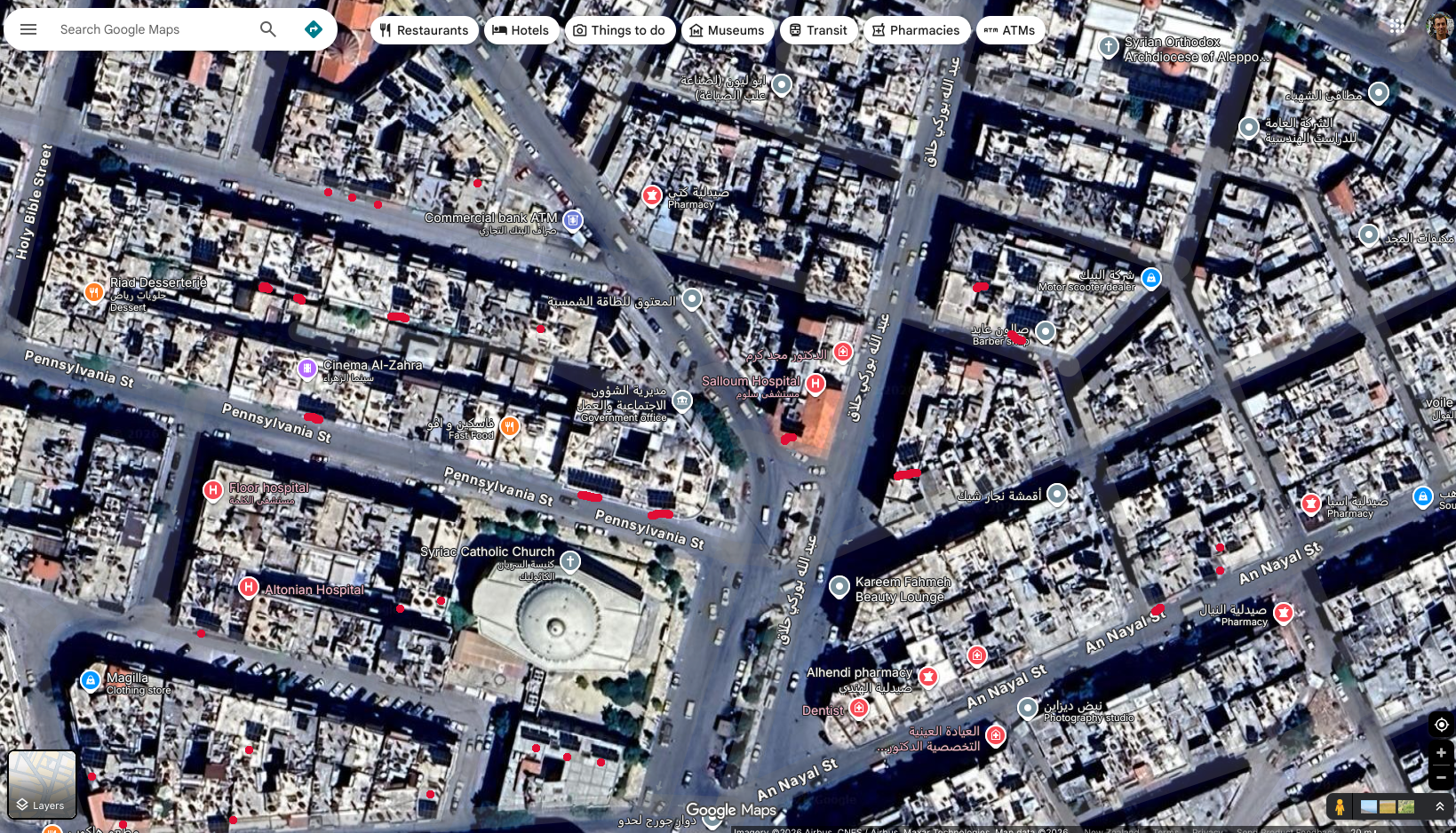
It’s great to see so many but it’s way more scattered and patchy than in the OP photo.
Hmm my Google Maps shows the same 2026 date but when I compare to the Google Earth June 27, 2024 images I’m seeing the same cars in the same exact spots, like the white car right outside of the Syrian Arab Red Crescent Hospital
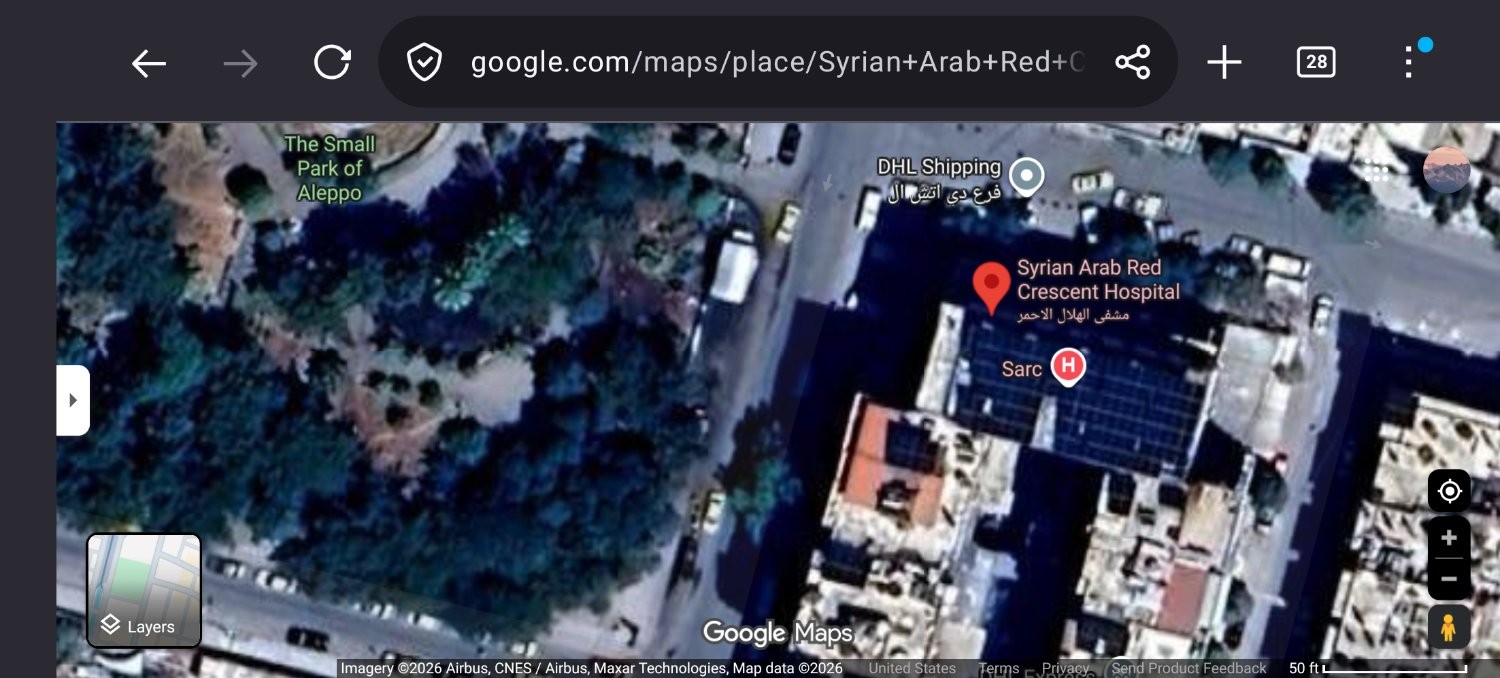
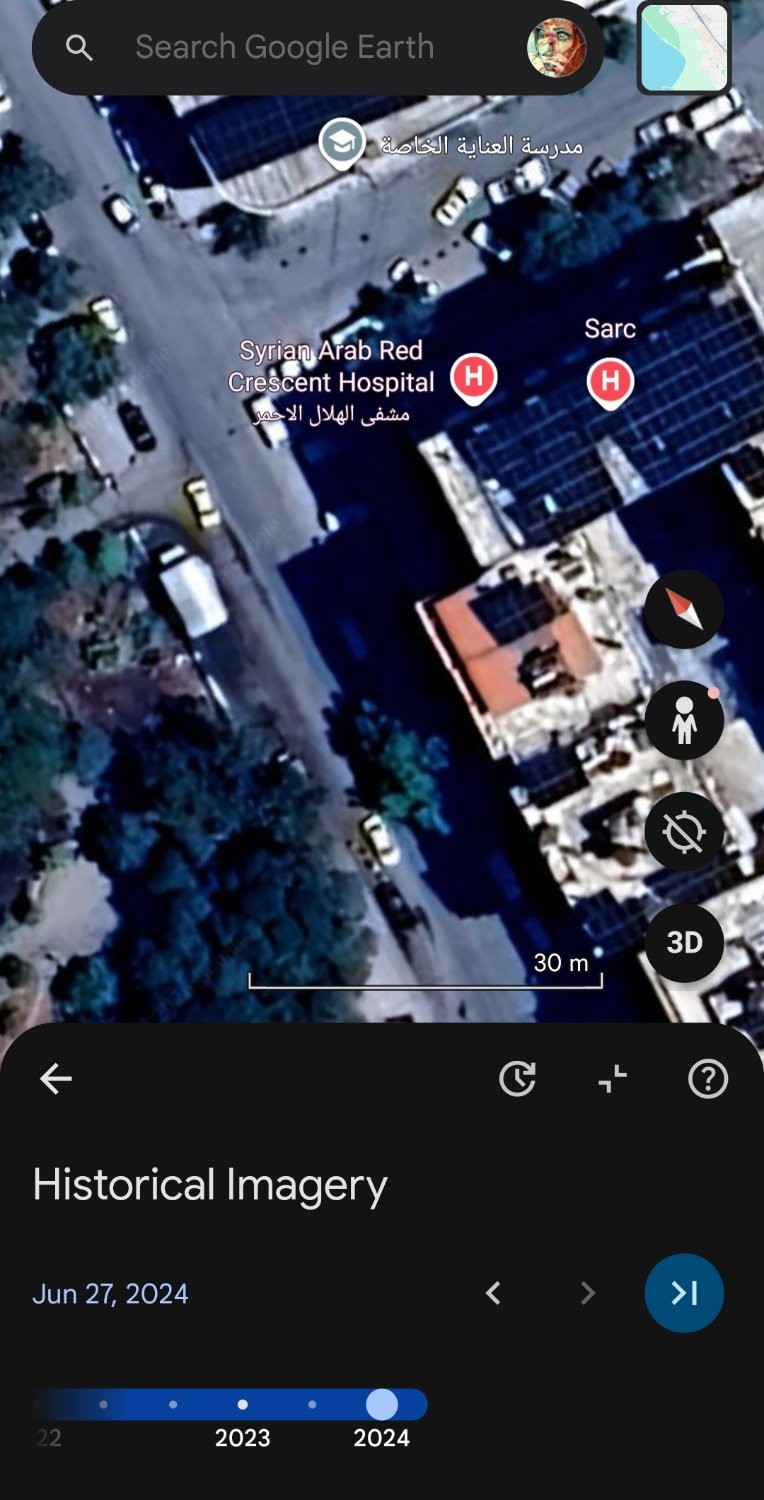
Ahh, so maybe on Google Maps that’s just a copyright statement rather than really when the imagery was taken. So I’m looking at quite old information.
That may be correct, I always thought that was the date the imagery was taken, but I typically go to Earth first because you can easily scrub back and forth along the timeline. Interestingly, if you go back to the 2023 images you can see that 2024 was a big year for solar already. That pace continuing into 2025 and 2026 could definitely result in the area looking like the image in the OP. Wish we had location data from the original so we could see when and where it was taken as I’m super curious now. And its a slow day at work so I have time to dig around lol
There’s this photo from the same location in a Aljazeera article on the area. Apparently they are the Sheikh Maqsoud and Ashrafieh neighborhoods.
Oh thank you, and that’s from Jan this year. Haven’t found the exact location yet but those neighborhoods are very close to where I was looking
I can’t find any evidence that this photo is real. Doubt they built all that in 2 years.
How similar most of the panels are makes me think someone there’s actually doing distributed infrastructure right :)
Yep, Bob is making a killing selling them out of his truck.
As Bob, my truck is not nearly large enough nor my supply chain so consistent
Implements taxes on solar energy
Citizen, you have an outstanding debt for the 2 hours of sunlight you’ve enjoyed yesterday.
I wonder if the black panels increase the urban heat island effect.
It’s a pretty sharp departure from the light coloured buildings.
Interesting question. From what I gathered from this nature study on that, it seems that solar farms can increase ambient temperature compared to an area with some vegetation, which may be due to the panel preventing the ground from irradiating heat as effectively (by like, bouncing it off the back of the panel) and removing the vegetation that cools the area from evaporation.
But I think on a rooftop that may not have as much thermal mass as the ground, it may not have that effect, and overall should lessen the cooling needs of a building somewhat due to the shade the panels provide. Panels also don’t get quite as hot as an unshielded roof, since they do reflect some infrared energy despite their dark color.

tl:dr, probably not much or at all since they’re on a rooftop, and if it does, it could probably be mitigated by planting more trees and vegetation in the city (which can drop temps up to 8 degrees). But that’s mostly an educated guess.
deleted by creator
oh cool, maybe they did this cause a long time ago during the civil war there was frequent power cuts?
There still are frequent power cuts in Syria.
In Damascus, the power is on for like 8 hours per day.
oh, i thought it ended.
Well there is still a province that is under Druze grasp so I wouldn’t say the civil war ended.
Well, Assad is gone at least but it is still pretty unstable there.
And the people are not educated enough to call for real democracy, they are happy with the majority Sunni in power.
alr tanks for the info.
I wonder if they use batteries and what kind.
Also whether the local electricians have jury rigged some kind of bottom up grid of their own.
Does anyone have information?
This video goes into Syria’s electric grid, and how people have setup their solar installs. It shows batteries are used quite thoroughly, and doesn’t appear to be grid-tied or formed into a micro-grid, AFAICT.