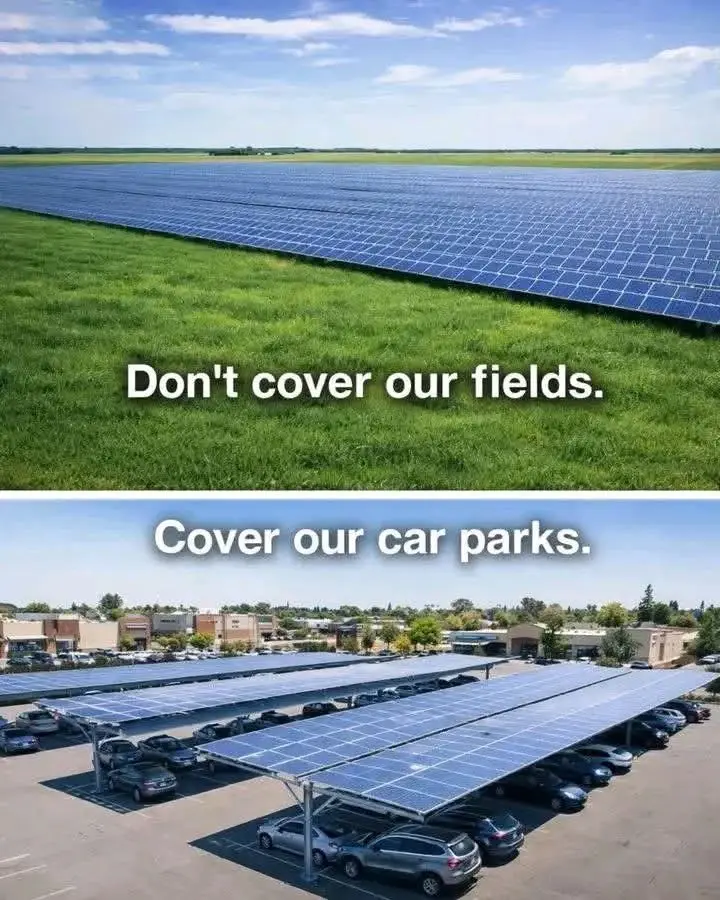
False dilemma.
Also that ain’t no field.
Crop yields are only very slightly affected by agrivoltaics and variance tends to be reduced. Water usage is reduced a lot.
Even dedicated agrivoltaics would only cover a fraction of usually sub standard land for giant power outputs. The fear of someone plastering the environment with solar is fear mongering.
Building enough parking infrastructure to cover with panels is a waste of space (outside of America).
It’s probably a good idea to put solar panels on car parks where we’re going to have car parks anyway, though. In addition to agrivoltaics and using, as you say, substandard land for large scale solar. Also put it on roofs. Basically anywhere it doesn’t do any harm, I say.
Governments should encourage every home to have at least enough solar powered energy to run a small refrigerator, a space heater, a small cooking surface, and a radio as a matter of national security. That can be achieved with porch solar and significantly hardens a population against attacks on energy infrastructure.
Would also require an isolation switch to be effective. With a grid-tied solar install it’s going to dump all of the energy into the grid, and during a power outage that energy will simply not be collected.
I could see that becoming a thing where during a power outage you flip a switch near the electrical panel and then every green-colored outlet will run entirely off the solar panels when the sunlight is available. Or if we really want to make it technical solution, create special outlets that are dual power (grid and direct from solar) and then appliances plugged into these special outlets will switch between power sources as they’re available. Potentially some issues with two different AC circuits touching depending on how it’s implemented on the appliance side, but it could be a good solution especially if the controller can still backfeed excess energy production back into the grid
We already have hybrid inverters that does that automatically, you don’t even need a different circuit or special outlets. It can manage all the grid ties, off grid and battery parameters on the fly
Well shit that’s awesome! Like I’m kinda curious how it handles the load exceeding capacity, but I suppose if you just turn everything off that should probably be fine
how it handles the load exceeding capacity
As in what happens if you plug too much stuff that it exceeds your solar production?
I’ll use mine as an example, but it might be different with different models and configurations:
Inverter can handle up to 10kw
If solar production is at 5kw, and home is demanding 7kw, in my case, I have it set up as to draw the remaining 2kw from the battery, if battery is depleted, it will draw 2kw from the utility companyIf home demands more than 10kw that the inverter can handle, it will trip the internal inverter protection or a circuit breaker leading to it
You don’t need that switch. There are already automatic switches. And if you have batteries you can load them from the panels and, in case they go too low, from the grid and then use the batteries to power your house.
I want to do something like that but just have the solar circuits entirely disconnected from the grid, running stuff like fridge, freezer, water heater, car charger, etc (depends how many watts my panels can actually manage in practice; I don’t have a ton of space). all without being able to draw from the grid at all.
My state is pretty shitty about solar, and I don’t particularity want to give the electric company my surplus power for free for them to turn around and profit from, so fuck ‘em, ill figure out how to perfectly balance my use with my capacity and just save the spend.
That’s so fucked up. Even people who install solar have to give free energy to the utility company, who probably still charge them for energy…
Yes, thats exactly what they do. No net metering, no discounts or rebates, nothing, but if your power flows back into the grid, they sure will charge for it at the exact same rate as if they created it themselves, and charge you as much as they can get away with to eat into your savings (some utilities around here even make you pay a monthly fee to have your own solar on “their” grid…). No surprise hardly anyone here has solar; it’s generally not worth having unless you can guarantee you use all of the power yourself.
My locality is mostly hydro power, we don’t even really have peak/off-peak rates, just pay the same all the time regardless because they can’t easily adapt to demand anyway. And like yay renewables and stuff, I’m super on board with that aspect, but I’m not on board with having a monopoly on the renewables, since my area is not typical of the state.
That’s absurd. People should use repurposed EV batteries and just power their homes on solar without connecting to the grid. I get that it’s probably a legal requirement to connect your solar to the grid, but that’s bullshit and nothing short of state-sanctioned theft.
With the current prices of panels you might install a few more than needed.
Except most solar systems go down without power from the grid
I would say let’s maybe not have car parks at all? They suck. We should as a species try to phase out personal cars, first of all. And secondly, until then, underground garages are infinitely better for everyone else.
OK, so in 100 years you get your wish and personal cars no longer exist. For the next 100 years, would you like to:
- put solar panels on top of car parks; or
- not do that?
In addition, after 100 years on top of the car parks that still exist (perhaps for the shared cars), would you like to:
- have solar panels on top of them; or
- not have them?
That’s a false dichotomy. I can choose a third option. Where we place car parking garages (multi-level above or underground) all around ring roads and ban cars from entering city centers. Then we put solar panels on top of most roofs, and in fields for grazing animals.
This obsession with car parks is exclusively American.
So you want to demolish all the car parks that already exist? All of them, tomorrow? Don’t you think it will take some time before the builders can come and replace the last car park in your country with whatever it’s going to be replaced with? During that time, would it not be better to put solar panels on it? (And then remove them before it gets demolished and put them somewhere else)
I am not American, I just think it’s a stupid criticism of such a plan that we “shouldn’t have cars and therefore shouldn’t have car parks” because the fact is that we already do have them so we may as well use them as best we can.
In any case I don’t agree on a total ban on cars entering city centres, at least not in the foreseeable future. The most bike-friendly cities I have lived in and visited have also had many cars. I suspect there is a place for personal cars, deprioritised compared to buses and bikes, in most cities for many years to come. During that time there will need to be car parks. Those car parks should have solar panels on, along with pretty much all other buildings.
Many cities have already banned cars in their centers. It’s not a “what if”. It’s been done and works. And it takes as long to build those garages as it’d take to build those solar parks. And not like they couldn’t be done at the same time. Like instead of building solar over the car parks, why not spend the time and resources building them over warehouses and apartments?
You’re right that this is a very American thing. But we are a huge country responsible for huge amounts of climate damage. Our parking lots are enormous. 5% of our entire country is parking lot, owned by companies that can sure as hell afford contractors, especially if there’s incentive.
Also, here, banning cars in city centers here often does NOT work. Even the city I live in tried it for decades - businesses constantly failed, there was no foot traffic despite being surrounded by residential communities and beautiful upkeeping of the town center. Once we opened it up to cars, suddenly it’s a flourishing area of local businesses and community organization. We as a nation are too focused on cars, yes. But changing that right now is absolutely not happening. There’s no alternative right now, and changing that has too much opposition to overcome. There has to be steps along the way. Covering massive bare parking lots in solar panels would absolutely be something we can get this country on board with.
I don’t know of any big cities that have banned cars from anything but small areas in their centres. I know that in my city, the centre of which is pedestrianised, nevertheless has many car parks, including two large park-and-ride facilities with large car parks that could have solar panels installed.
The reason to build them over car parks is because the ones being considered are surface-level, so any building work is cheaper and easier. And it also provides a benefit to users in the form of shade.
Ultimately we should indeed aim to cover rooves with solar panels, but let’s focus on the lowest-hanging fruit.
The USA has a stupid relationship with car parks, yes, but I’m not American and I’m not encouraging car parks at all, I just think we should put the space where they already exist and are actually useful to better use.
Ideally, yes, we’d have much better public transit infrastructure but it’d need to be every ten minutes on every route and not stop overnight or for Sundays or public holidays for it to be a viable replacement for a car for me. Which is very feasible in a big city but not so much out in the countryside.
Ultimately, some people will either always need personal cars (or perhaps some other solution, but no public transit I’ve ever seen will do it) for a huge variety of reasons, including disabilities and house locations (and I don’t mean suburbia, that’s generally solvable with public transit and also generally a bad idea).
Well, we could also stop adding a certain percentage of biofuel to our cars. The land that we gain from that, if covered by solar panels, would produce enough energy to cover all our energy demand.
Also a great idea. One of the things I think is good about putting it everywhere, though, is that it cuts transmission requirements+losses and increases resilience by having the generation be localised.
Eh, we’ve done pretty well with transmitting power. So although I do agree that spreading the load is always better, it should not be compromising the costs. As putting it “everywhere” also comes with some downsides.
Transmission losses are quite large and long distance transmission lines use fairly limited resources. Just getting a grid connection is the bottleneck in renewable projects in the UK right now.
Imagine a roof on the highways with solar panels.
Solar panels are less efficient the hotter they get. Heat makes the electrons in the panel bounce around more at rest, which means they can’t be excited as much from the sun’s energy. Throwing them in a concrete desert with hot cars parked underneath would probably affect their performance significantly.
Yes, I’m well aware of this. There are plenty of locations where that’s not really a problem, though. And generally when they’re hotter and therefore less efficient it means there’s also relatively abundant sunlight, somewhat counteracting the effect of the heat. Cars also aren’t necessarily that hot, particularly if they aren’t powered by burning stuff. And putting all of that under the shade of a canopy would reduce the heat reaching the ground. If you used a brighter paving material like concrete, you could even benefit from bifacial panels using the reflected energy.
There are problems and there are solutions, maybe the problems outweigh the solutions but it’s still a worthwhile avenue of research to find that out.
All I’m saying is it would make more sense to put them over agricultural land than in parking lots.

deleted by creator
- yes, absolutely, we should be putting solar in car parks
- you deploy agricultural solar panels in grazing lands where the panels act as shade for grazing animals
I don’t think it is intentional on OP’s part, but this is really well-disguised fossil fuel propaganda. Carport solar is way more expensive than ground-mounted, and it isn’t viable for utility-scale projects. Should we do carport solar? Absolutely! But we also really need utility scale solar.
And if you put it on marginal farm land and make the ground cover pollinator-friendly, it actually improves yields on nearby farms without any real loss, since that land wasn’t great for growing food anyway. (Not to mention that cropland is about the furthest thing from a natural ecosystem)
Why would it be way more expensive? Sure, you’ll have to put it on poles, but…
But we also really need utility scale solar.
If you put them on most viable mad-made surfaces… do we really?
You can place ground based solar farms just outside cities where they have access to main power lines that can carry megawatts; inside the city they probably can only push kilowatts per phase.
30kW is the limit for commercial (or any 3 phase) solar generators in my town, that is cheaper to mount on the building roof
The solar farm nearest me, right near the high voltage wires that supply that side of the city, has 13MW of panels, three orders of magnitude more
I like the vertically mounted bifacial panels.
Highly recommended for areas that get a lot of snow.
I had no idea this was a thing! Why isn’t this more widespread?
They can’t be more widespread. They need to be thin and exactly vertical to optimally work.
Sorry, I couldn’t resist
Except that agrivoltaics works out being better for the crops and the panels. https://en.wikipedia.org/wiki/Agrivoltaics
The crops part is similar to why grass grows better under trampolines. https://youtu.be/CoDn-1rGcpk
Some plants are shade loving and would do great under properly spaced panels
Just cover all fields used to grow biofuel crops with solar panels, it’s an insane number used for biofuels - like enough to power the whole US twice over if they were all covered in solar.
Yes, i’ll mention him (and another trigger after the ~1h mark warning for dipshits).
Both. AgroPV is a win win win.
It gives farmers an additional income stream
They can still farm the field with most Setups
Below the panels, the soil can regenerate and grow “weeds”, important for bugs and small criters.
Even if they don’t farm, you still get soil regeneration and solar panels leave no trace when removed.
But yeah, all the roofs, all the parking lots as well.
I’m not sure about the no trace part, wouldn’t the higher structures need concrete foundations?
Not necessarily, it seems you can work with screw-based foundations even with higher setups. I found a german source with good pictures for what looks like a raspberry farm
Oh, and a comparison when to use what (looks like ai, but, you know…)
Oh that’s great, thanks! It’s s bit disheartening to see how many fields are covered in PV without doing agri-pv, effectively competing with farming, at least in my area. It seems like agri pv is a purely academic thing for now, at least I haven’t ever read about productive usage. My best guess, aside from steep investment costs, would be that the laws are different for farming and pv (I’m in Germany).
I know and feel you, that’s wh I have looked into. It seems the biggest issues are bureaucratic (you can either produce power or food, if you want both, it gets murky and you need exceptions) and our bad grid. People can not transport the created energy without the grid straining.
Both can be solved, not sure if Frau Reiche wants to…
But, my favorite German example is the Hop farmer in the Hollertau who built a commercial system himself and is pretty happy (if the grid was stable)
How many places outside of Europe regularly use green houses for agriculture?
For Europe, integrating solar voltaics into the existing greenhouse covers seems like a decent idea. Most of the infrastructure is already there and there are various breeds of plants designed to be grown there.
North America, in contrast, doesn’t use greenhouses outside of niche crops. There is no infrastructure set up, crops are grown where natural temperatures are adequate, and breeds are selected to take full use of the sun.
Agri-pv may work in Europe because of how agriculture works there, but it may not scale to other parts of the world.
It’s not that the scale of greenhouse farming is enormous in Europe. To my knowledge, it’s mostly the Netherlands, and also “niche” crops (compared to the big ones like wheat and corn). Also my guess would be that the structures are more complicated to integrate with PV since greenhouse covers can be switched open/shut.
Europe also mostly has open farming and also usually grows crops that used to be fine with being in the sun all day. The issue is that the summers getting hotter and hotter with the climate change and they are struggling and need a lot of additional watering - or some kind of shade they didn’t need before. I’d assume that’s the same in NA.
The main difference I see between Europe and NA is how densely packed Europe is. Every square cm of land is already used for something, what’s left of natural habitats has to be protected. There’s real competition for space. Land is way more available in NA if I’m not mistaken.
Spain has a similar region filled with greenhouses. The test case used for solar voltaics is for a crop that is sensitive to temperature, so a minor loss in exposed radiance may be preferable to a consistent growing temperatures.
I feel like it also depends on where the land is regarding growing. France is an agricultural giant and would probably compare to California in regards to land values. Yet, both places have an enormous agricultural output.
It is also getting back to my statement as to what kind of farming would benefit from having plants compete with silicon for solar radiance. The best trade off is greenhouses, where is already an attempt to trade some weather exposure for climate control. I don’t see this technology being used for open fields because of how it will affect open farming. And in cases where European farmers use greenhouses to grow vegetables for longer parts of the year, American farmers trade off growing seasons based on latitude.
Just one word: Almería.
It’s called the “sea of plastic” because of the greenhouse extension.
I know that, but it’s not exactly representative.
I thought agrivoltaics gives a better yield as it protects the grass from too much sunlight that would cause it to dry out? I know in my garden the patch with the most grass growth had a wood sheet hanging over it.
Akshualy, covering your fields (partially) with solar increases crop yield by up to 20%. And also feeds your tractor environmentally friendly.
THIS !!!
As a solar engineer myself that started in utility scale solar and just left their first Commercial & Industrial (C&I) solar job, residential, commercial, and industrial solar is the best use.
-
you center generation as close as possible to utilization, minimizing transmission and distribution.
-
land is re-used, allowing other lands for other uses like rewilding, reforesting, and conservation.
You still have other problems like large power users, but you cannot ignore the benefits.
I hate that this even came to my mind, but I bet a significant percentage of people would actually be discouraged by point 2. I’m all in on it, go team save (and restore) the environment, but it seems like so many people sneer and get turned off just by hearing words such as “rewilding” as if it’s somehow working against their best interests
To the capitalist, everything is an asset that can make money, including land. No money making in returning land to nature, unless a positive externality is introduced by a tax credit or something. Not a perfect solution by far, but rewilding is a necessary pill to swallow because we’re in the sixth mass extinction and are using land for things like cows and pigs which is super water and fertilizer intensive.
-
You can (and probably should) cover your fields.
I wonder why not every single new warehouse, corporate HQ, supermarket, strip mall, shopping mall and commercial building do not have solar panels on their roofs?
The only reason is cheap electric prices for big corps. If they wouldn’t get subsidiaries, i bet you there is solar everywhere. Also a lot of them started doing this in the eu but there are not enough installation professionals to keep up.
A LIDL opened about 6 months ago near my place… zero panels over the car park… and 1 (one) EV charger… like… you’d think they’d had it pegged by now.
@0x0 @Mangoholic Nah, cheapest possible infrastructure is all.
But the investors want to hear you’re making investments that pay out within a year. A decade to see a return means they’ve got no interest.