
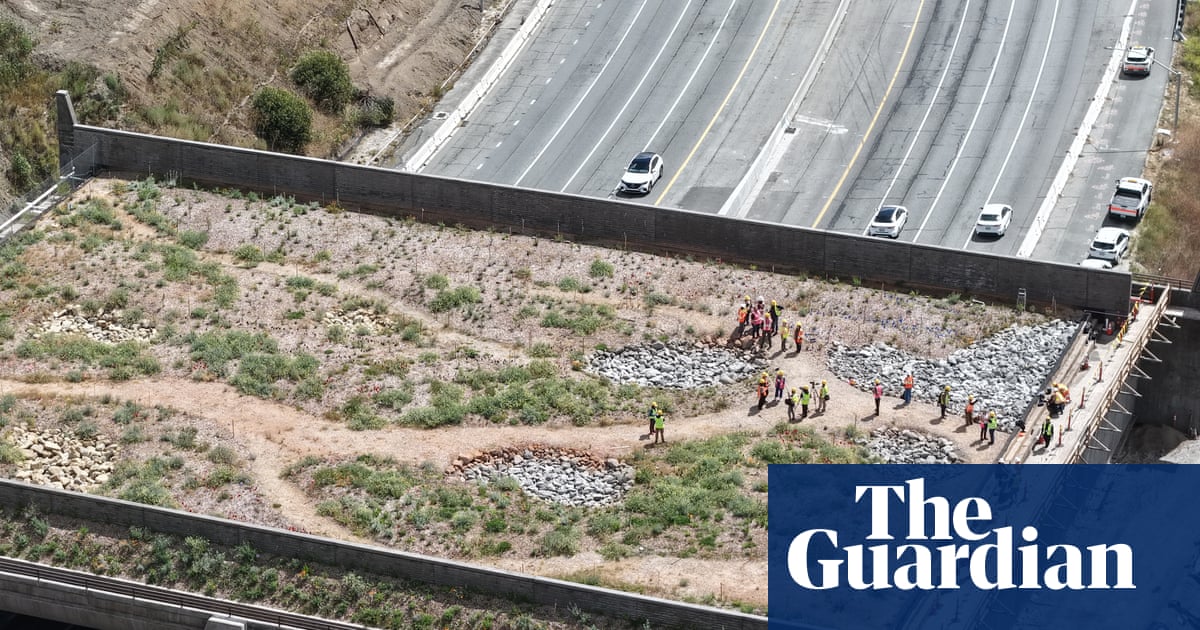
I’m only wondering why the bridge is costing $114 million. Is it part of a larger project?
I actually think the ecosystem benefit here will quickly payback even that large of an investment, an open air, safe feeling wildlife transit corridor for wildlife can easily be a keystone piece of architecture in maintaining a regional ecosystem and flow of nutrients/migration of animals. That isn’t even bringing into the picture the MASSIVE cost savings that a reduction in wildlife-vehicle collisions inherently provides.
Benefits of crossings
The U.S. records more than 1 million wildlife–vehicle collisions each year, and that is probably an undercount because of unreported incidents.3 These crashes cost more than $10 billion annually in repairs, medical care, and lost productivity, and they cause about 200 deaths and 26,000 injuries annually.4 According to the Federal Highway Administration, wildlife crossings can deliver key benefits for drivers and wildlife, including:
Crash prevention: Wildlife crossings with fencing can cut large-mammal collisions by more than 80%—and up to 97% for certain species, including deer and elk—making them among the most effective ways to improve driver safety and wildlife connectivity.5
Cost savings: Each prevented wildlife–vehicle collision can save thousands of dollars—more than $19,000 per deer crash, $73,000 per elk, and $110,000 per moose—in vehicle, injury, and wildlife costs, making well-placed crossings a strong investment.6
Habitat connectivity: Roads, fences, and development break up landscapes and block wildlife migration, limiting animals’ access to food, water, and mates, which can cause population declines and reduce biodiversity by up to 75%.7
Communities throughout the country are investing in a range of wildlife crossings to improve public safety and protect vulnerable species. (See Figure 2.)
Relevant article
https://y2y.net/blog/how-wildlife-crossings-revolutionized-conservation/
Another relevant study that looks interesting
My commentary isn’t about why a wildlife bridge costs this amount of money. It is more why a bridge of this size and configuration costs this much.
These kinds of bridges need to be built and they have to be wide so that prey animals will actually use it.
Building a large bridge like that, with the added complication of holding lots of protentially water soaked heavy soil and trees roots that try to break through the bottom isn’t cheap. More or less the same reason why roof-top parks are prohibitively expensive in most cases.
What I find a bit surprising is that they didn’t go for a tunnel for the cars, which is typically cheaper to do.
Or just build a bridge for the cars. That’s probably the cheapest option.
But it wouldn’t look as good.
It wasn’t mentioned in the article, but I suspect there was also pressure to keep as much of the highway open for as long as possible. Putting in a tunnel, or changing the road to a bridge would close a major shipping route for months, whereas putting in an overpass can be done with staggered lane closures.
Or build a bridge next to the road while keeping the road open, and then close and demolish the road afterwards.
Yeah, but that’s just not going to work with the geography involved here, because there’s mountains to one side, and a stream to the other. The wildlife bridge is connecting two protected natural areas, which makes it perfect for wildlife, horrible for construction.
… are we talking about the same bridge? I don’t see mountains or a stream.
If you can’t see the mountains in the big picture at the top of that article, I can’t help you, but here’s an actual map of the area showing the stream:
https://www.openstreetmap.org/#map=18%2F34.138007%2F-118.728733
When your comparing a roof load to a bridge load, the bridge live load is going to be significantly higher than an uninhabited roof. A typical bridge in the USA is designed for 640 psf plus a 72,000 lb truck. In contrast, a new roof isn’t designed for anything equivalent to that.
Hence me specifying roof-top parks. You know, with lots of waterlogged soil and trees. The static load of that is significantly higher, but of course heavy trucks cause lots of dynamic load, which is another difficult issue.
Related video that goes into what’s needed and costs a little bit. There is a second video after too. https://youtu.be/UM2sDTMrkVE
I want these everywhere so badly.
Roads should be buried, or lifted, if they’re gonna happen at all.
Roof them with solar panels. Should be cheaper than wars for oil.
There’s the problem, “expensive” means “profitable for someone”