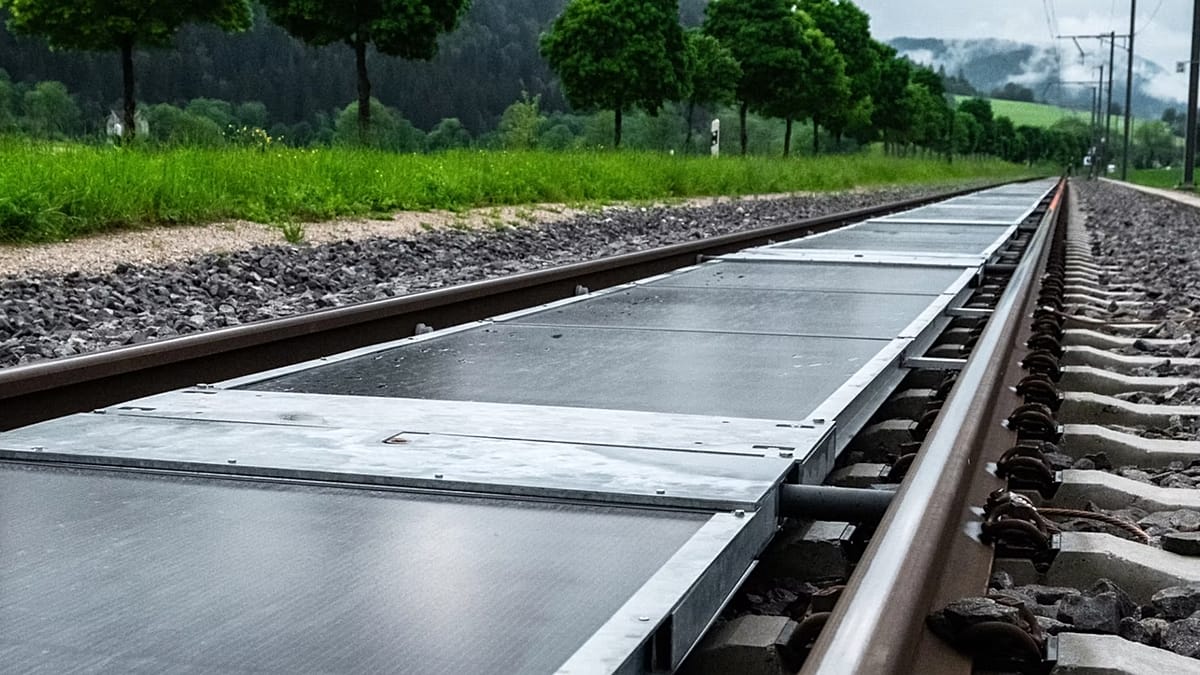
It’s like solar roadways, except once again trains are the natural evolutionary end point
Musk will do it better with tunnels full of self driving cars that are recharged in real time from the solar panel roads they are driving on!
Nah, the tunnel needs to be surrounded by magnets that induce a current in the Tesla as it drives through. That current can then be used to charge the Tesla.


Ok but now my brain is thinking we may as well strip it down as much as possible, just use the magnets to move metal boxes with wheels like a railgun
No. This would require the driver to keep the car perfectly aligned… Unless…
What if we used some sort of auto-steering system. Like, if the wheels had no ability to go anywhere other than the track.
And metal wheels on a metal road is going to have the least friction and least wear and… oh fuck we just re-invented trainsThe carcinization of transportation
that’s literally any maglev train in use in China or Japan.
“We can put solar panels in the tunnels! Give me another trillion!”
It’s like carcinization, the tendency for everything to evolve into a crab body plan.
Railinization? The tendency for every hare brained tech idea that touches transportation to evolve into railroads?
trains are just arthropods with wheels instead of legs.
- Body consists of a hard shell rather than a skeleton ✅
- Multiple locomotory limbs ✅
- Small limbs at the front of the face ✅
- Smooth top, greebles on the bottom ✅
after rolling out 100 metres of photovoltaic (PV) panels in between active tracks
One of the biggest concerns, previously expressed by the International Union of Railways, is that the panels could suffer micro-cracks, lead to a higher risk of fires and distract train drivers due to reflections
Built-in sensors also ensure they work properly while brushes attached to the end of trains can remove dirt from the panels’ surface.
Yeah that doesn’t really sound like a resounding success IMO.
Just put it on a house?
Concerns don’t mean it’s a problem, just that it was identified as a possible problem. Did this study bear these concerns out? From the article, right between two of the paragraphs you copied:
Sun-Ways has tackled these issues by building more resistant panels than what would be installed on rooftops, fitted with an anti-reflection filter.
Also, yes, install them on houses. We can do both. We should keep putting them just about everywhere they work until there is no added benefit or there is no more fossil fuel being used for electricity.
Sure if we can do both! But it seems like lots of easier options are still untapped in many places, like the sides of the rail right of way.
I still dont understand why it’s so important to have them along rail lines. Why not just build a regular solar farm?
The space and right of way is already procured, and the space between the tracks can’t be put to other beneficial use.
It’s to awe the masses, there is no other benefit.
@Valmond @supersquirrel Ah, the reflection thing. There was concern about that in the vicinity of #Cambridge airport.
But the really naïve response would be “surely the panels are designed to absorb sunlight, not reflect it?”
At certain angles it would be good to reflect light, as it cannot easily be absorbed and converted, and would otherwise just heat things up, which is not what you want for solar cells, they get very very hot already.
Pretty ridiculous idea on the face of it but who knows!
This coupled with solar canals would be amazing.
Solar highways as well.
Ok, but we don’t have much open canals here. We even revert straightened streams from the 1900s, because they have severe disadvantages, especialy in ecology and flood control.
solar fricken railroads?
This idea makes a thousand times more sense because they’re not trying to replace the load-bearing surface with an expanse of expensive and delicate glass, they’re just filling in otherwise unused space
You know what makes more sense? Putting them on homes. Solar railways are a pointless attempt at some money from the company involved. They are not practical.
I agree we should be putting solar panels on roofs. I disagree that this railway solar idea is impractical. If this article is to be believed they have already demonstrated effective operation at pilot scale. They mentioned some challenges specific to this application, but they also seem to have compensated for them
The challenges are what makes them impractical. The company has investment it needs to repay, so it obviously wants to tell you it’s not a big deal. It’s much more cost efficient and solar efficient to install them on roofs of homes and building, create shelters from them, or simply just make a field of them. Things like “solar railways” should be a last resort, after we have already covered the obvious solutions.
I don’t think it’s a slam dunk case. There’s lots of costs associated with installing solar on a roof that may not apply here. I think someone would have to do a comparative lifecycle analysis
This one makes a lot of sense though. You have a built in way to clean the panels through the trains, the panels are protected by the rails, and theoretically nothing should be putting weight on them (in practice the weight of a human or maybe a cow - at most)
Plus railroads last a very long time. Basically until we rip them up
We don’t need a solution to transition away from fossil fuels, we need lots of solutions. We really should be putting up solar panels anywhere and everywhere they will survive for at least a few years. Even if it’s 70% as productive as a properly angled panel, so what? We don’t need to min max here
We need production ramped up and capacity online as fast as possible. If solar railways become a new source of demand, that means more investment in both
the panels are protected by the rails,
Think a little harder.
Instead they just put it in a place where they have to be disconnected and removed to reballast or tamp the permanent way, or for railhead grinding, or for sleeper replacement, or for any maintenance task that needs access between the tracks…
I certainly have never done maintenance on railroad tracks. Do you think that’s more frequent than maintenance that needs to be done on rooftops?
Yeah by a long shot. Railroads spend 1-3% of the capital cost on maintenance. So if it cost $3 million to build a km of track they spend roughly $30-90k/year. It might not look like it since tracks are just kind of always “there” but there is a decent amount of work you need to do pretty much constantly.
The stones underneath the tracks and sleepers is called ballast and it needs to be rough, angular rock of a certain size. It’s an engineered fill material that’s designed to lock together and hold the rails in place. Every train that passes by does a couple of things at once. It cyclically loads the ballast and breaks down those sharp edges that lock it together. At the same time the force of the wheels on the rails contributes to fatigue causing microcracks to form on the rail surface.
If you leave rails unmaintained long enough (by gross tonnage BTW. Rail can last a long time if it’s hardly used at all) the track will start pumping, where it compresses and expands as each axle passes over it. You’ll start lifting the subsoil up into the ballast ruining its ability to hold the track in alignment even more. Also, microcracks can combine enough that the railhead begins spalling and eventually the cracks can combine enough that the rail itself can fracture well before it’s service life tonnage.
To fix this you have to tamp ballast every X number of tons, grind the railhead every Y tons, and replace the ballast every Z tons .etc
Basically every part of the permanent way is some kind of wear item that needs maintenance. Mind you, only mainline track needs to be perfect. As long as speed limits are low enough along with an inspection, you can run on degraded secondary rails or spurs safely. It just wears it out even faster.
An American rail section that last saw maintenance when reagan was elected
Fascinating!
I have seen these hulking machines sitting on the tracks sometimes, I think the manufacturer might be “comaco” - is that what does the tamping/grinding/replacing?
There’s a huge variety. Grinding trains usually travel at around 15-30km/h (depending on what model of grinder, how badly the rails need to be ground) and it looks like what Hollywood thinks an emergency brake application looks like
They usually have a water tender at the end with a water cannon to spray down fires started by the grinding train itself.
Railway ballast cleaning to remove fines and tamp
This level of cleaning is expensive… Normal freight lines don’t need this level of replacement except maybe every 10-20 years. But they do need their ballast tamped every so often to make sure you compact voids and re-lock ballast together.
Incredible videos
rocks, sand, parts, snow, ice all land between those tracks.
The article mentions reinforcing the panels and also adding “brooms” to the underside of the trains. I don’t know how it will shake out but it’s possible with the brooms they get cleaned more regularly than rooftop ones. Perhaps it will be important to leave gaps so that rocks and train parts can fall down between them as they are swept off (thus hopefully limiting damage to a single panel)
or just put panels on flat top buildings and cover parking lots.
I got some very interesting information from someone who seems to be quite experienced in railway matters in another part of this thread.
I have learned that this gap in the rails is much more ‘busy’ then I originally assumed.
Either way I frankly think we should put solar panels just about everywhere. I don’t think the current limiting factor is panel supply, I think it’s instalation bottlenecks but I could be mistaken
Was bedeutet das für Hessen?
I remember reading about this a year or so ago and just a tsunami of comments about why it was unfeasible. Have to love internet experts.
We just had that topic: https://lazysoci.al/post/48713985
Yes, this is after that test.
Not really. We are still a bit more than one year into the three year trial.
For his part, Joseph Scuderi hopes to shorten the duration of the pilot project in Buttes – set at three years by the Federal Office of Transport – and to obtain final approval quickly. “We have demonstrated that the solar plant between the rails is safe. The sooner we obtain final approval, the sooner our partners abroad will also be able to move forwards.”
We have demonstrated that the solar plant between the rails is safe.
But nothing about reliable. It snows in Switzerland.
Might be that the trains blow it away. But I also hope it does not get shortened, three years seems about right to me.
I’m interested to see how it impacts maintenance for the permanent way. I don’t think it helps at all… Reballasting, tamping, changing sleepers, railhead grinding .etc all need to go places where these panels are, so now you have to remove them, do your maintenance, and put them back?
I can’t find the article, but when I first read this news a couple of days ago, it mentioned that they could remove each panel in something like 10 minutes and it was as easy to put them back. I’ll look a little more and see if I can find it.
EDIT: Here is one of the news article that mentions it. Not the one I saw, but whatever. https://www.europesays.com/ch/96202/
The issue is you need to grind the tracks multiple times a year on busy routes, along with ballast tamping or replacement. That’s set by total gross tonnage not by a set time span, and these maintenance items are not optional. Tamping prevents pumping and rail fatigue which can be catastrophic if you allow it to degrade and suddenly fail. Rail grinding removes microcracks created by fatigue due to every wheel passing over it. Grinding deletes the cracks, but if you leave it for too long the cracks grow and can total the rail. 10 minutes per panel is a long time when you need to maintain tens of thousands of kms of track.
Even a short distance between two towns is a maintenance headache. It could take weeks to remove the panels entirely and that’s before you get started doing maintenance at all… All you’ve accomplished is removing a maintenance obstacle you put there in the first place. Then you have to put it all back when you’re done…
A railroad typically spends 1-3% of the entire cost to build a km of track just to maintain it every year. That’s a big operating cost that eats into rail budgets already (part of why I believe they should all be nationalized to better align public incentives with a natural monopoly but that’s beyond this conversation.)
For reference, most rail costs around $1-3 million per km to build, $5-10 million or more within urban areas due to land acquisition. Typical railroad maintenance is somewhere around $10 000-$30 000 per km per year with unrestricted access. 20 mins round trip per panel (probably half an hour with deadtime between panels moving tools and gear) that’s a massive amount of increased costs and more importantly service interruption. You can’t pass revenue traffic when they’re doing this.
I’m guessing that the picture in the OOP article is standard gauge at 1435mm, so I figure each panel is roughly 2m long? 500 panels per km roughly? 5000 minutes to remove, let’s say 15 min to be more realistic on pace, so 7500 minutes. That’s 125 person-hours per km to remove panels. Maybe a team of 2-6 and a backhoe on track wheels? At an average wage of $60/hr for a team of 2 people that should cost $7500 just to remove panels from 1km of track and it would take 5.2 days of labour, at 8 hour shifts that’s 15.625 days of labour, let’s say 16 days. 2 weeks and 2 days at $7500 and you have to do it all over again to put them back in place. You would need to do that at least once a year, probably multiple times though.
I’m also accounting for the cost of machinery in the wage number. Maybe it would be closer to $40-50? But I’ve also always heard to take the wage paid to a worker and triple it for the true total cost once everything is considered (unemployment, health and safety, tickets .etc) so the total bill for round tripping panels off and on could cost almost as much as normal maintenance on the permanent way?
How easy are they to steal?.. asking for a friend… who needs panels for his house… yes lets go with that
Probably similar to stealing them from a field, just with more risk of getting hit by a train