


At this point, I don’t really understand the point of reductive arguments like “it’s just a next-token predictor” in regards to LLMs. Even claims of “it’s not useful” (not even limited to “not useful to me”, just flat out “not useful”). There’s always the response of comparing any argument to humans, e.g. “humans can generate bullshit too”, but even aside from that, the proof is in the pudding, so to speak. AI is doing interesting things.
There’s downsides like power usage and centralized control by capitalists, but IMO those are problems to solve, not reasons to pretend AI is just hype.
This article is a thinly veiled advertisement for ChatGPT. It’s actually about some guy called Bloom who used ChatGPT to build a web site.
I don’t think that’s a fair take. The website Bloom built is useful background for why this is big news, and how we got here. But this isn’t just about Bloom:
And, on May 20, OpenAI shared a solution (opens a new tab) to the unit distance problem, along with a blog post (opens a new tab) explaining the work and a companion paper (opens a new tab) that featured nine world-class mathematicians commenting on the correctness of the proof and the importance of what had been done (as well as presenting a streamlined human version of the result). Mathematicians had generally believed that Erdős’ conjecture — about how many evenly spaced points can be placed on a plane — was correct. To general surprise, OpenAI’s internal model found a counterexample. To do so, it had found a sophisticated way to use tools from an area of math called algebraic number theory. As Jacob Tsimerman (opens a new tab) of the University of Toronto wrote in the companion article, “This is a really impressive piece of work. … It is definitely an intimidating construction.”
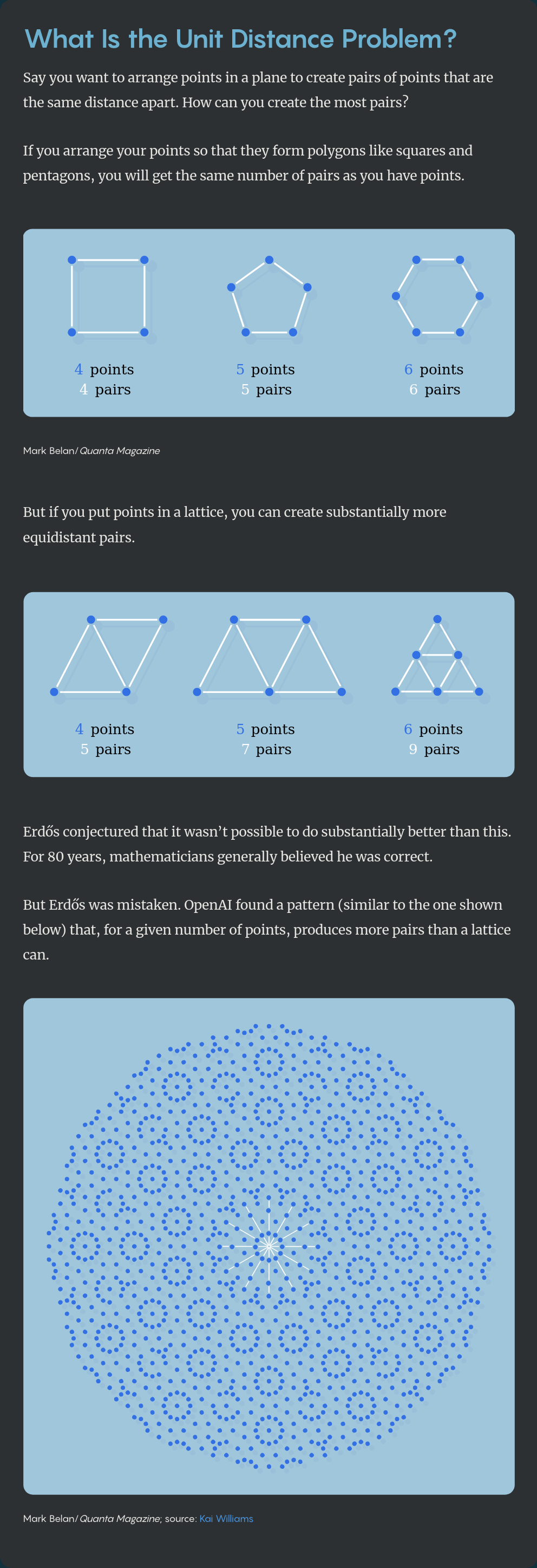
That’s an impressive, important result.
