
You must log in or register to comment.
Vultures have been shown to reduce the spread of dangerous infectious diseases at scale.
4 paragraph quote
From this perspective, each vulture species features peculiar skin microbiota compositions, likely involved in singular protective mechanisms of which characterization is yet highly desirable, acknowledging the potential implications under diverse applicative fields. Altogether, state-of-the-art knowledge pinpoints that the cutaneous microbiota constitutes a barrier of microbial, physical, chemical, and immunological nature for the skin [25]. Skin microorganisms represent the first physical barrier against exogenous microorganisms of environmental origin [25]. Here, pioneering microbial specimens promote physical hindrance against the secondary colonization of pathogenic specimens, aside from establishing direct connections with the host, aimed at regulating the differentiation process of keratinocytes [26]. By employing various mechanisms of resistance to colonization, such as competition for nutritional resources, direct inhibition, and/or interference with environmental survival [25], cutaneous microbiota enable, de facto, a microbial barrier that protects from the myriads of pathogenic microorganisms encountered in necrophagic activities [4]. Intriguingly, health-promoting strains of the Staphylococcus genera adopt fine mechanisms to antagonize pathogenic strains of the same genera (e.g., quorum sensing, antibiotic production, etc.) [27,28,29].
…
Vultures contribute significantly to maintaining ecosystem homeostasis. Part of their food intake is released as nutrients through their feces, promoting a cycle of nutrients that supports a healthy ecosystem [90]. From this perspective, efforts in the characterization of the fecal microbiota would elucidate the ecological service necrophagic birds provide to other animal species. Furthermore, vultures have been recognized for their public health benefits, primarily because they can efficiently dispose of vast quantities of inadequately managed carcasses, thereby maintaining adequate levels of hygiene in the ecosystem [5].
The pivotal role of the vultures’ unique ability to contain pathogens is attributed to the microbiota associated with the different anatomical districts of their bodies, with the cutaneous microbiota as the main actor [4]. Unlike other animals, vulture skin microbiota is the most populated in terms of microbial abundance and biodiversity. This is likely due to dietary style, since carcasses carry diverse and more specialized microbial communities, interfering with skin microbial development. It can be hypothesized that the taxa identified derive from the dead animal body, such as Methanobrevibacter smithii present in the intestinal district of the dead animals, or from environmental sources like, for example, Xanthomonas spp. and Actinobacillus pleuropneumoniae [4].
Genes identified in the facial region include elements correlated with putrescine [47], one of the main molecules produced in a decomposing carcass, confirming the influence that the carcass microbiota has on the assembly of the host’s microbiota. Further support for this hypothesis comes from the extensive functional diversity observed in microorganisms residing in the facial region. It has been observed that these range from producers of antimicrobials to normal intestinal bacteria and bacteria linked to plants and soil [4], agreeing that there is a significant influence from the environment and carcass on the composition of the facial microbiota. In this regard, determining the carcass microbiota would be necessary for further evaluation of this hypothesis.
The cleanup crew doesn’t fuck around
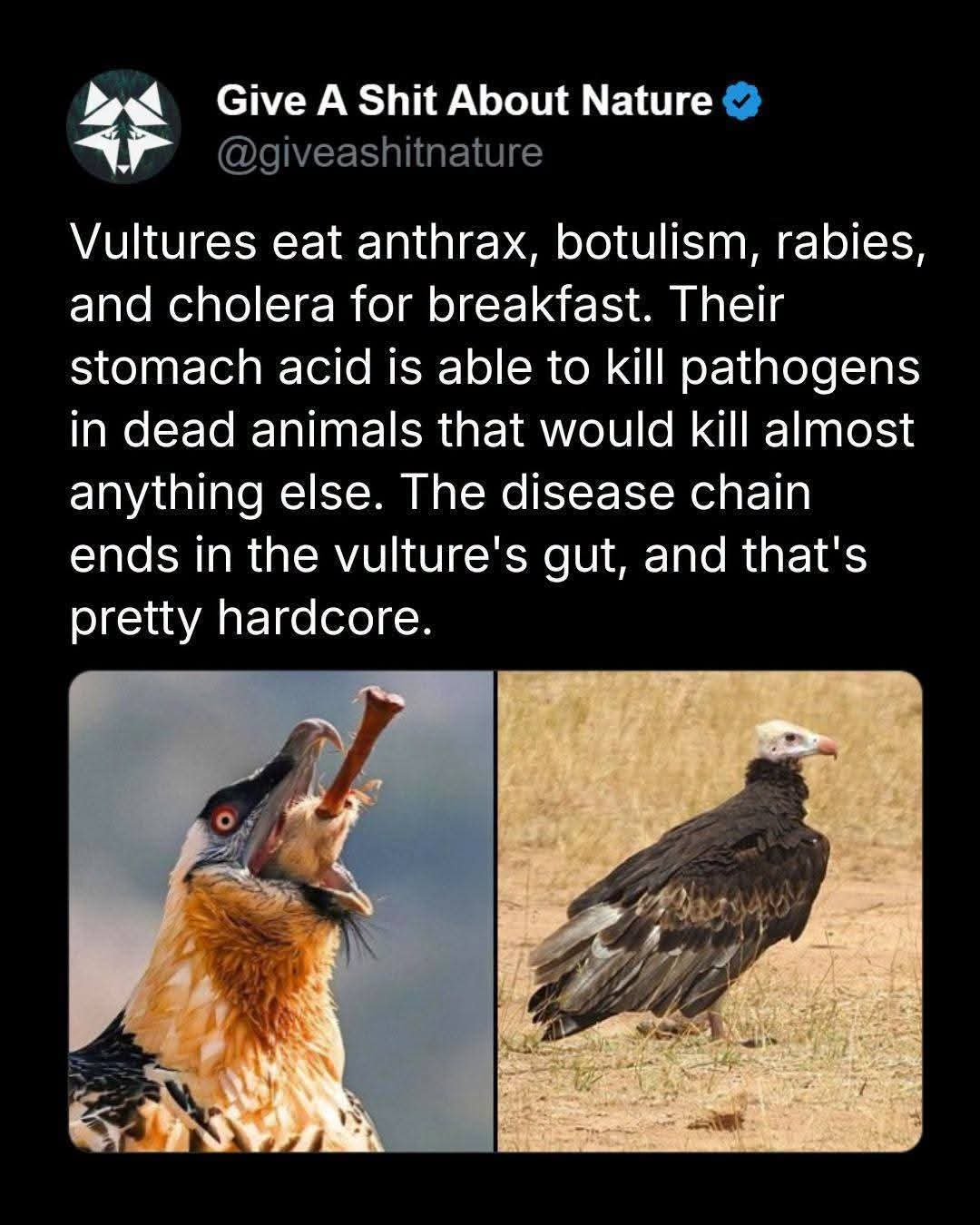
that would kill almost anything else
Guess what: It’s fact check time!!
Anthrax: ❌
Most birds are naturally resistant to anthrax because of their higher body temperature.
Botulism (actually botox, botulism is the illness caused by botox. You can’t quite eat an illness): ✅
“Botulism is one of the most toxic substances in the world, and [turkey vultures’] guts are filled with this bacteria, which apparently has no effect on them,” says Graves.
(Yes, the article made the same mistake)
Rabies: ❌
All warm-blooded species, including humans, may become infected with the rabies virus. Birds were first artificially infected with rabies in 1884; however, infected birds are largely, if not wholly, asymptomatic, and recover.
Cholera (actually avian cholera, which is distinct from “normal” cholera): ❓
Besides chickens, the disease also concerns turkeys, ducks, geese, raptors, and canaries.
So 2/4 diseases are already irrelevant for birds but they sound scary because they infect humans. But:
Avian cholera barely even counts because it’s caused by “Pasteurella multocida” while (human) cholera is caused by “Vibrio cholerae”. The two bacteria are genetically as closely related as humans and mammoths. And avian cholera does not kill anything but birds.
–
This isn’t to degrade the vulture’s ability to withstand pathogens and toxins, that is still very impressive. It’s just that obviously birds are immune to most human diseases, as pathogens don’t tend to easily jump between distant species.
And even if they DO jump between species, they usually do not bring their “deadliness” with them (unless they produce poison like botox) as different species react completely differently. Maybe rabies is the one exception, as adjusting the behavior of your host by rummaging around in the brain has some universally negative side effects.
Just wanted to note that botox is actually just a shortening of botulinum toxin. The organism that produces it is Clostridium botulinum.
Now if only we could bioengineer our own stomachs to be that powerful
There are sure to be tradeoffs which would explain why not every animal have evolved similar stomachs. It’s probably expensive energy wise to maintain that acidity. It probably also makes it hard to maintain a healthy gut flora. Also imagine the burn if you vomit up stomach acid with pH 1.0
Yep, that’s also why cooking food helped us quite a bit with evolving the brain, less energy used to in the stomach = more energy for the brain and muscles
probably has a very thick mucus layer, plus a robust stomach to withstand the low ph.
In the game Mass Effect, the Krogan race has all these “backup” organs. They pretty much evolved to become incredibly resilient.
But they also become alpha douches.
Either way, I love those little guys.
Krogans were heavily inspired by Klingons.
Human stomach acid is as low as PH 1.5
We are descended from scavengers
The acid we make is PH 0.8, it goes to 1.5 when mixed with the other gastric juices
Then why is food poisoning so common?
I presume it’s because some pathogens are adapted to us, or it’s because of our changed diet since the agricultural revolution 10k years ago at most, or our population density and food production and transportation system causes greater exposure to pathogens, or done mix of all those and probably more
The modern world is pretty complex
so you’re saying vultures are basically flying garbage bins?
That’s bin chickens.
Sadly the drugs we inject into cows, mainly NSAIDs, cause them to go into liver failure. This lead to large declines in populations, which in turn caused even worse problems because they weren’t eating the diseased carcuses, so other animals would eat them and spread the diseases. Fun times when we think we can control nature.
its diflenic, the nsaid, like most nsaids they mess with the stomach acid of people(causing acid reflux, and likewise it has a greater affect on the vultures.
Close, NSAIDs cause stomach problems in humans by preventing the prostaglandin-mediated acid balance and decreasing mucosal secretion that normally protects the stomach from the acid it produces, but that’s not what’s killing the vultures.
The vultures generally die of kidney failure, which can be a problem in humans, but generally not at commonly used doses as long as no other interacting drugs are used or other kidney problems exist in the person. The exact mechanism for the kidney failure in vultures is not known, however, and thought to be different to how NSAIDs cause kidney problems in humans.
My dog eats a lot of nasty stuff too. If it’s not any good, it comes back up.
Fun fact: rats can’t vomit.
A sea cucumber eats and shits through the same opening.
Most species have an anus at the other end but they all breathe through their cloaca
That’s one of the reasons humans and dogs created such a good symbiotic relationship. They would eat things, like waste and refuse, that if left around would make humans sick. They got an easy meal and we got protection from food borne illness and rodents.
I remember reading an article once about how difficult it is to make dog food. Because they have to make it appealing to dogs while at the same time not making it so gross that humans would be turned off at the site and smell of it.
the pic on the lef tis a beared vulture, lammageir, its stomach acid is has unusually lower ph(high acidity) compared to other vultures, because its bones. the acid also destroys bacteria, parasites and viruses , mostly.
How insanely toxic is their poop though?
thier poop still carry pathogens from the carrion they eat.
There’s a neat Turkey vulture that likes to hang out on the roof of my garage. The neighbors have a wide open field behind my house. I’m pretty sure he lives nearby.
You should get checked out by your doctor, maybe he knows something you dont.
Vultures are metal af.
I’ve always wondered about this. The bacteria itself isn’t usually the problem, its the compounds they shit out right? So like, are their livers just beastly? How are they metabolizing all those crazy nerve agents?
Our stomach acidity is pretty low too.
Looking it up I just read that our gastric acid is produced at PH 0.8
It’s immediately increased to PH 1.5 by the other gastric juices, then is increased more as it is used to digest
People who eat one or two meals a day probably have very acidic stomach acid at each meal; those who snack constantly or eat 5 meals a day probably never see strong stomach acid except maybe at breakfast