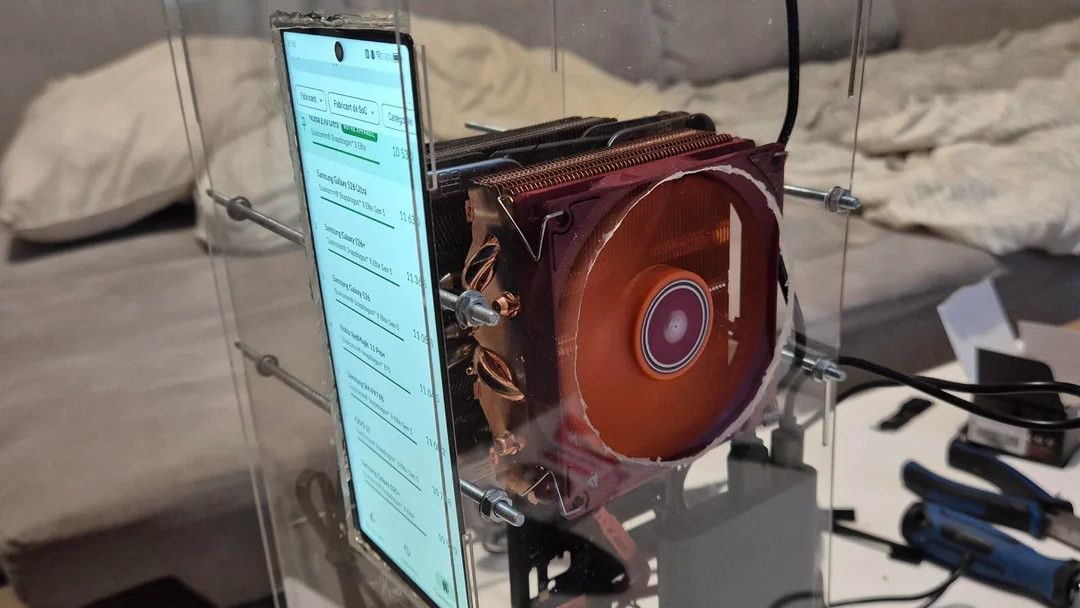
On the software side, the Redditor explains: “I’m running a full XFCE Linux desktop through Termux, with GPU acceleration, plus Windows apps/games. The goal is basically to use the phone as the whole PC.”
Quite a few Redditors are asking how this system runs PC games, and the answer is via Wine and Box64, or in some cases, using GameNative, an Android emulator.
So, hold on. There is Android, running Termux, that runs graphical stack, that runs WINE. To me it feels like there is so much translation going on in here, just because of binary blobs
It’s worth noting that Valve is working on this very thing with their “Steam Frame,” and so support for this is likely going to expand in the future.
But, you can try it for yourself right now. GameNative is free and it works pretty well. Clearly, not every phone is powerful enough to play Witcher 3, though.
My phone is just a mid-grade Moto G Stylus 5G 2024, but I was able to get small games like Megabonk and Placid Plastic Duck Simulator running just fine.
I will note that I had to change the container -> graphics -> graphics driver setting to “system” in order to have it work.
deleted by creator
GameNative uses FEX.
While I agree that ARM Linux is superior to Android in a lot of ways, Valve’s work on FEX will benefit Android as well.
Android is sufficiently Linux still (having it as a kernel and all) to run Linux binaries as long at you can supply the dependencies. FEX + Wine/Proton does most of the job for you, and works on Android too.
The other interesting Android related thing Frame does is Android app containers, which will help Android emulation on PC in general. (inb4 Gamenative on Frame)
GameNative, an Android emulator.
“Why would you need an Android emulator on Android?”
Searches… It’s a PC emulator for Android.
A, the Linux subsystem for Windows naming question. What direction does the reference go!? 🤔
WSL2 also known as a virtual machine container
Its neat, kind of dangerous for your butt if you like to play a quick game while you poop
And your phone. Even light games makes my s24u hearts up like a hot plate
I’m running a full XFCE Linux desktop through Termux, with GPU acceleration, plus Windows apps/games (…) via Wine and Box64, or in some cases, using GameNative, an Android emulator.
Even with a beefy phone, I’m surprised such levels of containerisation don’t create bottlenecks.
PS: this is not a Linux phone - it’s an Android phone running a Linux container.
I thought termux didn’t have GPU pass through. Maybe things have changed.
Still got some snapdragon 645’s so I can actually play around with this.
Sad everything only works for snapdragon first and foremost.
The biggest problem in ARM is graphics usually, much less standardized
@TheMightyCat@ani.social be like
It really is a dream of me to make my own hardware, if I can get enough of a financial buffer from the FP6 work to absorb the financial risk I really want to do it.
Which im also why I’m never starting a crowdfund like the liberux nexx that failed, I’m making the financial buffer from genuine work first, and then it’s my money on the line, and the community won’t be at risk of getting nothing in return.
The work on the FP6 wad really a good entry for this, when I first opened the wire diagrams I had no idea what I was looking at, now I know how to read them, and crucially make my own.
As far as I know the only competitor in this space is pine64, and I really disagree with their mentality. Their mentality seems to be make the hardware, get the community to make the software for free while they earn the money.
That’s not what I want to do, I want to make the hardware and software. Everything open source so people can contribute if they want, but I’m not outsourcing my software development to unpaid community members.
If and I repeat if I do this, I would open source all the hardware aswell so people can assemble it themselves. Like the FP6 currently in my shop buying from the shop buys you convience, not features. And I think that is the most ethical way to run a business.
Lemmy, I am disappointed in you that a redditor did this.