

If you’re planning to buy a GPU in the 2020s it’s probably best to aim for late 2023.
Just avoid nvidia. AMDs RX 9070 XT is still a solid deal. I bought one two weeks ago for under $700. This thing is fantastic, plays everything Ive tried and the open source drivers on Linux are a breath of fresh air compared to the nightmare of nvidias drivers
If one is on Linux I’d urge to avoid NVidia like the plague. Replaced my 4070 Super with an AMD card and I’ve had zero problems since.
Ah yes “Go for the 8GB card” you know, the same one we’ve been telling for years to avoid because of its limited vram capacity.
Ah so the price hike is finally here after years of price stability…
I’m avoiding computing I guess… I won’t pay those absurd prices, and I will not every pay for cloud bullshit.
I’ll abandon computing and the internet if it comes to it.
I got a used 3ds and dsi and been loving it. Love them more than my switch. I’ll go for vintage hardware and vintage games if needed over paying for cloud computing.
Hot take, developers should start optimizing for 4GB of VRAM or less. I’m personally just fine with a 7th-gen console level of detail at 1080p60, and I’m even willing to settle for 720p30.
Then again, most of the games I play these days are literally from the 90s, so what do I know?
Nah I’m happy with 720p even for modern games - ideally 60fps but i’ll take what I can get. I have a 1440p monitor and 720p looks good on it as it’s an exact 1:2 ratio
Didn’t know it was an integer ratio, I will try this on my 1440p monitor as well!
I would recommend using a tool - don’t rely on your operating system or the game for upscaling. Lossless scaling works incredibly well for this. I’m currently playing FTL (720p pixel art game) on my 1440p screen and it looks magnificent with this tool set to integer scaling. Razor-sharp pixels instead of the blurry, mushy ones that it suffers from with its built-in upscaling.
None of this makes any sense with 3D games though, of course. You have to be blind to play 3D games at 720p on a modern display.
What’s the point of using a lower resolution if not for demanding 3D games? Unless we’re talking 240p for CRT gaming, but that’s a whole different thing.
It only makes sense to use a modern resolution with a modern upscaling method like FSR4 or DLSS for 3D titles. Just turning the resolution down gets you a terrible experience, because these games were designed for higher resolutions. Details - including ones that are important for the player reading a situation, e.g. seeing enemies and enemy behavior - get lost in the visual noise from pixelation.
You can easily simulate this effect by watching a YouTube video of a modern title at a low resolution. With some recent games, even 1080p is actually too low.
What I really wanted to know was why you were using a lower resolution for 2D games, but it turns out you’ve already gone over that in a different comment.
IMO, low resolutions for 3D are still valid particularly if you don’t have a recent GPU, and the idea that 1080p is “too low” for some modern games honestly really bothers me. I feel like 720p should be enough, and that developers are doing something wrong if they can’t scale their UIs to fit that properly.
It’s often not the UIs, it’s that games are so visually dense now (foliage, hair, texture detail, draw distances, small animations everywhere, effects that are heavy on particles and transparency) that lower resolutions don’t work anymore. I first noticed this during the last gen, watching a relatively low-res video of a then upcoming Forza Horizon game. It was almost impossible to tell what was happening on screen. Granted, compression was also doing its part, but much of it was due to there simply not being enough pixels to display what the developers wanted players to see.
I have also noticed this with some titles on the Steam Deck, which has a display resolution of 1280x800, so effectively 720p with a bit more vertical space. There are games that aren’t all that enjoyable at this resolution. There’s a reason why most competitors in the handheld gaming space chose to use 1080p or higher res screens, even though the can be a challenge to drive with mobile chipsets, but Valve’s handheld is old enough that upscaling that makes higher resolutions possible wasn’t as mature yet.
If you look at improvements to all major upscalers on the market (FSR, DLSS, XeSS and PSSR), they have pretty much universally become better at preserving fine detail, even to the point of giving up a bit of performance for this. They are designed for modern games, after all.
There are still plenty out there that more or less work at lower resolutions, like most e-sports and F2P titles (which also have tend to have low hardware requirements in general). We have reached the point where even reasonably decent integrated GPUs can play fairly recent games at 1080p or thereabouts. 1080p has been the minimum for years at this point, which is also reflected in hardware requirements, where 1080p/30 at low settings is often either directly stated or implied for minimum requirements; more recently, it’s admittedly quite often with upscaling, but that’s a relatively new development, years after 1080p had become standard.
Keep in mind that 720p as a resolution standard is positively ancient at this point. This was usually the target resolution during the Xbox 360/PS3 era (although there were plenty of titles that ran at lower resolutions, as well as a few that pushed up to 1080p), which started 21 years ago. Even four years prior, I was already playing games at 1280x1024 on PC. It’s not outrageous for developers to move on from this, which the overwhelming majority did with the last console generation, at the latest.
deleted by creator
Yeah i tried playing the new halo on 720p “the bad way”, and yeah it was pretty bad. I’m better of just continuing using DLSS performance mode.
I’m curious, why do you want to use upscaling on games that are easy to run? Are you using really old hardware or are the games more demanding than one might think?
No, I’m using pixel-perfect upscaling on 2D titles like FTL, because it simply looks better that way.
Here’s a comparison between the built-in scaler and using integer scaling with Lossless Scaling (but any other tool that supports integer scaling would have the same result):
Built-in upscaling from 720p to 1440p.
Integer scaling (one pixel gets turned into four without any blending).
A tool that allows you to see the difference even on a small screen, with various options, including a slider:
https://twinlens.app/compare?share=2c26f762ee78
As you can see, it’s the difference between blurry, mushed-up pixels and dull colors (since they get blended between pixels) vs. crisp, bright and much more pleasant to look at pixel art. It doesn’t work this way with every game, of course: For my 1440p screen (2560x1440), a game needs to be 720p (1280x720 - exactly half as many pixels on each axis) for pixel-perfect scaling.
It should also be noted that in my opinion at least, this method only makes sense for modern 2D games that are designed for flat screen displays. With old games intended for CRTs, it makes more sense to use a good CRT shader instead. More info on this here.
By the way, this was very annoying to capture. Steam only took 720p screenshots of the integer-scaled image, as did two other screenshot tools I tried. I had to manually upscale the second screenshot using nearest-neighbor scaling (same thing as integer scaling) to simulate what it looks like.
You should be avoiding NVIDIA anyway, AI boom or not.
To be fair, people need to set their priorities straight. Even though these are marketed as ‘gaming’ hardware, are they actually?
I have an RTX 4060 8GB VRAM that seems to have people hating all over it, but I don’t see the point, currently, to buy another GPU. It runs smoothly enough every single game I’ve attempted to run it, including stuff like Alan Wake 2. There’s also the fact that most AAA games that demand a strong hardware are barely worth playing.
But as long as ‘gamers’ keep fixating on the idea that gaming can only be enjoyable when they own the best hardware to run things on 4k, 120fps, almost zero input delay, and whatever the fuck else the market sells as essential for a ‘true gaming experience’, that’s what you get: extremely overpriced hardware, that will never feel enough.
Same experience with my 3070, and expect it to be the situation for a good while still.
Considering where I’m posting this, maybe it’s sacrilege, but I just don’t think it makes business sense to develop a triple A game that can’t run on the consoles - and console cycles have gotten really long.
is here
As in, it wasn’t here a year ago? Two years ago?
Its been here for long enough to set up a tent
I’ve been avoiding Nvidia for a while now. Too much buck per bang.
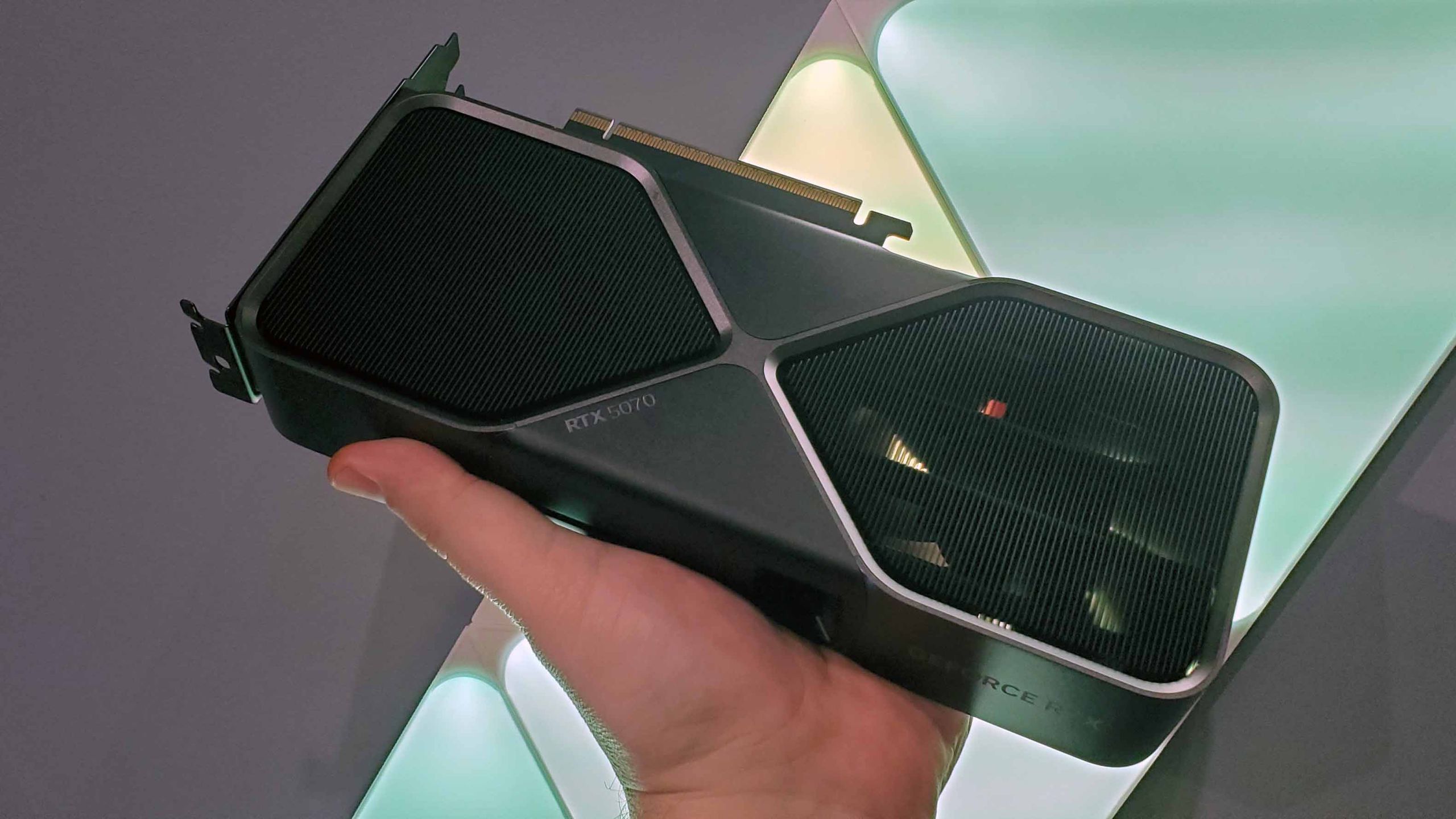
The GPU price hike is here and you should avoid any Nvidia card
with more than 8 GB VRAM, if you value your bank balanceFirst crypto now AI, can the users just asking for a decent GPU catch a break here?
Crypto was limited bad since it only targeted GPU performance. AI targeting DRAM affects EVERYTHING. Phones, TVs, monitors, your router, smartwatches, ANYTHING that runs even a semblance of OS…
Microcontrollers are mostly safe as they use a different structure of RAM (500kB-8MB RAM doesn’t need multi-thousand MT/s, so older tech is useful there).
But everything else is fucked.
What? Nvidia cards have been super expensive for many, many years. Keep your old card- it’s probably fine. If you need a new card get yourself a nice cheap B580 or whatever AMD is on now. Play some older games or just turn off some of the eye garbage. You’ll be ok.
This will be The Year of Optimization (copium)
if you value your bank balance
Joke’s on you, I don’t have a bank balance


