

- cross-posted to:
- socialism
- cross-posted to:
- socialism
There are no memecoins in Busytown. There is no gig economy. There are no junk fees, phishing scams, fine print, higher than normal call volume, deepfakes of Bill Gates hawking fake Alzheimer’s cures, sponsored search results, phony reviews, dynamic pricing. There are no collateralized debt obligations, credit default swaps. The people of Busytown are not followed by an all-seeing Palantir eye that compiles a data profile on them. Private equity has not bought their apartment buildings. There is no slopaganda in Busytown. In Busytown, life is straightforward and things are what they seem to be.
Sometimes I open my copy of Richard Scarry’s classic children’s book Busy, Busy Town just to remind myself how the world ought to function. One of over 300 books Scarry published, Busy, Busy Town is about the world of work, depicting all of the animals going about their jobs. Everything is refreshingly straightforward. At the garage, “when something is wrong with the motor, the mechanic fixes it.” The painter paints the walls. “On Main Street you can buy medicine, tools, apples, and oranges.” When there is a pothole, workers from the city come and fill it.
Economists and politicians often scratch their heads wondering why people are unsatisfied with the economy even when, by conventional criteria, it is “doing well.” I suspect one reason is that the 21st century U.S. economy is just a difficult system for ordinary people to survive in, in part because so many things are more complicated than they ought to be. Compare, for instance, the experience of American healthcare today to the world of Busytown. I’ve written before about how maddening the experience of trying to comparison shop for insurance policies on Healthcare.gov can be. (The New York Times quoted an economist who found the system so complicated that they gave up trying to compare the plans.) I’ve also written about how sponsored search results have made people fall for insurance scams. That’s just buying health insurance, of course. Using it is a whole other matter, and when we think about people who have spent time dealing with complicated medical billing during a loved one’s fatal illness, we understand a bit better why so many people cheered when Luigi Mangione shot the CEO of UnitedHealthcare. (In his confession, Mangione said that when he had posed as a rich investor to get the details of where the CEO would be, he received the fastest response he had ever had from an insurance company.)
It’s not like this in Busytown. When Lowly the worm goes to the medical center, Nurse Nelly, Dr. Lion, Dr. Rabbit, and Dr. Dentist simply take care of him, then he leaves. (Sidenote: why is Dr. Dentist not called Dr. Fox? The inconsistency is grating to me.) And as Current Affairs has noted many times before, it is possible for us to have this kind of system in our world. This is not a children’s book fantasy. You really can have a system where people’s first thought when they call an ambulance is not “How am I going to pay for this?” Dr. Abdul El-Sayed, a leading proponent of Medicare For All, says providing free-at-point-of-use universal healthcare is not only possible, but is necessary because “it shouldn’t be this hard” to attain basic things like being treated for an illness.
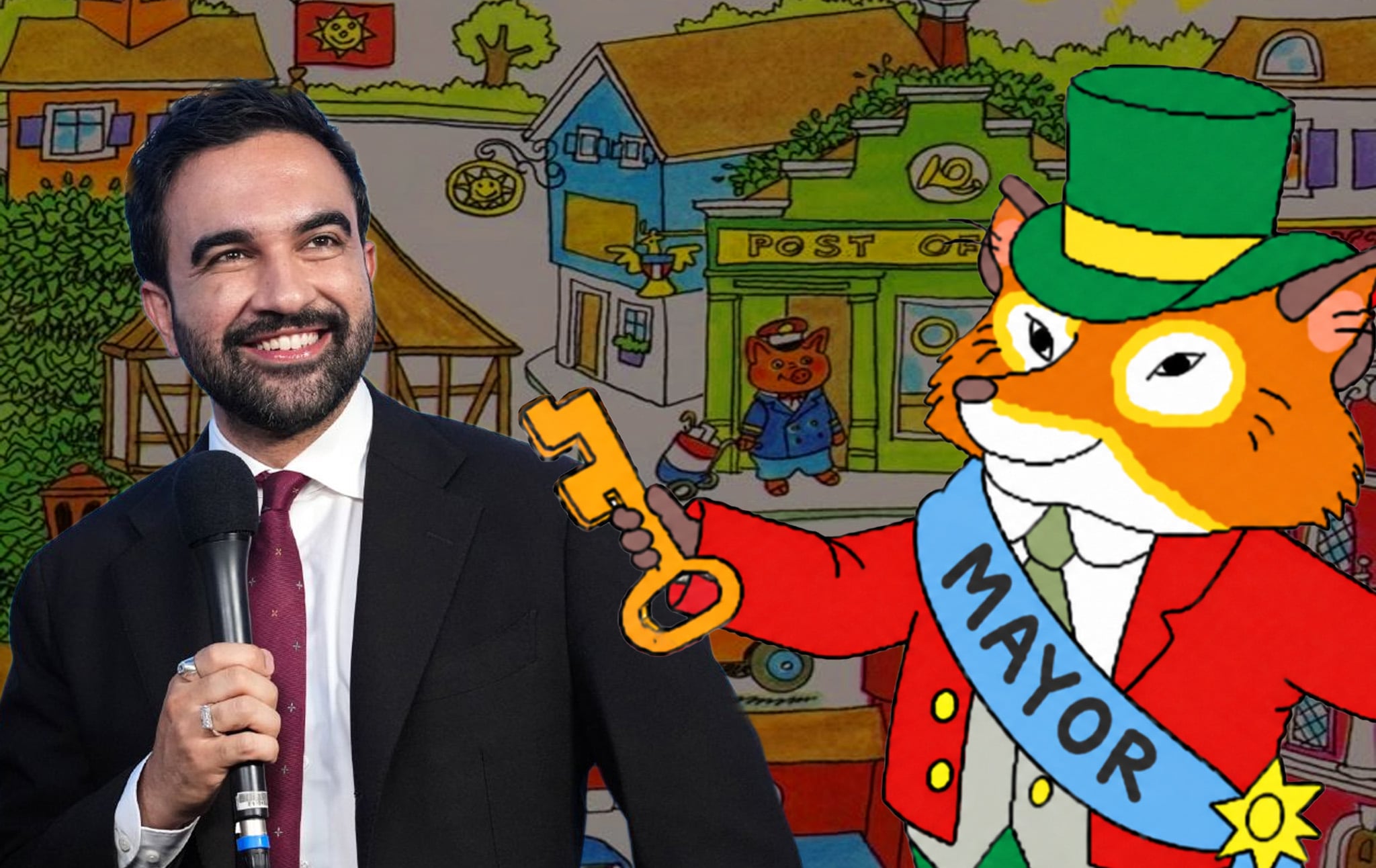
Which brings me to Zohran Mamdani. Now, I know I risk getting a reputation as someone forever coining bizarre types of idiosyncratic “socialisms,” having already written about Mamdani as a “suit socialist.” Marxist purists will assuredly roll their eyes when I introduce another attempted coinage, Richard Scarry socialism, to describe part of what I think Mamdani is trying to do. But I think there is an important way in which Mamdani’s approach to being the mayor of New York has not just been about trying to create a fairer city, but a city that operates a little more like a city in a children’s picture book might operate. The mayor’s celebration of garbage workers and taxi drivers, his promise to simplify city bureaucracy, his promotion of parks and operas and ticker tape parades—I’ve seen more than one person online say that Mamdani seems like a mayor from a 1990s kids’ movie. I can’t remember enough 1990s kids’ movies to know if that’s true, but I do think he seems like he’s trying to be the mayor of Busytown. Sometimes I’m surprised he doesn’t walk around wearing a big sash that says MAYOR on it.
You must log in or # to comment.
When every part of our society, from gov’t to everyday business is running some sort of scam, having anyone act in a straightforward manner is a novelty.
The pigs eat sausages, which is dark, as noted in an article on “animal cannibalism in the world of Richard Scarry.” And as we have noted before, there appear to be subtle class divisions, with pigs doing a disproportionate amount of the dirty labor.
I can’t help but wonder if this is Scarry getting in a jab at Animal Farm.