- cross-posted to:
- techtakes@awful.systems
- cross-posted to:
- techtakes@awful.systems
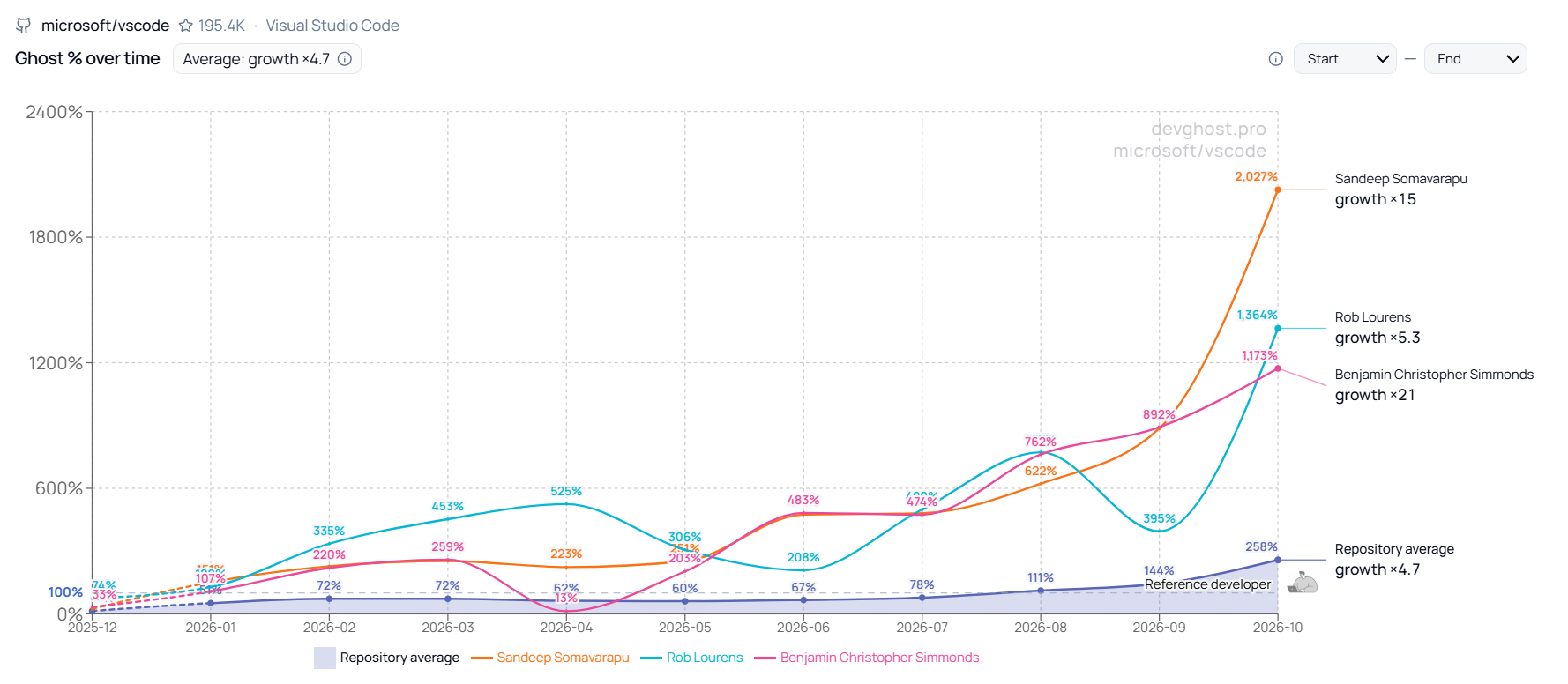
I’m Pavel, founder of DevGhost. We went through the public Git history of VS Code and Ghost. For several developers, our Git-based estimates show a 5–21× increase in the work reflected in their code changes.
Agent traces turn up in the original commits, replies to reviewers and the fixes made after review:
- From October 1 to November 14, 2026, 561 of Rob Lourens’ 564 commits say “Written by Copilot”. Example PR.
- In Ghost, 142 of Hannah Wolfe’s 180 PRs have direct agent traces, including follow-up fixes. Example PR.

The chart’s 15× and 21× labels compare each contributor’s December 2025 output with their own October 2026 output.
Full analysis, estimation method and PR examples.
If you use coding agents, how does the 5–21× increase we saw compare with your own experience?
You must log in or register to comment.
If your problem is “agile velocity” or typing speed, maybe you shouldn’t code. Code is a liability, the less you have it, the better. Unfortunately, LLM folks seem to have quite opposite stand to this. Just to inform, I’m not against the llms, I’m against mindless usage of it just for the sake of using it
FFS. I don’t have any issue with using LLM’s for coding but the number of lines committed is not and has never been an indicator of “productivity.”
Typically, the more lines someone (or something) shells out, the more concerns I have about their quality of work.
And with the proliferation of vibe coding, more lines is an increasingly common sign that the person who made the PR doesn’t even understand the code they’re trying to merge.
I should really tell my bot to start producing lots and lots of lines of code. I want to be 100x.
Exactly! I guess we are back to using lines of code as a metric of value.
Output is meaningless. I could easily increase my output tenfold by writing code as verbose as possible, but that would make me a worse developer, not a better one. What have they actually achieved with that output? Is the software stable and maintainable?
Let’s say on average you have a bug for every 1000 lines of code.
Let’s say you create a PR with 3000 changed lines entirely by hand. That’s 3 bugs on average, and review might find them, or they might end up in prod.
Let’s say you multiply that by 5-21x.
Lines of code are a terrible metric for productivity. This has been known for a long time. The more you achieve with less, the better. Some of the best tools and libraries out there are as small as a few thousand lines of code, and some even in the hundreds.
Looks like they didn’t check whether the 10x is 9 “fixups” until the tenth change is what would have traditionally been the real solution in one change.