
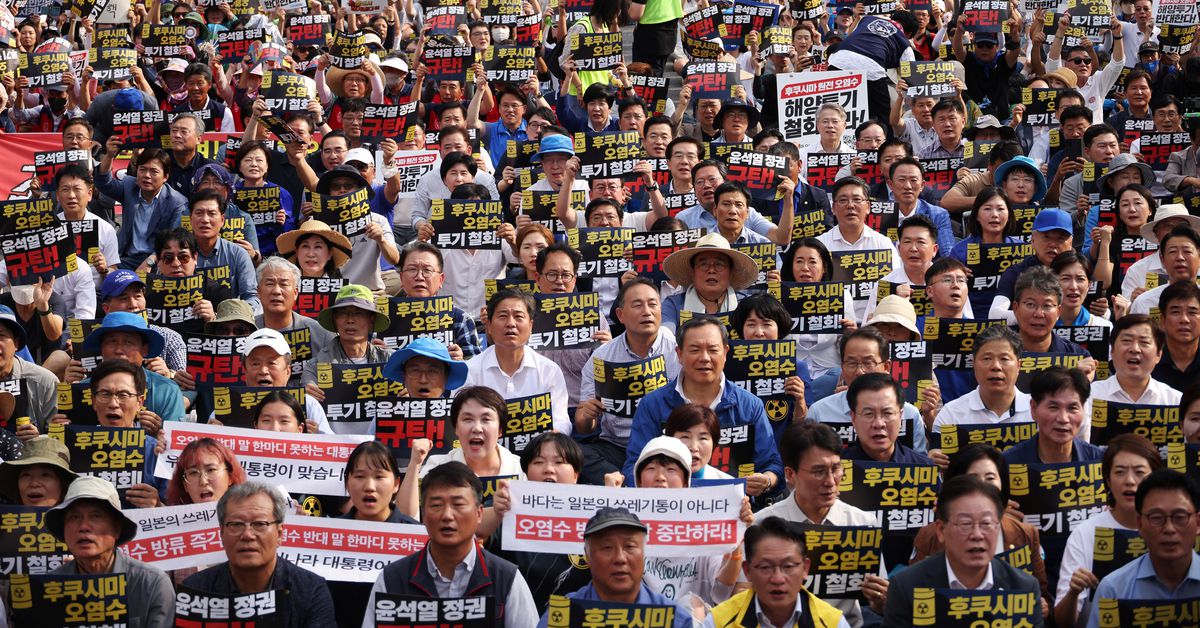
Here in SK right now (yes it’s 4:30am), everyone’s against it but no one knows the data. Once people see the data they’re like “oh”.
South Korea has an inherent hatred for Japan, so this isn’t surprising at all.
The Japanese did some pretty radical things during the occupation. It’s interesting to see the ripple effects of these policies so far into the future.
Japan also never apologised and pretends they did nothing wrong.
I keep hearing about this, but haven’t delved into it.
Usually when they do a water release like this, or there’s potential for contamination to interact with humans in other matricies, such as metals on mines being uptaken in berries and plants used in traditional use (consumption by first Nations), they will do a Human Health and Environment Risk Assessment (HHERA).
These HHERAs look at multiple exposure pathways and consider rates and likelihood of exposure. I find it hard to think that they didn’t do this step with something as dangerous as treated waste water from a nuclear plant.
The plan was reviewed, and tested by, the UN and by the International Atomic Energy Agency and found to be very safe. Here’san article that briefly talks about it.
This is the best summary I could come up with:
SEOUL, Aug 26 (Reuters) - Protesters gathered in the capital of South Korea on Saturday to demand that the government take steps to avoid what they fear is a looming disaster from Japan’s release of treated radioactive water from the Fukushima nuclear power plant.
Japan began dumping the water from the plant north of Tokyo into the sea on Thursday despite objections both at home and abroad from fishing communities and others worried about the environmental impact.
“We will not be immediately seeing disasters like detecting radioactive materials in seafood but it seems inevitable that this discharge would pose a risk to the local fishing industry and the government needs to come up with solutions,” said Choi Kyoungsook of the Korea Radiation Watch group that organised the rally.
Japan and scientific organisations say the water, distilled after being contaminated by contact with fuel rods when the reactor was destroyed in a 2011 earthquake and tsunami, is safe.
Japan’s fisheries agency said on Saturday that fish tested in waters around the plant did not contain detectable levels of tritium, Kyodo news service reported.
Japan says it needs to start releasing the water as storage tanks holding about 1.3 million metric tons of it - enough to fill 500 Olympic-sized swimming pools - are full.
The original article contains 319 words, the summary contains 213 words. Saved 33%. I’m a bot and I’m open source!
If Americans think it’s ok, how about we grab a few tankers and dump it off the California coast?
Two-faced fucks.
Edit: https://www.science.org/doi/10.1126/science.abc1507
The water contains traces of other non-tritium radioactive isotopes. These do bioaccumulate.
It’s not about america it’s about understanding chemistry.
Yeah I’m not sure where Amercia factors into a protest in South Korea, about Japan, as reported on by a journalism company based in the UK.
Because everything is always America’s fault
Generally, the people on these forums are American. It’s white people saying that the opinion of POC don’t matter because they’re not white.
Then y’all shouldn’t have a problem with it, right?
Yet, every single response has been antagonistic because nobody wants this waste dumped near them.
This water? I wouldn’t be concerned with at all. I’d gladly fill a swimming pool with it and shine some UV lights on it and throw a pool party. It would be approximately as dangerous as drinking from uranium glass. I wouldn’t recommend drinking large quantities of the water, much like I would recommend with all pool water, but otherwise it doesn’t matter.
Per this source: https://www.science.org/doi/10.1126/science.abc1507
The treated water contains traces of other radioactive elements that do bioaccumulate. While the water alone is below the legal food limit, that can’t be considered as a fair limit due to bioaccumulation of heavier radioactive isotopes.
They filtered out the majority of the other bio-accumulating isotopes. “Trace amounts” of isotopes exist in every single element independent of nuclear power plants.
But the traces in the wastewater are fairly high, falling just below legal food limits (ignoring that bioaccumulation by definition accumulates toxins from the water into animals).
Where are you reading that? I saw that the heavy metals were all filtered out and this discharge is for the Tritated Water only, with “trace” amounts of the heavy metals, meaning what you would find in normal salt water.
How about linking to a source that doesn’t have a 30 to 15 dollar paywall for non-members? Or at the very least posting the full study instead of straight to the paywall that most people can’t afford.
The paper is also from 2020 so it’s also missing the most recent information and context in regards to the water being diluted and sent out.
Edit: a user directed me to where I could find the full study, and it can be found here Ultimately the study says there should be additional research into the isotopes found within the tanks beyond the tritium found in them.
I definitely agree additional studying should be done, but even then the article doesn’t disagree with releasing the tanks. Instead they would rather wait until the isotopes are more decayed. There is however a risk of tank breach due to possible natural disasters such as tsunamis or earthquakes that would allow these isotopes to be release in a more potent concentration.
So the option is to either release it in lower concentration and diluted water is specific amounts, or hold on to it and hope the tanks don’t breach for 60 years.
My bad - FWIW, Science is considered to be very reputable and should be accessible from most libraries.
The risk exposure isn’t changed, though. The plan is to slowly release it for decades… So if there’s natural disaster, the risk is still there.
It’s Tepco wanting to preserve their bottom line at the cost of human health. Simple as that.
WTF are you on about?
I thought the standing order was to blame Canada for everything?
Quite literally couldn’t care less
This whole thing would legitimately be the stupidest story of the decade in any decade where Donald Trump isn’t making daily headlines.
How far do they dump it from the coast?
0km from Fukushima’s coast, so about 500km from South Korea
They aren’t dumping it. They dug miles of caves below the sea floor and are pumping the filtered water into the caves slowly over the span of decades. That’s why this whole thing is very dumb. Japan is taking enormous measures to do this safely.
Dumping is illegal where I live, you’ll get a fine ;)
Jokes aside, does anyone with a chemistry/physics background know of a technical solution/alternative to dumping? I suspect Japan would not dump nuclear waste in their domestic waters if they could avoid it.
The radioactive component is mostly tritium. As long as they get almost all of the heavy radioactive elements, the hydrogen isotopes are basically harmless in the quantities we’re talking about here. The ocean is a very, very big place.