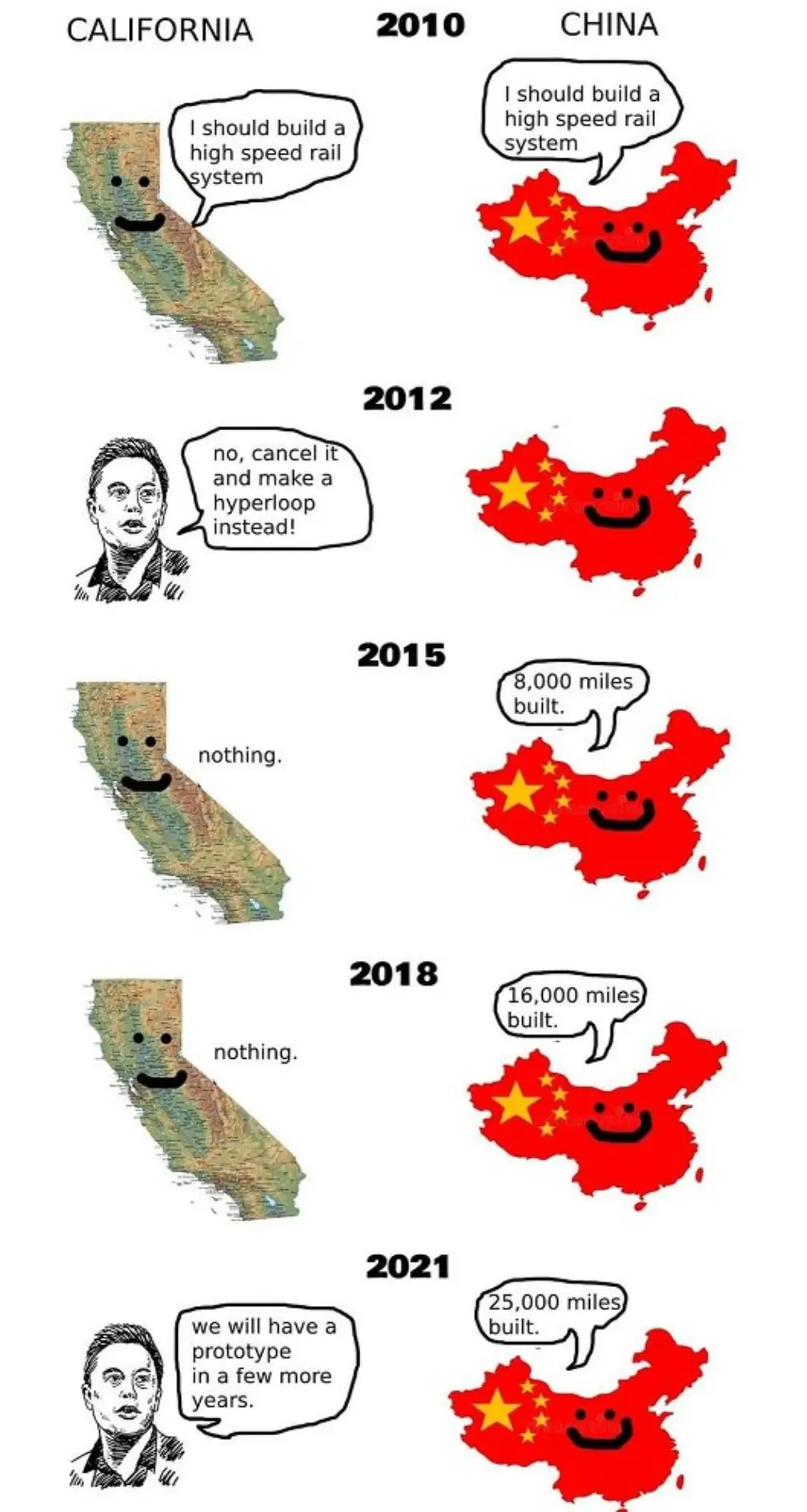
Hyperloop was invented to try to kill light rail. It succeeded at killing Maryland’s new venture and Illinois’. Neither were built because Hyperloop promised bullshit. Elon hates public transport.
Elon’s main thing is selling cars, of course he actively opposes whatever would let people not buy a car.
He didn’t even invent it.
deleted by creator
deleted by creator
guy who sells cars spreads FUD about competition to cars
Hyperloop is against high speed rail, which is for transport between cities.
Light rail is nicer trams so meant for transport within cities.
Wait, what did Hyperloop kill in MD? It looks like the proposed route was from DC to Baltimore underneath MD 295 – we already have Amtrak and MARC serving that corridor.
This is misleadingly reductionist. California high speed rail has made consistant progess in that time. That progress has been slower than ourslowest expectations. It demonstrates the void of expertise the US has in rail megaprojects. However, that expertise is being built, slowly and painfully. Its still forward progress for a nation which tore up half its rail overthe last 50 years.
America invented rail megaprojects.
America still has the largest rail network by far. It’s well more than twice the size of China’s.
The only interesting note is that it’s almost all freight compared to other nations’ use of passenger rail.
Hehehehe
With 0.92% of electrified rail it’s a joke to say that NGL. Absolute numbers are meaningless.
You have to see it into perspective per area then you’ll get to feel how dense and therefore useful the rail network actually is. Because what good is a rail network if you can’t reach your desired location.
And then you’ll see that swiss, Germany and Luxembourg for example end up with less than 10 square km per km of rail while the usa has around 40.
Okay, but the comment implied America doesn’t have the expertise to build a passenger network when it actually doesn’t have the political willpower. It has the expertise to spare, but no one in power actually cares.
That still is not correct.
Planning a high speed high throughput flexible passenger rail network is a whole different beast than laying non-electrified single track lines in a straight line through the middle of nowhere that basically only serves the occasional 2miles long freight train.
The parameters are vastly different and almost incomparable. And America has decidedly no expertise left in the former.
Other than the fact that there are several American firms who have already done it, and even if there was a knowledge deficit it’s the easiest thing in the world for an American company to headhunt foreign talent. Too easy in most industries.
Opposition to new railways is political, be it from establishment organizations or private owners, like in California. That’s all there is to it.
Which ones? Which company actually has put out a consistent, significant, structurally sound high speed rail network including stations and the trains themselves that is based in the US?
And headhunting foreign talent tells me that you have not worked in the rail planning sector. These companies are extraordinarily protective of their high value who are the executive “talent” behind their stuff. And the biggest rail tech companies are multinational conglomerates (Alstombardier, Siemens, CRRC, Hitachi) who have no desire or need to outsource to America.
There is noone currently who has both intimate knowledge of American geodetic planning and high stress track planning. And building that knowledge takes a lot of trial and error.
https://en.m.wikipedia.org/wiki/High-speed_rail_in_the_United_States
While their current average speed isn’t great compared to the highest speed rails in Europe and Asia, it is comparable to the average high speed services, and Amtrak seems confident in their claims for Acela in 2024.
Absolute numbers are meaningless.
You have to see it into perspective per area then you’ll get to feel how dense and therefore useful the rail network actually is
Same goes for the meme tbqh
Thats true. And then America stopped. And then the people who had actual on-the-ground experiance died of old age. Its really another effect of the slow tragedy that is the auto industry
Yeah, but who BUILT our rail system?
According to the documentary Hell on Wheels it was mostly built by a man named Cullen Bohannon with his own hands. When he got tired, he used some Chinamen and I think maybe a woman dressed as a man for a stretch.
Misleadingly reductionist is what /c/memes should be renamed to.
Indeed. We’re fixing the great car mistake at a glacialy slow pace
Yep. All while getting resistance the entire way in spite of the fact that the US regularly funds without question the expansion of highways and building of interstates. Slowly but surely there does seem to be a growing appetite for rail transit throughout the nation and it is possible for more upgraded corridors to be built and if the US can keep momentum up the lessons learned in california can be applied in building rail elswherre
It’s much easier to build rail in places that weren’t designed around cars. Even in rural China people live in condos and apartments with parks between. This helps with NIMBYism and combined with the already large amount of green space left in Chinese cities such systems can be built with the only real concern being the engineering itself. But China is also in a good position for that, as their workforce is incredibly well educated with more engineering talent than they can even fully employ domestically. All that PLUS the political will of a single party state meant it was a very different situation than California.
And that’s before you even consider ridership, where even the best possible SF to LA route would still pretty much require you to get a car or taxi once you get to LA (because LA was basically torn down and redesigned for cars).
In LA it is supposed to end at Union Station, which amazing access to commuter rail, a metro system, which admitly is small, but still can take you to a lot of places, bus rapid transit and it is right next to downtown. Obviously it is not comparable to NY, London or Paris, which are of a similar size, but you should be able to go to a lot of intressting places, without needing a car once you arrive in LA.
I finally found one in the wild!
One what?
A delusional fetishist. I wonder how much time they’ve spent in China.
Are you saying China didn’t build that rail?
I don’t see where I typed that.
So, what’s the delusion? Are you saying California has built comparable levels of HSR?
Thinking “even in rural China people live in condos and apartments with parks between” is hilarious. Tons of rural Chinese still use outhouses and only have communal water sources, no indoor plumbing. They live in simple wooden shacks and cook over an open fire.
I have absolutely no idea where they 're getting the ideas they have but they’re laughable.
edit: though to be clear, their high-speed rail system between cities is great and an example the US should look.
LA is slowly working on good rail transit. You can already get to Union station (where CA HSR will stop) from just about everywhere served by the rail and busway network
Ya all looking at this like it’s a conspiracy. It’s just a guy looking to sell more cars. Shame on anyone who thought it’s a real thing.
LOL 🤣
comparing CCP China to California…
Noice 👍👌
deleted by creator
Removed by mod
deleted by creator
So same as the US democracy then. All that matters is money and nothing else. Musk did the Hyperloop bullshit just so it would delay the train and people would be more Tesla’s.
Maybe compare California with Spain (4000 km of high speed rails).
I like that better… Spain probably has a full democracy to boot…
deleted by creator
deleted by creator
deleted by creator