Read the article, the problem is that kids don’t care and don’t listen. Teachers asking kids to take their airpods out during class, and receiving harassment back when asking. To me the kids proved they couldn’t handle it (not their fault, it’s an addiction device), but the school had to step in or it wasn’t doing its job
And the kids that are this brazenly disrespectful and disruptive would be disrespectful and disruptive without phones too. Most kids aren’t though, no matter how much alarmist media wants them to be. It’s a good old fashioned moral panic. Punish the actual wrongdoers, leave the test of the kids alone.
I don’t think wanting kids to pay attention in school is alarmist panic, to me your comment is more inflammatory than the post. Whether they should do it for just classes or not, or if they should take a punishment first approach can be debated, but out of all media and journalism, this is not alarmist.
And most kids already do. People have been complaining about “kids today” for literally thousands of years. Probably longer, we just don’t have records of it. There have always been troublemakers, and there always will be. People have been blaming everything from literature to TV to music to video games to, nowadays, phones. This, too, will blow over, and it’ll be fine.
People have also been making choice and being actively involved in raising kids for thousands of years. Imposing rules on kids is part of normal human life.
One thing that leans me towards technocrit’s more absolutist stance on schools is how different they are now compared to when I was in high school (2003-2007):
Schools have become much more prison-like since then. My partner is a high school teacher, and all the stuff I remember being important parts of socializing like recess, gym, free periods, clubs, band, theater, etc, have been absolutely slashed.
My partner is on teacher conversation boards where other teachers are lamenting that kids talk to each other too much, but they’re locked inside with each other for 8 hours against their will! People are treating kids like school is their job, but it’s completely uncompensated from the kids’ view.
Is school an important tool for social mobility? Yeah, absolutely, and I don’t think either I or technocrit would advocate abolishing schools, but they need to be heavily reformed in terms of what they actually offer the students before I’m comfortable discussing the next thing that schools want to strip away from them.
While I do agree that rules that are clear oversteps; like “No Talking in the halls”; should be curbed; I don’t think depriving students of their phones is on the same level.
Kids should be required to pay attentionwhen they are a student. Banning things that disrupt classrooms from functioning is a fundamental thing we all should agree needs to be done. In short; the child should have learned something that was being taught before leaving that classroom if reasonably possible.
Do I think that means schools must run like prisons? Hell no. But I do believe the teachers and administration need the ability to contain disruptions in class.
I’d be all for phones in schools if they were school-issued devices that were tailor-made to be educational and actively contributed to the classroom and learning environment…but those sorts of implementations are very sparse and unlikely these days; and tend to be scoffed at because of their cost.
Kids should be required to pay attention when they are a student.
I agree with this provided we have supplied them with a reasonable learning environment and expectations. Employees should be required to pay attention when at work, sure, but if we are put in a horrible work environment we would also refuse to work, or if it’s really bad, quit. Students don’t have the latter option, (nor the monetary incentive to ‘tough it out’) so the former is, by necessity, what they go to.
I think people have got this backwards: Lack of attention doesn’t disrupt the learning environment. Lack of a proper learning environment disrupts attention.
I do believe the teachers and administration need the ability to contain disruptions in class.
Looking at your phone doesn’t stop anyone else from learning; that’s a disruption to the class. You can’t define “class disruption” as “not learning” (you can stare blankly at a textbook quietly and not learn anything). Class disruptions are behaviors that prevent or impede other students from learning, which looking quietly at a cell phone doesn’t do.
I am reminded of the axiom of, “if one employee (student) is failing (being disruptive), you have a Personnel problem. If many employees are failing, you have a Management problem”. There will always be problem students, but they’re not really who we’re talking about. We’re talking about a widespread disconnect from a large number of students, because they are not being provided with a learning environment that engages them.
I work at a large company, and WFH during lockdown completely changed the employee attitude towards being trapped in a box of our employers’ choosing. My entire team is now remote, and maybe 10% of people go into the office once a week, at most, and probably half or more of us would quit outright if you tried to force us into RTO.
Students also experienced this, but they are all being given RTO orders, and (to reiterate once again), cannot quit, which really reinforces that it’s entirely possible for them to not be in the school building each day, but are being forced to for someone else’s benefit (and kids aren’t dumb, the argument that reopening schools was for the benefit of getting parents back to work was very publicly stated, and kids saw that). This does not make for a healthy mental situation that is conducive to (school)work/learning.
Do I think that means schools must run like prisons? Hell no.
But they share fundamental similarities. That’s just the reality. What building forces adults to be trapped there, with no choice about whether to leave or not? Prisons. There’s really no way around this parallel. The question is then, “how do we make what isin effect a prison, feel less prison-like?”, and that has to be by making it an enjoyable environment. But no schools aside from the super-wealthy are even able to do this, and most aren’t even trying at the carrot. Instead, they’re switching to the stick, and that don’t work.
It makes sense, I really like what this principal did, and he was fully aware that kids were addicted and were going to go through a withdrawal period. I think the pouches are a good thing, they may have gotten addicted during covid, but now is the time to end that and make sure the next wave of kids don’t suffer the same. I really liked the results:
Gabe Silver, another eighth-grader, echoed that sentiment. When the pouches first arrived, “everyone was miserable and no one was talking to each other,” he said. Now he can hear the difference at lunch and in the hallways. It’s louder. Students are chatting more “face to face, in person,” Gabe said. “And that’s a crucial part of growing up.”
Some students hadn’t realized how much their phones diverted their focus. Nicole Gwiazdowski, 14, followed the earlier rule not to use her cellphone in class. But even in her pocket, it was still a distraction. Her phone would buzz five to 10 times a day with notifications, she said, prompting her to take it out and check it.
Everyone is paying more attention in class these days, she said. And it turns out that being separated from your phone for the day isn’t as big a deal as some students feared.
“People thought, ‘Oh my God, I’m going to miss so much,’” Nicole said. “You don’t miss anything. Nothing important is happening outside school.”


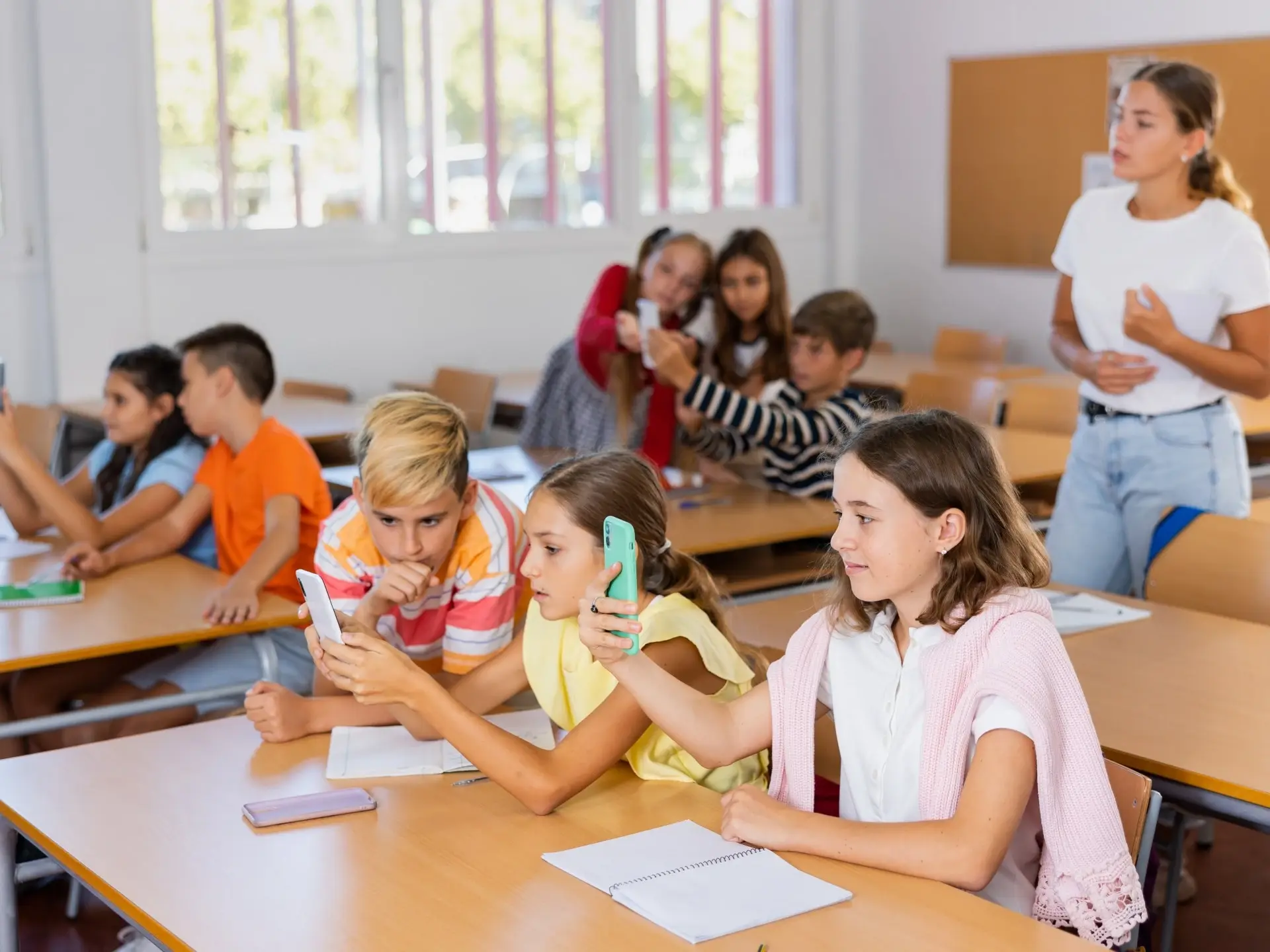
In the 2000s and early 2010s, less of your life was lived on a cell phone or smartphone.
For kids now, it’s 100% of their lives. Post-COVID, the majority of social interaction between peers is through a social media app.
That means that close to 100% of kids are on their phones during the school day. If you aren’t, you run the risk of social isolation and FOMO.
Administrators can’t send a kid to detention for using their phone because ALL kids would be in detention every day.
Here’s one article that examines the problem
As long as the phone isn’t used in class I fail to the the issue. There’s no need to ban phone use in general while on school premises.
Read the article, the problem is that kids don’t care and don’t listen. Teachers asking kids to take their airpods out during class, and receiving harassment back when asking. To me the kids proved they couldn’t handle it (not their fault, it’s an addiction device), but the school had to step in or it wasn’t doing its job
And the kids that are this brazenly disrespectful and disruptive would be disrespectful and disruptive without phones too. Most kids aren’t though, no matter how much alarmist media wants them to be. It’s a good old fashioned moral panic. Punish the actual wrongdoers, leave the test of the kids alone.
I don’t think wanting kids to pay attention in school is alarmist panic, to me your comment is more inflammatory than the post. Whether they should do it for just classes or not, or if they should take a punishment first approach can be debated, but out of all media and journalism, this is not alarmist.
And most kids already do. People have been complaining about “kids today” for literally thousands of years. Probably longer, we just don’t have records of it. There have always been troublemakers, and there always will be. People have been blaming everything from literature to TV to music to video games to, nowadays, phones. This, too, will blow over, and it’ll be fine.
People have also been making choice and being actively involved in raising kids for thousands of years. Imposing rules on kids is part of normal human life.
And why would these children comply with a phone ban if they don’t comply with anything else?
So you didn’t read the article.
Schools are literally mini-prisons that feed into actual prison.
The important thing is not reasonable control but complete control.
deleted by creator
Gamefaqs and Gaia, you’re taking me back. :)
One thing that leans me towards technocrit’s more absolutist stance on schools is how different they are now compared to when I was in high school (2003-2007):
Schools have become much more prison-like since then. My partner is a high school teacher, and all the stuff I remember being important parts of socializing like recess, gym, free periods, clubs, band, theater, etc, have been absolutely slashed.
There are schools now that are trying to enforce “no talking in the hallway” rules in place.
My partner is on teacher conversation boards where other teachers are lamenting that kids talk to each other too much, but they’re locked inside with each other for 8 hours against their will! People are treating kids like school is their job, but it’s completely uncompensated from the kids’ view.
Is school an important tool for social mobility? Yeah, absolutely, and I don’t think either I or technocrit would advocate abolishing schools, but they need to be heavily reformed in terms of what they actually offer the students before I’m comfortable discussing the next thing that schools want to strip away from them.
deleted by creator
While I do agree that rules that are clear oversteps; like “No Talking in the halls”; should be curbed; I don’t think depriving students of their phones is on the same level.
Kids should be required to pay attention when they are a student. Banning things that disrupt classrooms from functioning is a fundamental thing we all should agree needs to be done. In short; the child should have learned something that was being taught before leaving that classroom if reasonably possible.
Do I think that means schools must run like prisons? Hell no. But I do believe the teachers and administration need the ability to contain disruptions in class.
I’d be all for phones in schools if they were school-issued devices that were tailor-made to be educational and actively contributed to the classroom and learning environment…but those sorts of implementations are very sparse and unlikely these days; and tend to be scoffed at because of their cost.
I agree with this provided we have supplied them with a reasonable learning environment and expectations. Employees should be required to pay attention when at work, sure, but if we are put in a horrible work environment we would also refuse to work, or if it’s really bad, quit. Students don’t have the latter option, (nor the monetary incentive to ‘tough it out’) so the former is, by necessity, what they go to.
I think people have got this backwards: Lack of attention doesn’t disrupt the learning environment. Lack of a proper learning environment disrupts attention.
Looking at your phone doesn’t stop anyone else from learning; that’s a disruption to the class. You can’t define “class disruption” as “not learning” (you can stare blankly at a textbook quietly and not learn anything). Class disruptions are behaviors that prevent or impede other students from learning, which looking quietly at a cell phone doesn’t do.
I am reminded of the axiom of, “if one employee (student) is failing (being disruptive), you have a Personnel problem. If many employees are failing, you have a Management problem”. There will always be problem students, but they’re not really who we’re talking about. We’re talking about a widespread disconnect from a large number of students, because they are not being provided with a learning environment that engages them.
I work at a large company, and WFH during lockdown completely changed the employee attitude towards being trapped in a box of our employers’ choosing. My entire team is now remote, and maybe 10% of people go into the office once a week, at most, and probably half or more of us would quit outright if you tried to force us into RTO.
Students also experienced this, but they are all being given RTO orders, and (to reiterate once again), cannot quit, which really reinforces that it’s entirely possible for them to not be in the school building each day, but are being forced to for someone else’s benefit (and kids aren’t dumb, the argument that reopening schools was for the benefit of getting parents back to work was very publicly stated, and kids saw that). This does not make for a healthy mental situation that is conducive to (school)work/learning.
But they share fundamental similarities. That’s just the reality. What building forces adults to be trapped there, with no choice about whether to leave or not? Prisons. There’s really no way around this parallel. The question is then, “how do we make what is in effect a prison, feel less prison-like?”, and that has to be by making it an enjoyable environment. But no schools aside from the super-wealthy are even able to do this, and most aren’t even trying at the carrot. Instead, they’re switching to the stick, and that don’t work.
Phones in pockets are damaging, too, FYI. Children 15 and under shouldn’t have smart phones at all, ideally, but definitely not at school
It makes sense, I really like what this principal did, and he was fully aware that kids were addicted and were going to go through a withdrawal period. I think the pouches are a good thing, they may have gotten addicted during covid, but now is the time to end that and make sure the next wave of kids don’t suffer the same. I really liked the results:
Thank [some deity] for video chats, those little bastards couldn’t spell to save their lives 😅