
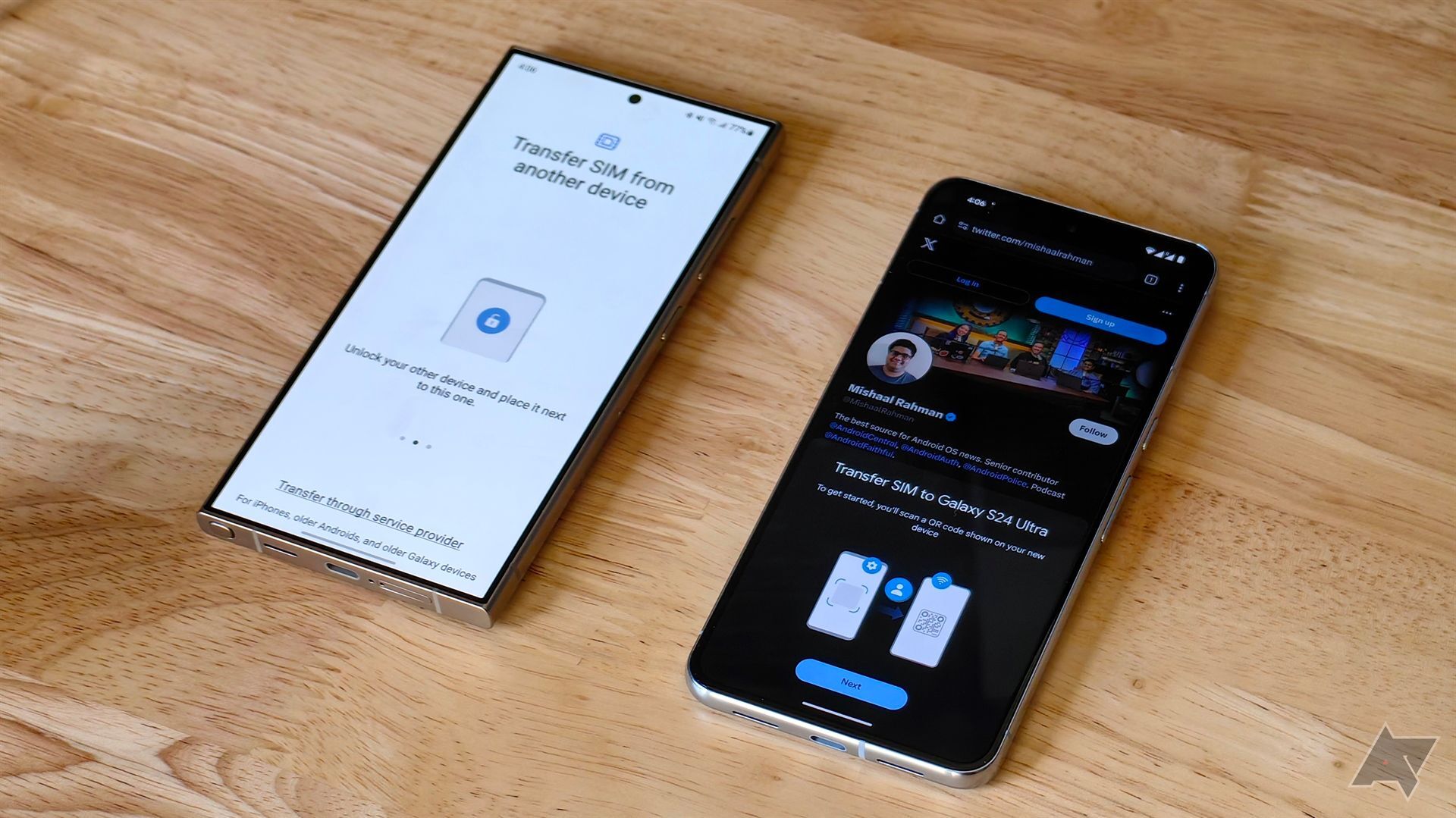
I don’t understand how this wasn’t more of a priority to begin with. If you’re going to offer a digital solution for something it should at least be as convenient as the existing physical solution.
Hah. To swap eSIM on O2 in the UK, you have to order a physical pack that gets posted to you with the QR code in. There is no way to get the code to appear on a screen you can scan with your camera, or in an app on the phone you can transfer to the phone’s eSIM manager. It’s so dumb.
Removed by mod
Same here. Seems like Google did a pretty good job with the eSIM registration in their app. I’ve swapped phones a number of times with zero issues.
That is very dumb with Verizon in the US you just type in the esim imei online and submit it and it auto downloads and activates the esim on your phone very easy.
Uh, I assumed that was a minimum viable product requirement.
deleted by creator
Maybe in somewhere free like the EU or SEA. In the US, most phones bought from a carrier (and most sales are that way, some exclusively so) are locked so that no other SIM (e or physical) can be used.
That’s your problem as a consumer accepting that. This thread makes me depressed, with the amount of people happy to allow shitty US consumer hostile practices to become more common globally.
as a consumer accepting that
That’s the special condition we get in the US, though - there is little or no effective choice across the spectrum. Without regulation, corporations will become asymptotic to maximum financial extraction techniques. There are few real choices at the consumer level and the barriers to entry are such that a single consumer - or even an uncoordinated (read: without a national, staffed organization) - cannot circumvent the system.
Cell phone use was a US thing that spread there before any other country. Five fold the amount of mobile phone users than the next closest country. They were also invented in the US.
The way of buying a cell phone and paying too much for the monthly pan, but getting the phone for free kicked off in the 90s and has never managed to go away because yeah, the cell companies are assholes, but also because consumers got used to getting phones this way. The bs part is that you plan isn’t any cheaper, even if you own your phone outright.
But for most people in the US there’s little use for switching carriers while using your same phone, so sim stuff isn’t all that important. Most don’t vacation outside of the country.
Maybe it’s just bad luck, but the last time I tried to swap a physical SIM, I inserted the removal tool in the hole, and then the mechanism somehow broke. So I cannot swap my SIM from my current phone to any other phone, unless I have eSim. Unfortunately, my current phone does not have eSim.
How do these eSIMs work from a user’s perspective? I’ve only ever had phones with physical sim slots
on T-Mobile USA: I preordered my iPhone 15; the QR eSIM and automated SIM transfer system was completely down and I had to spend 30 minutes to an hour on the phone with customer service to swap over my physical SIM to an eSIM I could type (IIRC) into my new phone.
How frustrating
deleted by creator
That’s my big concern as well.
Removed by mod
Its a shitty replacement. If I couldnswap phones like a sim card i wouldn’t care. But they charge for a phone swap no thanks.
You call support and have them issue a new one.
Don’t you need a SIM for calling?
I’m not sure if there’s some special calling feature to reach a previously associated provider, but when I’ve been in that situation I just borrowed my roommate’s phone.
deleted by creator
No, they issue it virtually. Then you download it via their app or via regular cell network provisioning.
download it via their app
On the phone that isn’t connecting to the internet, because it doen’t have a SIM yet? Or do eSIM phones use free internet before they have an eSIM issued?
In the store if you’re getting the phone from a store, or somewhere with wifi (home, a friend’s, a cafe) if you’ve gotten it some other way.
If you don’t have any of those, you probably live way out in the jungle, and I’d be surprised if you had service even if you got the eSIM. But in the edge case that you somehow got home delivery postal service in the jungle, you’d probably be able to survive just fine without it until your next trip into town.
In the extreme edge case that you are in the jungle, get service, and your need is critical, I would have an activated backup phone tested periodically and ready to go.
The same way Verizon phones used to work: less well.
Exactly back to phones working on only one carrier. I know not yet but give it awhile.
@AdmiralShat @FragmentedChicken phones that support esims have actual sim chips inside, and esims basically flash the carrier data onto that chip.
Removed by mod
Yep, same here. Wouldn’t want to use eSIMs at all if they were any more hassle than this. But their process to me is good enough to outweigh the physical SIM swapping process.
They’re functionally the same as normal SIM, instead it is stored in a secure location of the storage (which can survive factory reset). In a way, it makes it a bit more secure as a thief can’t just yank out the SIM card to avoid being tracked (although it doesn’t defeat a faraday bag) or take it out to use it in another phone.
The major function of a normal SIM is the ability to take it out of one device and put it into another one, effectively disconnecting my identity towards the network provider, from the handset. With eSIM, that doesn’t exist, and if my phone breaks, it’s unclear what happens.
To me, that’s not secure, that’s unsafe and insecure.
From a corporate device perspective it’s an interesting evolution though, since we can remotely provision an eSIM through our mobile device management platform. No SIM to handle from the user point of view, and they can’t take it out.
Generally you go to some site your carrier has, enter the IMEI or some number from your phone’s settings, then scan a QR code. It’s not bad… depending on your carrier.
And pay a fee.
When I got my Pixel 8 Pro it asked me if I want to convert the physical SIM from my Xiaomi 9 SE (and disable the old SIM). I didn’t have to take off the case and move the SIM, so I liked it.
but some carriers don’t
*Google
I tried to transfer my eSIM from my old S21 to my new S24 the other day. It failed miserably. My carrier charges me $10 for a new eSIM (which i think is way too much for a digital service). Transferring eSIMs sounds like a good idea if it works, but might not be endorsed by carriers that earn large profits from the service.