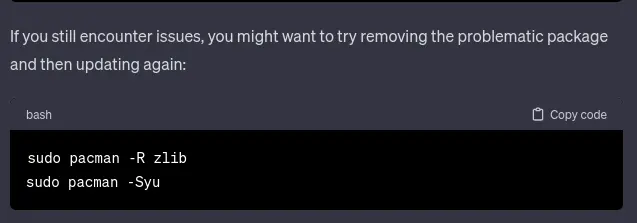

In my case, there are 95 packages that depend on zlib, so removing it is absolutely the last thing you want to do. Fortunately though, GPT also suggested refreshing the gpg keys, which did solve the update problem I was having.
You gotta be careful with that psycho!
Not copy pasting random commands you are not 100% sure about is basic terminal literacy
Online forums can give bad advice, but this is just next level bad. GPT truly has no remorse.
It’s a language model, I still don’t understand why people expect it to always give correct answers. You asked for some code, it gave you some code, I don’t see what is the problem, it worked as it should, and it’s astonishing that current technology can do this.
I also don’t like the term “Artificial Intelligence”, we should call these things LLM, or ML as Machine Learning.
LLMs are a specific implementation of ML, which is a field of AI. It’s all still AI
I think the topic should change from A.I. to machines or smth.
Doesn’t matter if its a simple bot regulating something simply or a LLM. For some dumb reason the are both called A.I.
Real Artificial Intelligence doesn’t exist yet.
Because they are both AI. Artificial intelligence and Artificial General intelligence are not the same thing. AI is an entire field of computer science dating back to the very beginnings.
People expect the current models to be sentient, conscious etc. but we’re still very far from that. All of our ML creations are still very narrow in their scope.
Meh, we call people intelligent and they give wrong answers confidently too. It’s not AI in the traditional sense, but AI has now come to mean LLM for non tech literate users. Language evolves. We don’t need to fight it.
How will you call the “AI in traditional sense” when we finally arrive to that? You can’t call that AI, because that’s LLM now.
I’m not against the natutral development of languages, I simply don’t like mislabeling things.
Already AI is categorized. Likely it will be called true AI or complex AI or something similar. Like any technology, eventually the newer version will replace the old and it will just be called AI again.
What people mean by AI has changed. When Optical Character Recognition was new, that was considered AI. Nowadays it’s so common that it’s nothing special any more. When people talk about AI in the 2020s, they usually exclude OCR from the definition.
deleted by creator
It gives a lot of plainly wrong answers, including in fields where one would expect it to excel (basic physics, for instance).
Why would a program that outputs sudorandom strings based on how often they appeared after the string before excel at basic physics, even if it did have most of the text side of the internet fed into it to determine how often string b follows string a? It’s a miracle of programing and self reinforcement that it can form a sentence at all.
It also gives a lot of right answers.
The point is not to blindly believe either and use it as a tool to further research.
Works with online forums and real life interactions too. Just because someone said or wrote something doesn’t automatically make it reliable.
So you’re saying not to blindly trust everything written on a forum is true. Which means I shouldn’t trust that anything on Lemmy is true. Which means your comment on Lemmy saying not to trust everything on forums to be true must be false. Therefore everything including your comment is true, which means everything is false which means everything must be true…
It’s all become quite clear! I…need a nap
LOL
But seriously though:
Must be false-> may be falseSome times it’s difficult to tell.
Well, LLMs base their answers on content scraped from the web and those same online forums.
I guess, one day GPT will tell me to run rm -rf /* because it read that on an online forum somewhere.
Removed by mod
Also H2Ogpt, if anyone is interested 👍
Removed by mod
Oh, yea, it has the habit of pretending to know things. For example i work with a lot of proprietary software with not much public documentation and when asking GPT about it GPT will absolutely pretend to know about it and will give nonsensical advice.
GPT is riding the highest peak of the Dunning-Kruger curve. It has no idea how little it really knows, so it just says whatever comes first. We’re still pretty far from having a AI capable of thinking before speaking.
Why do people expect it to give perfect answers all the time? You should always question whatever it gives as an answer. It’s not a truth machine, it’s an inspiration machine. It can give you some paths to explore that you hadn’t considered before. It probably isn’t aware that zlib is a dependency for many other things, because that’s extremely niche information. So it just gave you generic advice and an example on how to remove a package.
I have had some luck asking it follow-up questions to explain what each line does. LLMs are decent at that and might even discover bugs.
You could also copy the conversation and paste it to another instance. It is much easier to critique than to come up with something, and this holds true for AI as well, so the other instance can give feedback like “I would have suggested x” or “be careful with commands like y”
I’ve also tried that, but with mixed results. Generally speaking, GPT is too proud to admit its mistakes. Occasionally I’ve managed successfully point out a mistake, but usually it just thinks I’m trying to gaslight it.
Asking follow up questions works really well as long as you avoid turning it into a debate. When I notice that GPT is contradicting itself, I just keep that information to myself and make a mental note about not trusting it. Trying to argue with someone like GPT is usually just an exercise in futility.
When you have some background knowledge in the topic you’re discussing, you can usually tell when GPT is going totally off the rails. However, you can’t dive into every topic out there, so using GPT as a shortcut is very tempting. That’s when you end up playing with fire, because you can’t really tell if GPT is pulling random nonsense out of its ass or if what it’s saying is actually based on something real.