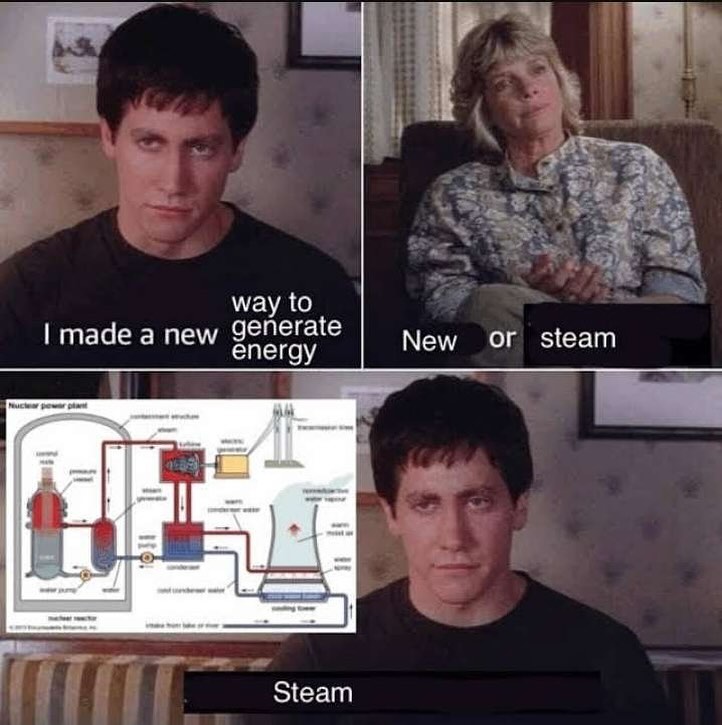

Water and steam just too goddamn convenient. Super high latent heat so it can move a ton of energy with a quick phase change, works at reasonable pressures and temperatures, stays liquid all the time when you want it to so pumps work, and it’s so readily available as to be damn near free. Super cool!
also almost non-corrosive, non-toxic, doesn’t damage ozone layer, zero global warming potential, non-flammable etc (lots of organic rankine cycle fluids fail one or more of these. tradeoff is utilization of lower temperature sources)
deleted by creator
It’s great for nuclear reactors. Hot rock make turbine go brrr
Best explanation of nuclear energy I’ve ever heard
Nuclear energy is solar too
nah not solar, the energy comes not from Sol the star, but from dead stars of past.
Him: Our sun is a nuclear reactor too.
You: Our nuclear reactors are made of dead suns.
Both right, yet disagreeing.
That’s why Photovoltaic Cells got the Nobel Prize, imo. The only new way to generate electricity actually put to use AFAIK.
Of course it’s completely inefficient at large scale and they just revert back to mirroring light into a collection tower where steam happens.
Wasn’t the main appeal of the mirror installations that you can store the heat somewhat efficiently? Rooftop solar is cost effective even here in Germany, where darkness and shadows loom around every corner.
These numbers change every year, but: solar panels on roofs don’t track so they’d be lucky to get 20%, average closer to 12%, efficiency and slowly degrade over a few years. Sun tracking panels can reach a maximum of around 40%, theoretically, but on average more like 20%-30%. You have to subtract the negative impact of creating and assembling the materials from it’s lifetime effectiveness, in Germany I believe Hydrogen Steel exists which is much greener than other types of smelting, or otherwise Aluminum is the higher grade material used for such things, and Photovoltaic Panels have a very specialized Glass in most cases that has to be exceptionally clear and strong. If the capacitance of the system is not enough to hold the produced power then an electrical failure will occur, so you must also include large commercial and industrial batteries.
Meanwhile, a Heliostat (a Collection Tower and Mirror Array) out in the desert has a theoretical efficiency just below 70%. Furthermore, if the capacity of the grid fills up then the array can be disable by adjusting the mirrors and excess power can be stored for extremely long periods of time by utilizing molten salt beneath the tower.
These efficiency numbers refer to how much of the heat energy from full spectrum light hitting the array is converted into electricity. Home panels are nice because you can put them on your home
Yeah, but PV is dirt cheap nowadays. Also
degrade over a few years.
If by “few” you mean like 30-50 then sure, they degrade. But it certainly beats anything with a spinning turbine. Or anything with moving parts really. PV is purely solid state physics, you can’t get more longevity than that.
If the capacitance of the system is not enough to hold the produced power then an electrical failure will occur, so you must also include large commercial and industrial batteries
That’s not true. You can also simply turn PV off. The inverters only run when they sense 50 Hz on their output terminals, it’s easy to have them turn off when it’s 50.2 instead. Basically all big powerplants follow that rule already, ordered by things like shutoff time etc.
a Heliostat (a Collection Tower and Mirror Array) out in the desert
Funny that you specified in the desert. The appeal of PV is not only that it’s cheap and easy, it also scales down to small investments and local power generation. If base load actually becomes a problem concentrated solar power will be relevant. But for now, slapping a few solar panels on your roof just makes sense.
lmao your consumer grade photovoltaic panels will not last 50 years.
The solar panels I just bought have a manufacturer warranty for 87% power output after 30 years.
That’s much more realistic, I like that.
it’s both, but i’m not sure if these large solar concentrators (ivanpah or these things in spain) are more efficient than current pv panels
I mean, if they’re dramatically cheaper, they don’t have to be efficient.
That being said, solar cells get around 20% efficiency, steam generators maybe 50% on a good day, subtract the reflection, collection and storage inefficiencies and you might get roughly in the same ballpark as solar cells.
Non-tracking solar panels are closer to 12% actual efficiency, 20% would be a theoretical efficiency. I only mention this because you used an actual efficiency estimate for the steam generator but not the solar panel.
That’s because I’m so smart I completely ignored that the sun moves around during the day.
Cost per MWh is what tends to matter more than efficiency. Photovoltaics have become dirt cheap. Mirror collection systems haven’t been able to keep up, and the projects for them are basically defunct at this point.
Was worth trying, though. It wasn’t obvious that photovoltaics would get so damn cheap 10 or 20 years ago.
deleted by creator
great for satellites tho
“I found a new source of naturally occurring waste heat”
Some types of fusion can bypass steam generation and use what’s creatively called Direct Energy Conversion. If the fusion products are charged particles they can be passed through a magnetic field to separate them based on charge and collected onto plates. When you look at the electric potential between the plates you’ve effectively created a voltage, no steam necessary. It’s also theoretically possible to do the same with some types of fission products too.
I thought they take advantage of the velocity of the charged ions to magnetically transfer power to electromagnetic coils around the reactor.
There’s a whole bunch of mechanisms, largely depending on the fusion architecture and the atoms being fused. For tokamak reactors the circular nature lends itself well to what you describe, though usually it’s energy being imparted into the ions to keep them contained and away from the walls. In the ‘standard’ deuterium-tritium fusion model (the easiest to perform) fusion produces a helium nucleus and a neutron, where the neutron gets most of the energy. Since a neutron can’t be contained by magnets it impacts the chamber walls. This heat is wicked away by, you guessed it, cooling water which turns into steam. In order to use a direct energy conversion strategy you need a fusion reaction that produces no neutrons, but we’re not there yet.
/uj Steam is just an intermediary form for almost all these tho (except maybe geothermal? not sure), not the real source.
Steam just makes sense as a fluid for heat engines, thermal power plants are mostly steam, except when gas turbines are involved, but even then there’s most of the time steam bottoming cycle. (gas turbine burns something, then exhaust is hot enough to power steam cycle) Unless thermal power plant is small, then it’s more likely to be diesel engine (up to few MW). Only when it’s photovoltaics, or hydropower, or wind farm (or tidal powerplant, or some other weird ones) there’s no place for steam to be involved (solar thermal plants sometimes use steam cycle). Geothermal powerplants use steam if source is hot enough, otherwise it’s something more volatile in organic Rankine cycle
I’m referring to the root energy source, rather than how it’s transferred.
“Root” energy source really just depends on where you draw boundaries of thermodynamic system in question
Then it’s just heat transfer medium for most of geothermal powerplants too, because from what i understand, most of the time condensed water is recycled (and source of energy is just “hot rocks” anyway)
then if you look at the bigger picture, all that energy can be traced back to either sun, nuclear fission (in reactors) or nuclear decay/primordial heat (geothermal)
Geothermal power still uses steam to generate electricity. It’s steams all the way down.
Steam isn’t the energy source tho, just a transfer mechanism.
Same for all the others like coal and nuclear though. So that’s a dumb distinction to try to make.
Steam is always just a transfer mechanism if it’s part of the power generation
Then why focus on steam specifically, why not other required intermediaries, like turbines, the storage mechanism.
The main meaningful distinction in energy generation is the root sources of the energy, nuclear, wind, hydro, etc. All of those share similar conversion methods and intermediary forms, but have different sources.
Because it’s a funny fucking meme my dude.
Hence the meme. Because almost everything uses steam.
Any other jokes you want to break down for no reason?
deleted by creator
and diodes
I like piezoelectrics and kinetic generators. The only two methods of generating electricity I know of that don’t involve steam other than solar panels.
At least, I think they’re different… Is a standard copper wire+magnet generator pizeoelectric? Or is it simply the operation is similar in that you generate electricity from moving things together? Like the difference between tiny little things in your shirt that generate electricity as you move around vs those flash lights you shake to charge.
Piezoelectric effect is when you vibrate certain crystals and they give off electricity. It’s also reversible. You can feed them electricity to generate sound. The beep-boop sound from small electronic devices is usually from a piezo speaker, because they’re dirt cheap.
You don’t get significant amounts of power out of it, though.
Yeah. The one thing I ever saw that has me excited for a product that could exist, is that they can power a simple OLED display. And since an OLED display can be paper thin, they could put one in a t-shirt and you could have an animated design on your shirt instead of just a static picture. And that would be dope.
Of course, you’d need more than just the display, and i don’t think the little generators that can be sewn into a shirt would be enough to power the computing device that would be necessary to drive the animation for the display.