
deleted by creator
But what if my perspective differs?
Argumentation cannot account for that.
Argumentation requires a shared perspective and shared axioms.
If a worldview is devoid of reason and no argument will dissuade the person, all useful dialog is impossible.
It isn’t a worldview devoid of reason. It’s perfectly good reason based upon a set of assumptions that differ from yours.
Reason is the house. The assumptions is the ground upon which the house is built.
Some ground is rock, some swamp, some flat, sloped… all require different house designs. Dig?
Correct me if I’m wrong, OP, but it sounds like you’re talking about retreating to the axioms of the particular belief system, as in there is a point where reason breaks down because you get to things that you (the person whose expressing their opinion) have accepted that’s different than me.
To me this is a bit of a Motte and Bailey fallacy as your question was whether or not you have a good argument and then someone replied to that and then moved to the set of assumptions which has nothing to do with argument.
For me personally, the other person has to demonstrate some level of critical reasoning for me to respect their opinions, even if their assumptions are different than mine. Beliefs that are entered into using reasoning are more useful than ones without because they can be changed which is what discourse is all about
https://en.wikipedia.org/wiki/Motte-and-bailey_fallacy
Today I learned! :)
Really? A worldview requiring accepting ideas without verification and contrary to logic isn’t devoid of reason? In what planet?
deleted by creator
But language cannot convey perspective. It can only refer to it. Language only works when perspective is shared.
If perspective is not shared then, tho we use the same words, the meaning we assign to them differs. We may appear to be communicating but we really aren’t quite, there’s something broken there, and that brokenness generally gets translated as “this guy is just stupid”.
This is a problem with language and the internet.
deleted by creator
Some opinions cannot be explained. For example “chocolate is better than vanilla”.
There are a lot of those. It’s the earth upon which all argumentation stands.
So at some point the question arises, “do I respect the individual?”
But for us, on the internet, the individual doesn’t really exist?
“I enjoy chocolate more” and “I associate chocolate with positive memories” are both explanations that are still personal experience that isn’t necessarily shared experiences but can be understood through communication.
deleted by creator
Depending on what you mean by respect and opinion, yes. If you’re discussing an opinion then someone is probably going to expect you to explain why, that’s a logical point to cover in any such discussion. Even if it’s subjective. If it’s an opinion on something objective, then there’s an actual burden of “proof” and possible consequences, and the stakes rise accordingly.
There aren’t many reasons to “properly” respect an opinion that is irrational (not just subjective), factually wrong (“interpretation” only goes so far), dishonest, or anything like that. I’m skeptical of endorsing any opinion until I know why it is what it is.
I like chocolate feel free to be skeptical of endorsing it all you like I don’t need to explain myself
deleted by creator
Sort of. I respect your right to have an opinion, but I’ll respect the opinion a lot more if backed by facts and data.
It depends on how harmful that opinion is. You prefer vanilla ice cream because you like the mild flavor - cool, difference of opinion. You prefer there were no same-sex marriages because your religion is against it - no, that affects other people’s lives so if you want me to respect that opinion you would have to have a good argument.
OP asked this less than 24 hours before they went mask-off as a Fascist.
Yes, you do need a good argument. And no, Forced sterilization and eugenics isn’t a good argument or even a conversation worth dignifying.
Edit: OP has deleted their post after an avalanche of downvotes and dissenting comments. I have some screenshots, although I expect OP to delete this post too.
Post:

OP letting the mask slip:
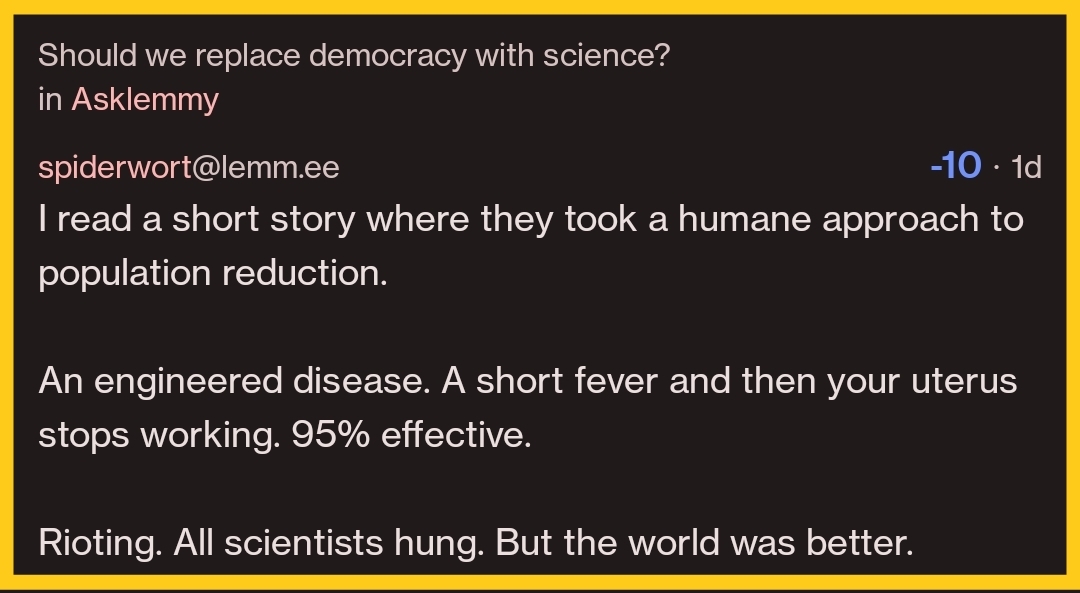
Extremely concerning shit
People that spend energy on arguing their right to have opinions rather than defending the opinion are deeply uninteresting and often stupid people that I don’t not respect in any capacity.
Hahahahaha yeah, no. You dont need to be smart to be able to talk someone down. Not everyone who is smart wants to fight others every step of the way.
Making statements that degrade others like this shows a deep lack of understanding and empathy.
that the sky is blue for your doesnt mean its blue for everyone. Sure you can debate people, with consent though.
Have a good one.
I also dont respect people that start comments with a joker laugh.
No problem. Blocked.
Yeah those guys are the worst.
You are literally one of those guys. All your replies in this thread is you being that guy.
I respect facts and objective evidence. Opinion is immaterial.
Otherwise, there is no point to it.
Unfortunately there are many subjects where all the facts aren’t known, therefore opinions must be discussed to advance the understanding and ultimately help to establish future facts. Also, one person’s believed facts may be a misunderstanding, for example, hence why discussions and arguments may happen.
As such, there is (nearly) always a point to it!
I don’t subscribe to the notion of opinion being equated to hypothesis.
I also don’t believe in facts. A fact simply is.
Opinions are held beliefs that are usually founded in how a person feels about a subject. I see no reason in respecting a belief. I can respect a person, when earned. But their opinions and beliefs are not anything I require to be respected. And I expect nothing less toward myself.
It’s also why I tend to extricate myself from any argument people like to have. Because my experience has taught me that most people have no idea of what they speak, and when proven wrong in the face of objective fact, they double down on their beliefs.
So I reiterate — there is no point without objective fact and evidence.
I certainly agree that a fact simply is, noting your lack of belief, however communication is only possible through description so I suspect some somantics here. My point was that within an arguement, opinions can be extrapolated from known facts to suggest unkown/unproven facts, if only so to the individuals involved. Essentially this is that basis of any argument - to exchange ideas/possibilities etc to reach the ultimate goal of determining what is a fact.
Though, as you say, many discussions and arguments, especially in a casual scenario, are taken as exercises in ‘winning’ rather than with the aforementioned aim. I agree this is frustrating and understand your stance.
Re respect. If you respect a person (your approach being much the same as my own), does that not preculde that you respect what they say?, at least in most instances, even if they are mistaken or incorrect? Though I think there may be two points here, one re emotional beliefs & one re fact-based beliefs. The latter being more what I’ve been refering to. Emotional beliefs are much closer to pure opinion than facts.
I would say yes. The only time you don’t is when I already agree with you, but that’s because I (hopefully) already know the good argument.
I don’t believe in “common sense”, that’s just the biases someone already has. Some of them correct, some of them not, all unchecked therefore all invalid as a basis for anything.
If we could dispose of respect for the individual, then we could replace democracy with science. That would be efficient.
Depends on what it is about. We meet and you say :
- You’re vegan. Good.
- You use Linux. Good.
- You’re on the Fediverse. Good.
- You love bicycles. Good.
Now we meet again and you talk about privacy and then ask for my WhatsApp number (which is non existing) to continue that conversation later -> The heat is on! 🔥
So it depends on the threat level. That’s prudent.
There’s tiers.
I have no respect for an opinion that the holder doesn’t understand well enough to argue since they are parroting a “common sense” belief based on premises which are easily disprovable.
I can respect an opinion I disagree with which the holder understands, but up until the point where they are willing to argue in good faith. If they are deliberately spreading info which they know to be false because it’s to their advantage that others hold those beliefs, I thinknit’s a major problem. If they refuse to entertain any challenge to their opinion however obvious, that is also a problem.
The opinion I disagree with which I respect the most is one that is in total good faith which causes me to question my opinion. This is how I learn.
If it’s a totally subjective opinion, no. You can like food I don’t, or even have kinks I don’t.
If it’s even slightly fact-based, kind of yes, unless you keep it entirely to yourself. I don’t have to agree with it to respect it, though, if you have any reasonable kind of argument.
Like someone else said, in practice nobody actually cares what I respect.
good. no. valid. yes. as long as the premise is reasonable and its logical. If its about how you feel or everyone does it type of thing I just won’t care as long as it just effects you.
The depends on the opinion
This is a spread from yes to no where “yee” applies to hypothetical things that are fully objective and “no” to hypothetical things that are fully subjective
Do you have any examples for „fully objective“ things?
No. I specified that they are hypothetical for that reason.
Yes
What if they simply see things differently?
Chocolate is better than vanilla. Argument? Of course not.
Argument requires shared assumptions. If the assumptions are not shared then you can’t argue.
And then what’s left? Respect for the individual?
“Chocolate is better than vanilla” is surprisingly ambiguous. If you said “I prefer chocolate over vanilla” there’s no argument because that’s a subjective statement. If you said “the human pallet prefers chocolate to vanilla, thus those that prefer vanilla are defective” well now you have made far more than a subjective statement that also labels those that don’t share it, you have to be prepared to defend that. If you said “chocolate is healthier than vanilla” then you might need to at least be able to provide some facts and figures like lower sugar content or something.
The point is: when it’s a matter of subjective preference, presented in a way that makes no judgments of dissenters, no arguments should be expected. Making a claim of fact may require evidence. And making a critique of others is asking for a fight.