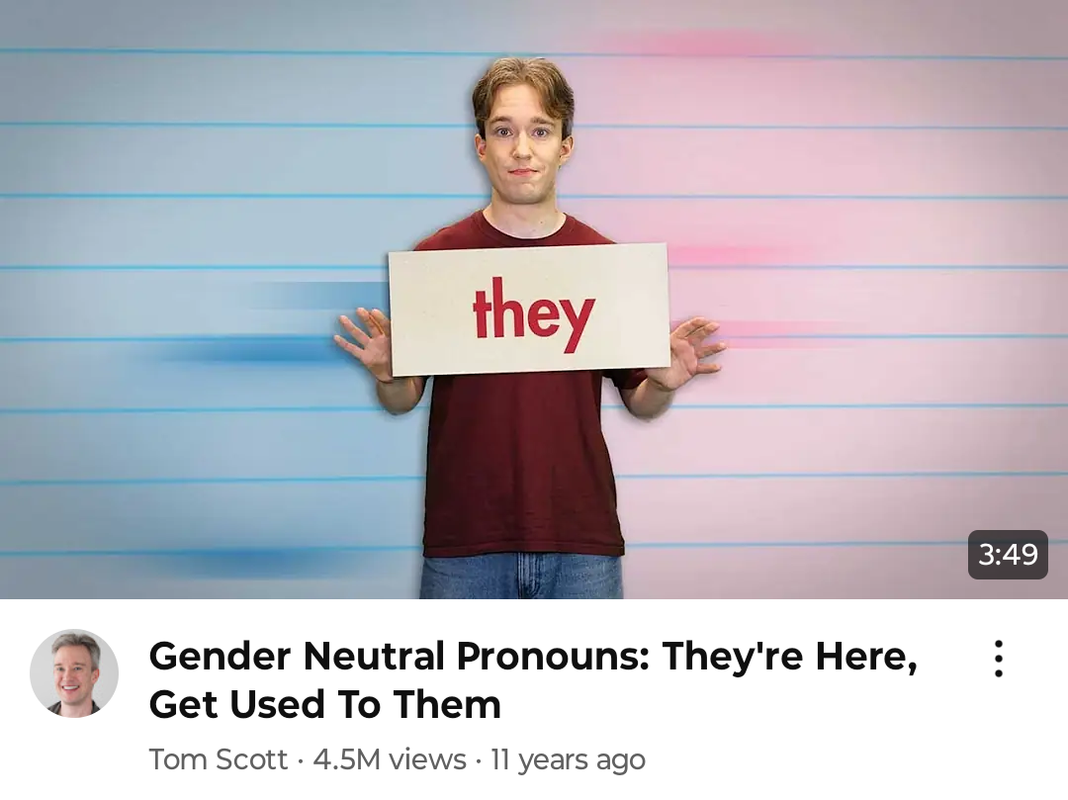
Blaze (he/him) ( Blaze@sopuli.xyz ) to 196@lemmy.blahaj.zoneEnglish · 2 years ago11 years agoi.postimg.ccimagemessage-square45linkfedilinkarrow-up1463
arrow-up1463image11 years agoi.postimg.ccBlaze (he/him) ( Blaze@sopuli.xyz ) to 196@lemmy.blahaj.zoneEnglish · 2 years agomessage-square45linkfedilink
minus-squareResonosity ( Resonosity@lemmy.dbzer0.com ) linkfedilinkEnglisharrow-up4·2 years agoI believe I read somewhere that the singular for “they” used to be “thy”, but that makes language sound terribly old. Doubt it’ll get picked up in the mainstream
minus-squarezagaberoo ( zagaberoo@beehaw.org ) linkfedilinkEnglisharrow-up12·2 years ago‘Thy’ is the disused informal ‘your’. There’s ‘thou’/‘thee’ but that’s still second-person.
minus-squareResonosity ( Resonosity@lemmy.dbzer0.com ) linkfedilinkEnglisharrow-up2·2 years agoInteresting! Do you have any etymological sources that go into this more? I’d be curious to learn
minus-squareAnimalsDream ( AnimalsDream@slrpnk.net ) linkfedilinkEnglisharrow-up4·2 years agoThis looks like an alright starting place: https://en.m.wikipedia.org/wiki/Early_Modern_English


I believe I read somewhere that the singular for “they” used to be “thy”, but that makes language sound terribly old. Doubt it’ll get picked up in the mainstream
‘Thy’ is the disused informal ‘your’. There’s ‘thou’/‘thee’ but that’s still second-person.
Interesting! Do you have any etymological sources that go into this more? I’d be curious to learn
This looks like an alright starting place:
https://en.m.wikipedia.org/wiki/Early_Modern_English