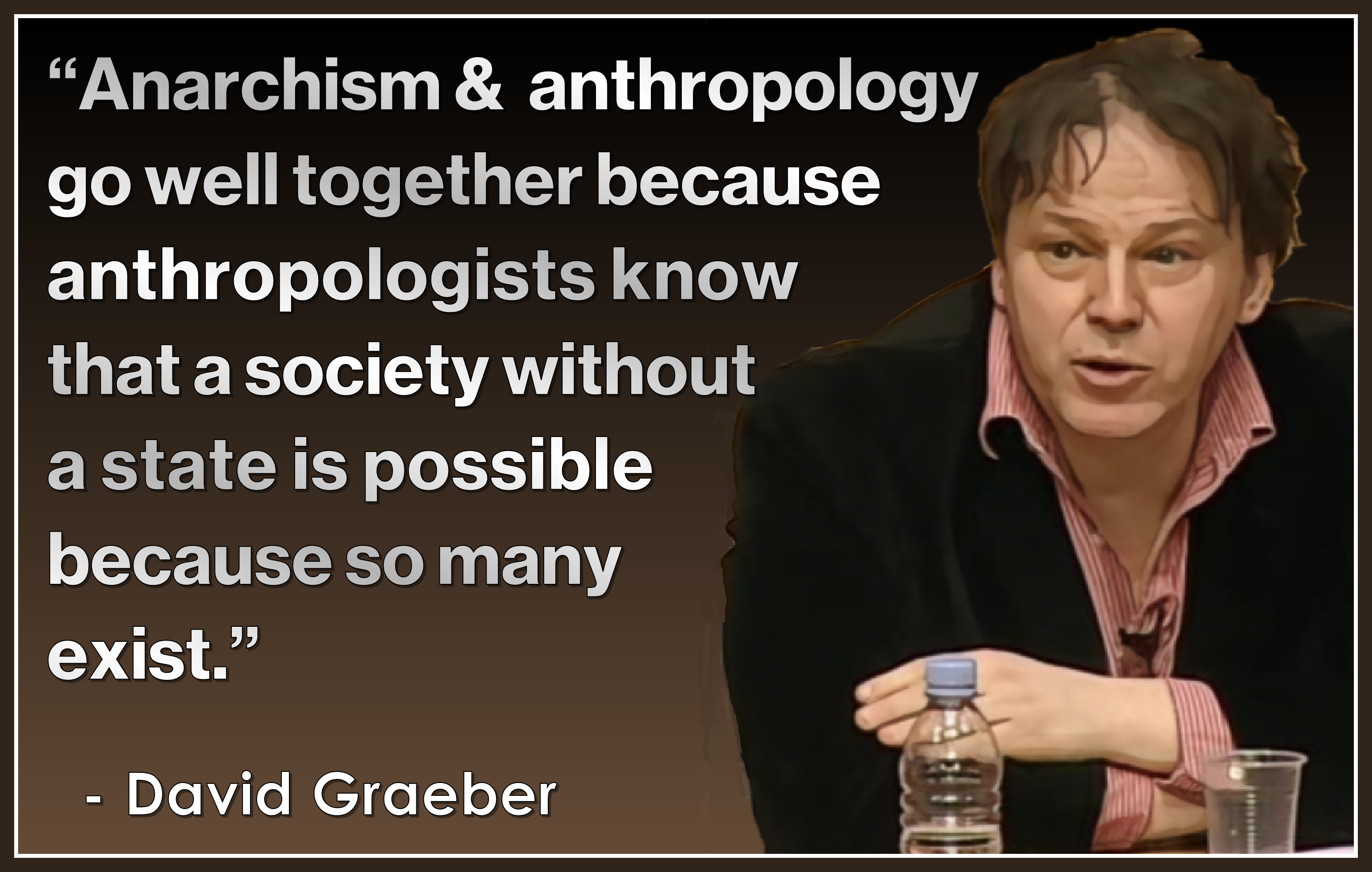

David Rolfe Graeber (/ˈɡreɪbər/; February 12, 1961 – September 2, 2020) was an American anthropologist and anarchist activist. His influential work in economic anthropology, particularly his books Debt: The First 5,000 Years (2011), Bullshit Jobs (2018), and The Dawn of Everything (2021), and his leading role in the Occupy movement, earned him recognition as one of the foremost anthropologists and left-wing thinkers of his time.
You must log in or # to comment.
Graeber radicalized me. Bullshit Jobs was my first book, later I read Debts and Dawn. Now I work a bullshit job and spend my working hours on lemmy and podcasts
:D <3
Which one should I start with?
I’ve not read them all, so I can’t really rank them, but I do share Are You An Anarchist? The Answer May Surprise You! often, and of course there are the renowned Bullshit Jobs and Debt. I’m sure other folks can add their own suggestions…
deleted by creator
up to what size & technological level?
There are historical examples with tens to hundreds of tousands of inhabitants. Those are actually quite common.
Graeber’s book “The dawn of everything” has some good examples.
For those of us without the book, what sort of examples does it give?
Early agricultural societies in the fertile cescent that existed for 1000+ years and build rather large cities and more recent various meso-american ones that existed in a sort of patchwork with others, but which due to the climatic conditions and later pillaging by European invaders didn’t leave much historical records.
In what way is the “technological level” dependant on a state?
From the top of my head: The Neo-Zapatistas in Chiapas show that both metrics can be answered with “quite high/a lot”.
my thought is actually that higher levels of technology begin to whittle away at the workability of more “free form” social organization.
For example, I’d argue that American Indians were living in something much closer to anarchy than anything else when the technologically vastly superior Europeans arrived with guns and absolutely demolished them.
I think anarchist societies could probably solve problems that require high technology (electricity, sewage, water distribution…), probably in ways we can’t imagine. But I don’t think they can solve the “higher technology oppressor” problem.
American Indians were mostly killed by the germs that the European invaders accidentally brought. In actual battles the Europeans didn’t fair so well as they were usually vastly outnumbered and the Europeans that defected or got captured mostly preferred to stay with the Indians afterwards. And yes, never trust history written by the winners.
For example, I’d argue that American Indians were living in something much closer to anarchy than anything else when the technologically vastly superior Europeans arrived with guns and absolutely demolished them.
I disagree. The native Americans were “technologically” quite advanced when it came to stewardship of the land. Think agriculture (food and forests), language and the like. Europeans basically enacted biological warfare on them.
Native American societies were quite sophisticated. Some were closer to anarchy, some weren’t. A lot of what we would like to know got wiped out before any European met them; initial contact was towards the south, but disease spread northward before Europeans did. The writings we do have about their society come from Europeans, which is hardly the best source.
What we can gather from archeology is that they had cities just as big as European ones at the time, and had trade and agriculture on the same level, as well. North America was a fully anthropogenic environment–altered to be better for humans–and the common perception of “vast, untouched wilderness” comes from the fact that Europeans were visiting a century after disease had ravaged the native population.
Edit: rereading your post, what society could solve the “higher technology oppressor” problem?
The thing is there is no tipping point. You have small size hunter gatherer groups who are egalitarian and others aren’t. Same for agricultural societies and cities and on and on. There are even groups that change depending on the season. The Dawn of Everything is a very enlightening book about this topic
I only heard about Bullshit Jobs recently. Now, knowing he’s an anarchist anthropologist, definitely putting it in my ever-growing-rarely-shrinking book list.
ever-growing-rarely-shrinking book list.
✊ The struggle is real fam
I didn’t actually know about this guy. Reading up on him now. Thanks for posting!
Question from someone uninformed on anarchism. How would an anarchist society do something huge, like for example get to the moon. It seems like that requires an intense pooling of resources and a level of coordination accross multiple industries, scientific disciplines, manufacturing techniques, etc.
Free associations of workers would work on that, if they want to do it, if there is a need for it. Tbh I don’t see much need for going to the moon in this moment.
i just don’t see that happening for fundamental science… these are big things that don’t mean a whole lot to the average person: going to the moon, discovering the higgs boson, ITER
you could convince scientists and engineers to work toward that goal pretty easily because they understand the necessary of pushing boundaries even when you’re not sure what you’ll gain from it, but i’m not sure you’d be able to convince people more removed from the academic world
the type of projects we did in the past to advance our knowledge of the universe were relatively simple compared to our modern science and engineering… we have grown to the point that no single person would be able to rebuilt the tools required to complete modern science from scratch, let alone how to use those tools
i’m not saying it can’t work, but i think that modern science is hugely complex, and the mechanism by which we manage that complexity is via government. i don’t see loosely connected groups being able to solve that issue
I posted more about this below, but I think it would work, it would just take much longer. Coordination takes more time, but if there isn’t a time constraint (which I think can be true in a functionally post-scarcity world) then that is much less of an issue.
Maybe it would take several decades to do what it would have taken 5 years before. But if the fundamentals are covered in the meantime, why is that an issue?
i’d argue that slow scientific progress is morally questionable… people live longer and quality of life increases dramatically with new scientific research. to extend that time would need a pretty big offset to that to make up for it
I dunno, I feel like rushing forward and making hasty generalizations and doing shoddy science is also morally questionable, and also ultimately gets worse results. And I see a lot of that in the tech industry anyways.
Just a had a convo today with one my mentors about javascript framework benchmarks, and how the main ones don’t actually measure accurately at all because of the way the engine inlines and optimizes things. He went through all the trouble of building a tool to make it easier to do rigorous measurements, because engineers at the company had been doing these shoddy benchmarks, using it to justify shipping “optimizations”, getting a nice raise, and then he would come in and realize that they had really just moved the work elsewhere and it actually caused a regression here or there.
And nobody really cared in the end. They used it for a while, then it fell by the wayside.
Real scientific rigor isn’t really respected in the same way it used to be, if it ever was. It’s more about marketing, finding an angle you can sell. Because when a metric becomes a target, it ceases to be a good metric, everyone starts gaming it. And money and productivity have become the ultimate metric.
and none of these big projects that we’re talking about are shoddy science. they’re highly structured, complex, peer-reviewed affairs with thousands of people involved. we could use far more money towards these things and peoples’ lives would get significantly better
Yeah, we could. But the structures of capital as they are currently running are funneling money away from that, and toward what makes profit. Look at what they’ve done to Boeing, once an engineer led giant, now a hollow shell.
I think worker collectives and more distributed decision making would slow things down at first, but in the long run would lead to more stability, more ownership, and eventually in the long term, more speedup as we build out infrastructure. I also don’t think we’ll ever get to a fully decentralized society, for a variety of reasons. But the first step in that direction would be something like more democratic company decision making and ownership (e.g. like the German model where workers elect a board member on large companies).
Yes, science is complex, infrastructure is complex.
i don’t see loosely connected groups being able to solve that issue
these are not “loosely connected groups”, it’s not a group of friends doing a party, it’s a complete industry.
thing is to change relations in production and to work according to needs and with solidarity towards each other and other communities. try to look at it as complete system, not just pinhole view at just scientists interested in particles or whatever scifi there is. that federated system would have to solve food, housing, medicine, education and through solving that and enabling others to work in fields they are interested in would in the end enable space travel, or whatever scifi other there is.
i would say that within that system it would be easier to develop science and more pleasant and beneficial to society than in current capitalist one
Agreed on necessity. I just mean, would having such a federated society allow for that kind of thing at all, or would it put an upward limit on how far society could go? I mean it’s all speculation I guess. Thanks for answering.
I think it’s more that it would take more time and coordination to do larger things. Like, you need to get all of the people on board, you need to convince them to work on it without coercion (either force or money), so it takes a lot longer. Everybody is going to want their basic needs met and their problems dealt with first.
But when you step back and think about it, with our current level of technology, that would be fine. Like, if I went to a hundred engineers and was like “hey I wanna build a rocket, who’s with me?” And they said “sure, once I have free time, but can we figure out food/water/shelter/entertainment/comfort first?” That would be reasonable. Maybe it takes a few decades or longer to figure those things out in a sustainable way, but at scale in society it could definitely be done.
Think about electricity. It is currently functionally limitless (yes, there are limits, but we don’t treat it like that in day to day life). And to keep it that way is relatively low maintenance, once we figure out renewables (or nuclear, or both) anyways. Same with the internet, once it’s built it’s fairly easy to maintain, and we’re at the point with fiber where it’s fairly difficult to overuse it, so giving it to everyone as baseline would be easy.
Once we had a better system for the basics, one that essentially is low maintenance and ensures everyone gets everything they need (with choice and freedom too, if everyone is fed but all we have is potatoes, the next question would be “ok how do we get more variety?”), then there would be a lot more time to focus on large efforts.
Those still would take longer, because even when we have all of the basics handled, it would take much longer to make decisions, there would be long, frustrating debates, somebody might storm off, etc. It might take a lifetime. But there wouldn’t be urgency either, because we all have the basics, plus luxuries, essentially our modern lives as they are. Just without the need to produce more every second of every day.
All of this could be decentralized too. It’s not like I’m saying there would be a command economy, necessarily. In fact, it shouldn’t be centralized too much ideally, that could over concentrate power.
Where this falls apart is game theory essentially. If I choose to be less productive and focus on that basic infrastructure, and take my time, that lets other players get ahead. If that goes on long enough, those other players may have advanced enough that they can dominate the game. It’s a literal arms race in that sense, this is playing out with AI right now. For it to work, everyone would need to agree to slow down, all at once.
This is a major issue because what’s happening is we’re hitting artificial maximum’s because of this strategy. I deal with this all the time working on software infrastructure. People want to push for product non stop, and then their code turns out completely unmaintainable. Infra comes along, analyzes, figures out a better pattern, and eventually we fix it, but not before the damage is done and it takes years to fix, or we just rewrite it all. If we had taken the time to build it the right way the first time, it would have likely been a much faster process. BUT, the startup may have folded in the meantime, because someone else put together a dumpster fire, spruced it up to look real nice, and got a bunch of people to choose them instead. And now they won.
So yeah, I think about this a lot haha 😅 we are, technologically speaking, capable of being post scarcity. Why are we still acting like technological advancement is about life and death? Why do we have to race to the bottom?
Edit: Oh, speed also does matter for coordinating in emergencies, so there is an argument for “we don’t have time because the environment will fall apart or we have an asteroid incoming, etc.” but like, re: the environment, that is not only happening, but the productivity arms race is making it worse! That’s an example of an artificial maximum’s there.
Thanks for this well thought out post. Given me a lot to think on. This was a substanial work, so genuinely thank you for taking the time.
i doubt about that limit, think capitalism puts more limit on science now, i replied to some other comment in more details regarding this
I mean it’s all speculation I guess.
i agree, to achieve conditions to enable forming of free associations of workers first capitalism(capitalistic relations etc.) must be abolished which is hard thing to do already
Agreed. Capitalism is interested in developing things that help capitalism acquire. Look to the pharmaceutical monstrosities in the US and see what they put their money into. Non- curative solutions that improve quality of life for chronic diseases. A truly free science might have solved a lot of these problems if funding weren’t so selective.
Burn it all haha.
do you remember one or two? I’m unlikely to go get that book any time soon.
deleted by creator
… But they study those societies by their bones.
We don’t owe the future tall buildings, smog, and a persistant thread of civilizational narrative. Humans living on their own terms might just die.
Many of those societies exist today and are thriving compared to our lifestyles. The San people in the Namibian desert have a much higher quality of life in terms of physical, mental, and social health than almost any of us English speakers.
are you under the impression that those in states dont become bones?
every example of “monkey considering monkey stranger” was “bad monkey.” That is the forest of this article: we’re good monkeys to monkey friends and bad monkeys to monkey strangers.
but that’s not the case at all, because we have monkey traditions and monkey manners and monkey mores.
again I agree that we don’t think of people outside our 150-200 person capacity in the same way as those we know well. we don’t give them the level of consideration we should. we don’t live up to the golden rule all the time.
but EVERY example in the article was monkey stranger --> bad monkey.