
Transcription
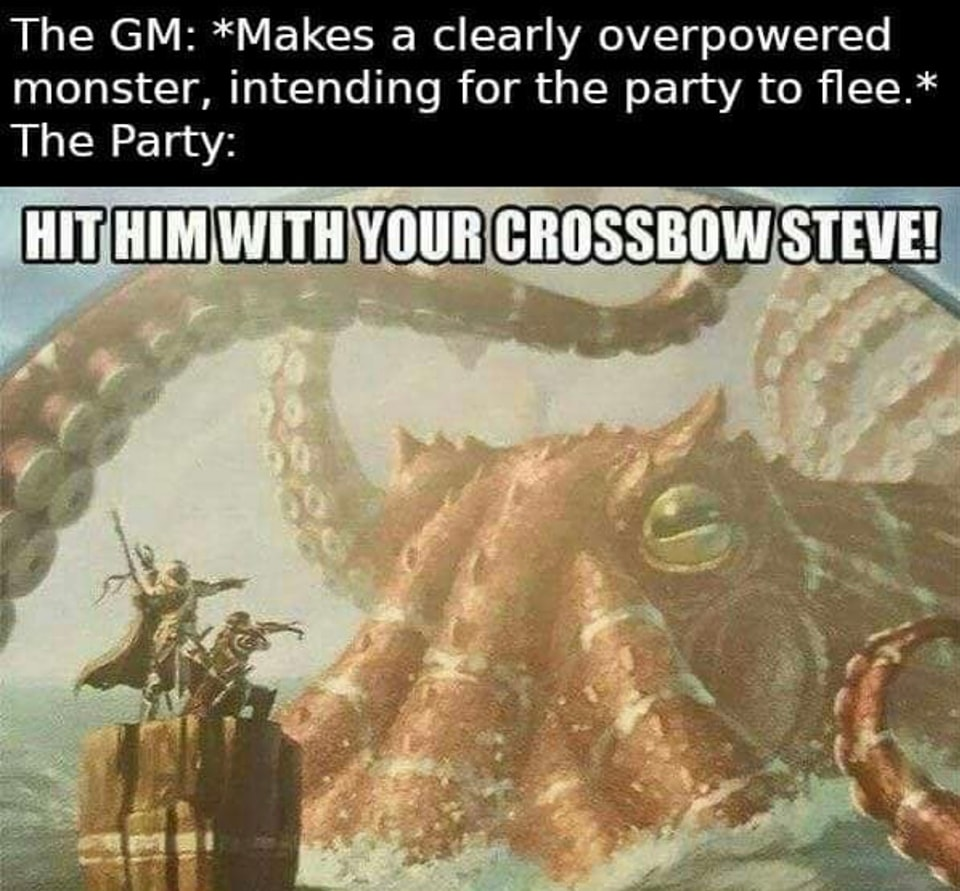
The GM: *Makes a clearly overpowered monster, intending for the party to flee.*
The Party:
[Picture with the text “Hit him with your crossbow Steve!” overlaid, of a large octopus/squid-like creature with tentacles raised out of the ocean. It towers over a pair of humanoid figures, one holding a staff in one hand and pointing at the squid with the other, the other person aiming a crossbow at it.]
You must log in or # to comment.
I had a thing set up with a Illithid giving the party a quest, hitting them with a psionic holding ability to coerce them and one of my players threw a fit about being held when he had a feat that specifically said it only prevented him from being held by magic spells, and not spell-like abilities or psionics or any other “magic but not really” mechanic.
So I let him move. He attacked the Illithid. So he also died.
It’s kinda a game flaw. Combat is usually encouraged by most modules, and fleeing is typically a bad option mechanically. So what else do players do?
The only solution is to make running the painfully obvious choice
The other solution is to have an alternative ‘out’. Like if the overpowered enemy doesn’t actually want to kill the players, but knock them out and capture them. Or if there’s an established (non–deus ex) rescuer who can come in and save them…preferably in a way that forces them to escape without removing the threat from being there in the future.
deleted by creator
Some games ask the players to define the stakes and goals when a conflict starts. This can help keep players on track.
Like, the players are on a journey through the mountains, and as they pass through a tunnel they encounter a giant spider. The default mode is “fight the spider to the death!”. But if you ask the players again “what is your goal here?” they might remember it’s “get through the mountains”, not “kill everything we meet.” Now they might focus on how to get past it safely.
If the DM rewards players for advancing their goals instead of just murder, that can also encourage non-murder behavior.
Some stuff to remember, if you don’t want a TPK
Never expect that the party will surrender.
If you tell the party it’s dangerous don’t go there , you can bet they’ll be there by the end of the evening
Ignore the critical fail rules when a PC use explosive
Fourth thing to remember:
If your party suffers an avoidable TPK once, they won’t do it again
If your party suffers an avoidable TPK once, they won’t do it again
Maybe not the exact same TPK, but some will definitely find another very avoidable TPK and try to solve it via headbutts
“Yes! A critical hit!”
okay, the Kraken takes 1 damage.
* Laughs in Pathfinder 2 level scaling.