
https://jabde.com/2024/08/10/should-neutron-stars-be-added-to-the-periodic-table/
I say yes, entirely because it’s hilarious
After reading I realised that this proposal isn’t a single new element for all neutron stars, but a separate new entry on the table for every individual neutron star in existence, unless there are two that happen to have the exact same number of protons which is unlikely. Sounds good to me
protons
we have assumed that Rex is comprised of a uniform nucleon fluid, with protons, neutrons and electrons in an idealised 1:8:1 ratio
This is how the author is estimating it, they are assuming 1/9th of the mass is protons. No idea how good that assumption is though, there is a source which doesn’t look the most convincing
Whoopsie. I used to assume neutron stars are made of neutrons. It turns out Big Astronomy lied to me.
Neutron stars are made of neutrons in the same way that tapwater is made of water molecules: primarily, but not entirely
Neutron stars have so high pressure that MOST but not all protons decay into neutrons plus
electronspositrons (plus neutrinos)Edit: (see quote below)
I’m not exactly well-read on particle physics, but to my understanding neutrons and neutrinos are neutrally charged and electrons are negatively charged. Why does a proton break down into net-negatively charged particles? I assume some weird quark shenanigans.
https://abc.lbl.gov/wallchart/chapters/03/2.html
I got stuff mixed
In beta minus decay, a neutron decays into a proton, an electron, and an antineutrino: n Æ p + e - +. In beta plus decay, a proton decays into a neutron, a positron, and a neutrino: p Æ n + e+ +n. Both reactions occur because in different regions of the Chart of the Nuclides, one or the other will move the product closer to the region of stability. These particular reactions take place because conservation laws are obeyed. Electric charge conservation requires that if an electrically neutral neutron becomes a positively charged proton, an electrically negative particle (in this case, an electron) must also be produced. Similarly, conservation of lepton number requires that if a neutron (lepton number = 0) decays into a proton (lepton number = 0) and an electron (lepton number = 1), a particle with a lepton number of -1 (in this case an antineutrino) must also be produced. The leptons emitted in beta decay did not exist in the nucleus before the decay–they are created at the instant of the decay.
Thanks for the clarification! That all makes sense to me.
I thought they were made from your mom’s dingleberries
“It is a truth universally acknowledged that no physics problem is complete unless some major component of reality is excluded to simplify the numbers.”
I’ll save this quote for my students. Amazing.
I highly suggest reading the entire article. That shit is pure comedy gold. Here are some highlights:
IUPAC currently recognises 118 chemical elements. The last twenty have half-lives shorter than Australian prime ministers, and are of equally limited utility to science.
Instead, we have assumed that Rex is comprised of a uniform nucleon fluid, with protons, neutrons and electrons in an idealised 1:8:1 ratio.7 This assumption will have to stand until cosmic-scale mass spectrometers can be developed.
Assuming a periodic table in which each element is represented by a 1 cm by 2.5 cm rectangle, 40 rows of 32 elements will take up one meter of space. At this scale, a periodic table incorporating element 1056 would need to be 7.82 × 1052 meters long. This is problematic, because 7.82 × 1052 meters is about 1037 lightyears, and the universe is currently estimated span a mere 93 billion lightyears. As such, the new periodic table would be a quadrillion times larger than the observable universe.
With the admin out of the way, it is now time to speculate about the chemical properties of the new element. At first, this might seem like your dentist asking you if you’re free at 3:15 on a Thursday afternoon in 2057, but the periodic table is more organised than your calendar.
Being in group 10, we might expect element 1056 to predominantly exhibit 2+ and 4+ oxidation states, and to participate in carbon-carbon cross- coupling reactions. This is unlikely however, because astronomical observations of neutron stars indicate that they do not behave like conventional atoms.
To appropriately study this exciting new branch of astrochemistry the authors have formed a new research institute the Centre for Unstable Neutron Transient Structures (CUNTS). This new institute comprises of two research groups the Baryonic Investigation Group (aka BIG CUNTS) and the Baryonic And Dark Matter Focus (aka BADMF CUNTS). We’re very proud that the exceptional nature of this research group is already being recognised with Amnesty International awarding CUNTS the 2024 Most Inappropriate and Offensive Acronym Award.While pleased to receive international recognition we have not been able to identify any offensive acronym usage and have invited Amnesty International to come and view our Award of Registered Sociopaths Equity (ARSE).
To experimentally verify this hypothesis, we proposed to send chemists to RX J1856.5−3754, but the ARC rejected our grant.
Finally, we considered the nuclear stability of our new element. Rex is radioactive in the literal sense because it emits radio waves.
We hope this paper will prompt someone to go to RX J1856.5−3754 and count its protons, so we can confirm exactly which element it is.
We thank the management of the Alien-Life Molestation Array (ALMA) for allowing us to piss around with their telescopes, while they were having lunch.
That shit almost made me piss myself from laughing.
This is problematic, because 7.82 × 1052 meters is about 1037 lightyears, and the universe is currently estimated to span a mere 93 billion lightyears.
Comedy gold. I could see Mitch Hedberg saying this.
Are they elements? 🤨
Personally, I think it’s high time we went back to just 4 of 'em. Earth, Wind, Water, Fire. It’s so much easier to remember them all.
Earth, Wind and Fire is where it’s at.
Do you remember?
Astronomical levels of snark
A representation of a binuclear compound of element 10^(56) with an average bond length of 100 quintillion angstroms.
Okay that was funny.
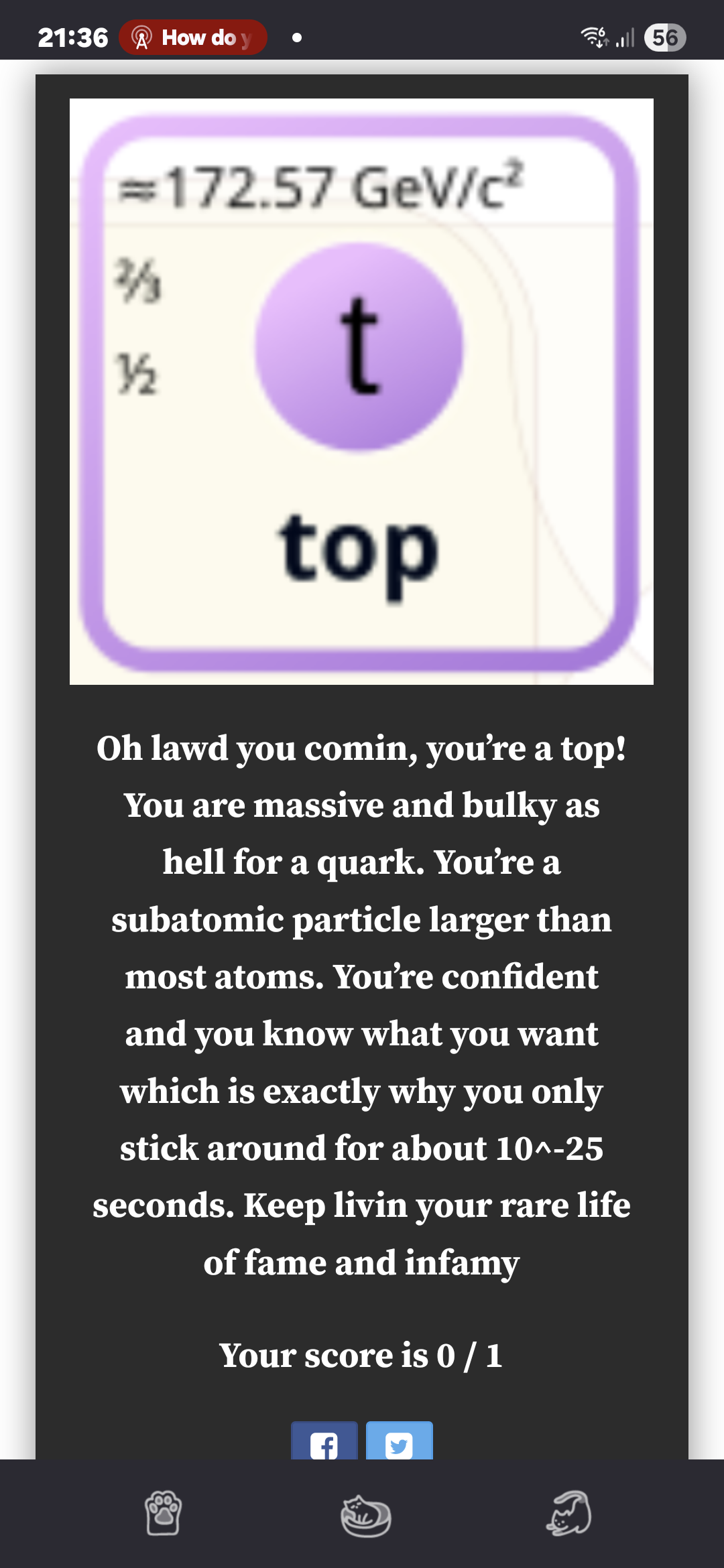
Apparently, I am a top. Link to a quiz

Go take the test everyone. It’s pretty funny.
Of course there is a relevant xkcd
(not to scale) is my favorite part
I particularly enjoyed
1020 +/- 1020 Å
Okay this is good
deleted by creator
@janus2 yes, put them in there. also we need to include every single isotope out there.
Probably This Table in Future will use circles instead of squares. Where in the middle circle are the Hydrogen and Helium, next layer has next atoms that are on the 2nd layer, etc.
No, seriously, stuff like electron metal and strange matter.
Now add a neutron star.
Removed by mod