

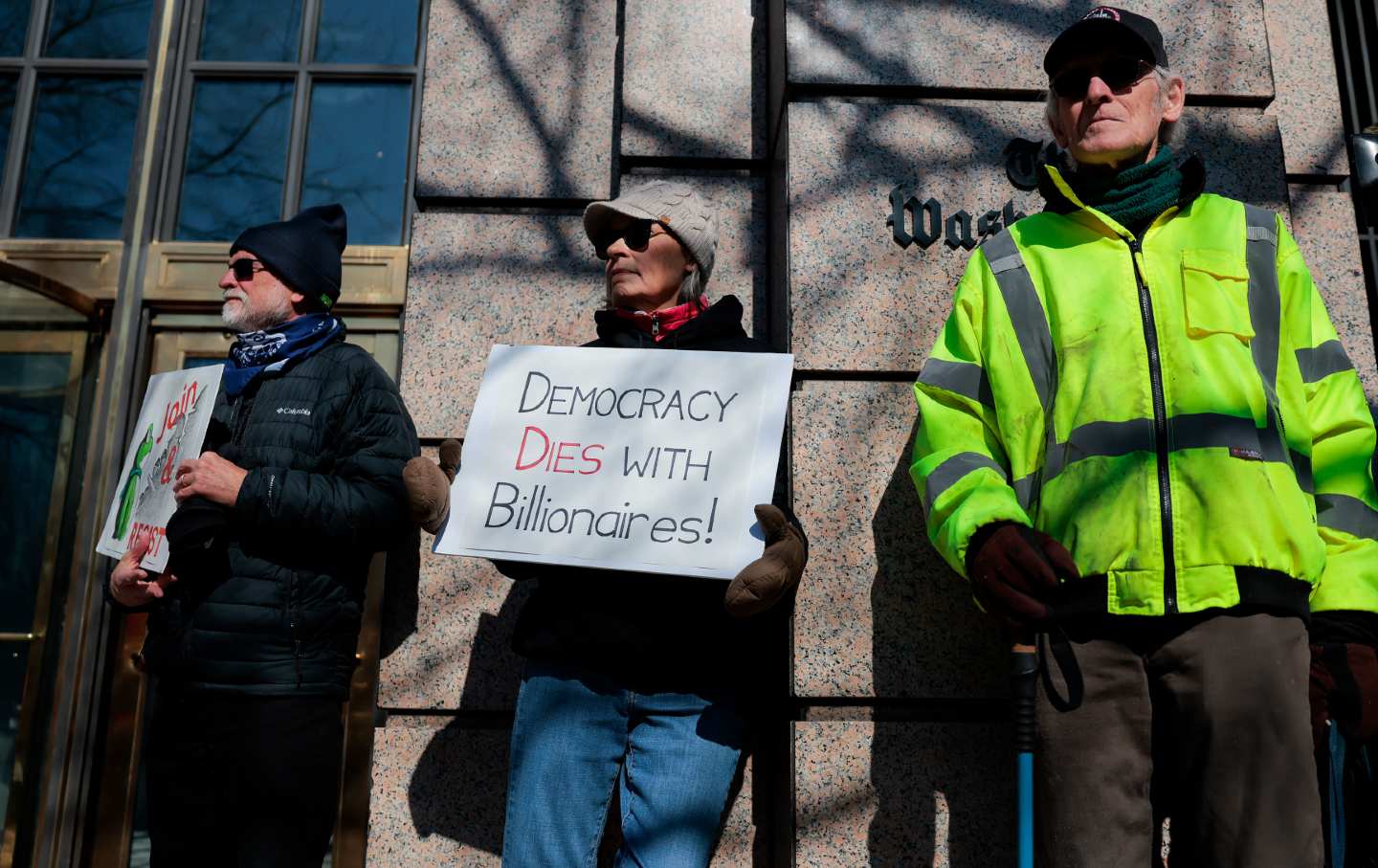
This is a little too wide-ranging to confine to posting in Environment.
It was Jeff Bezos, the Amazon billionaire, who came up with the tagline “Democracy Dies in Darkness” for The Washington Post. According to a memoir by the paper’s former editor, Martin Baron, Bezos greenlighted the “democracy” line after an internal staff favorite was rejected by his then-wife, MacKenzie Scott.
In his book Baron admits to initially being impressed by the new owner, now the world’s third-richest man. “Everything I’ve heard and seen tells me that Bezos honestly believes in an essential role for journalism in a democracy,” Baron wrote.
That didn’t turn out so well. Baron has left the Post, Bezos has cozied up to Donald Trump (Amazon bankrolled the recent propaganda film about Melania Trump), and it’s the Post that’s dying, bleeding out from a thousand paper cuts. Recent layoffs at the paper gutted, among others, its metro coverage, its international reach, its book section, and, not least, the climate team. One of the country’s great newspapers now lives in very dubious company, among other media outlets including CBS News and the Los Angeles Times, that were undercut by their own bosses.
You must log in or # to comment.
How well do you all think blogs and substack are doing filling the gap? Specifically you OP, I trust your expert opinion on this.
There’s some excellent work being done by nonprofits, but there’s a discovery problem. I try to include such sources in the posts I make so as to broaden their exposure.
Blogs and Substacks are even more niche when it comes to discovery, especially considering the collapse of Web search. And in the case of Substack, subscription fatigue comes into play. Like, I think we’re now going on four pieces in a row by Ed Zitron that are for paying subscribers only; while I tremendously enjoy his work, he’s not really doing much useful in my RSS feeds.
But he’s now Internet famous, so I guess more power to him. If I could get an audience to hear me bitch, that would be a fun living. I mean, I already did that in college.
The reason I opened with nonprofits is I think those have the best chance of stability. Not because of the funding source; rather, journalism is done better in groups. You want a couple of good editors (line and copy) to make sure everything’s kosher. But it also means if you are charging for access (which nonprofits absolutely can), that single subscription is paying for multiple roles, as opposed to buying one writer a coffee.
I hate AI but it seems a suitable if probably untrustworthy solution to the death of search. Summary is one of the few things they’re actually alright at. Just go straight to the links and don’t trust the summary.
I hear what you’re saying about subscription fatigue. They should all band together, have people subscribe to the overall group and get paid per unique user view maybe? I dunno. I sense that there’s some disruptive innovation on the horizon. All of the problems that you mentioned seem readily solvable. It’s just a matter of getting people organized to do it, right?
I think you’re on the money about non-profits though, pun intended.
The problem with the pay-per-view model is it atomizes the newsroom. You aren’t solving the problem of people only supporting one writer instead of the org as a whole. I understand we live in an era of “being your own brand,” but that is specifically antithetical to the newsgathering process. Why band together in the first place if you’re still getting paid by clicks?
That is a convincing argument, and I have to agree!
I have a small substack and all I ever want as a professor is people to read my analysis on democracies. I have no paywalls. If a network of writers banded together outside a pay per click/view model, I would without a doubt join such a movement. Yet I can not envision what such a collaborative would look like or how it would operate.
How would it differ from the Atlantic or Vox or 404 Media? Or traditional media? Genuine question.
I wish I had answers to your questions.
My experience is primarily in print, so I’m a bit adrift myself when it comes to current “standards.” 404 is doing good work. So is The Atlantic, which I’ve been somewhat surprised by. Jobs’ widow has apparently decided to leverage fuck-you money to say “fuck you.”
You love to see it.
There are collectives all over the country (and, presumably, the world) forming to figure out what comes next. In theory, if you take the printing press out of the equation, the classified representatives are long since gone, and ads doesn’t have to sell anything – and avoiding layers of needless management under a publisher who needs four houses – you have a lean operation that could be supported purely by subscriptions.