

This is a little too wide-ranging to confine to posting in Environment.
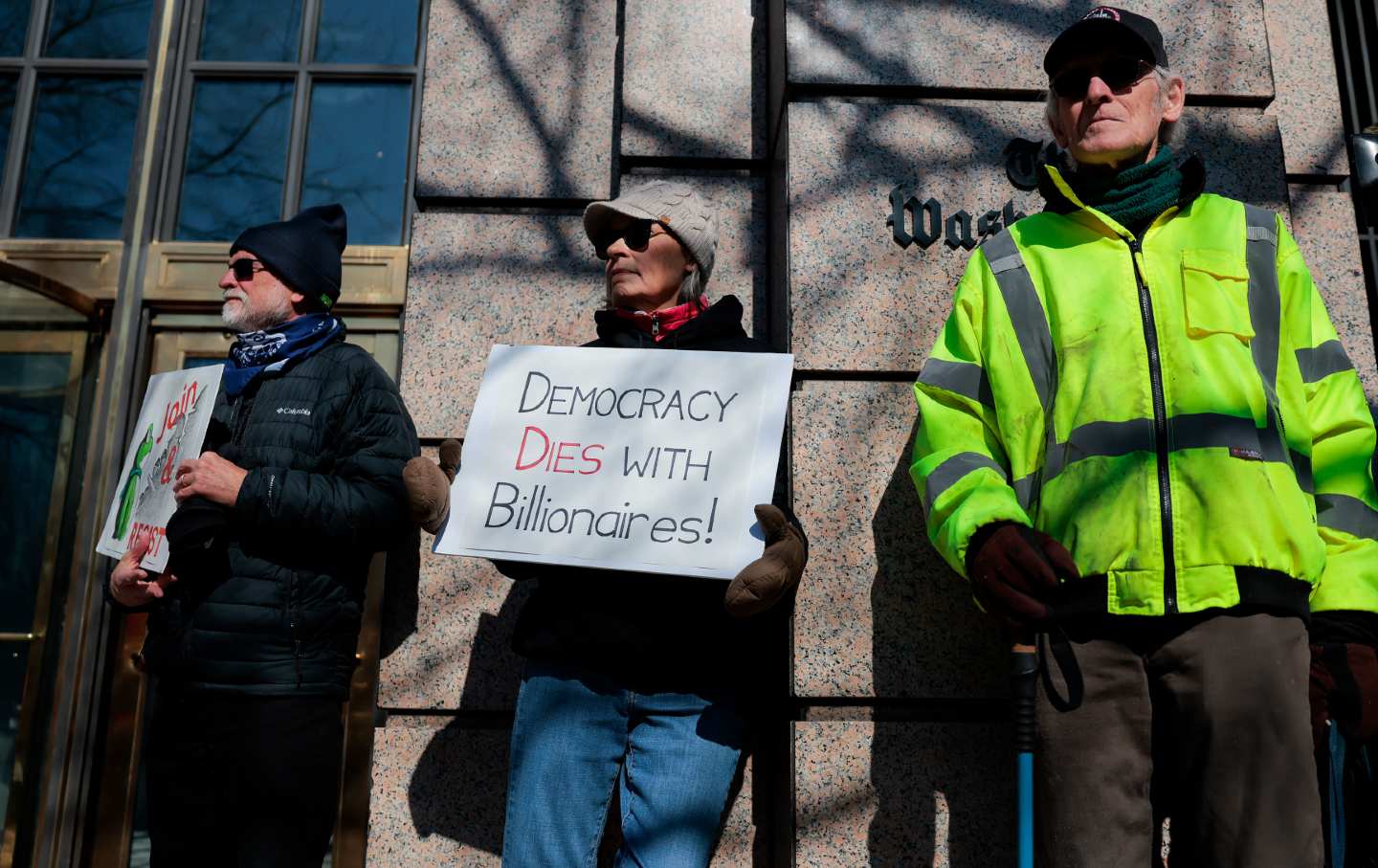
It was Jeff Bezos, the Amazon billionaire, who came up with the tagline “Democracy Dies in Darkness” for The Washington Post. According to a memoir by the paper’s former editor, Martin Baron, Bezos greenlighted the “democracy” line after an internal staff favorite was rejected by his then-wife, MacKenzie Scott.
In his book Baron admits to initially being impressed by the new owner, now the world’s third-richest man. “Everything I’ve heard and seen tells me that Bezos honestly believes in an essential role for journalism in a democracy,” Baron wrote.
That didn’t turn out so well. Baron has left the Post, Bezos has cozied up to Donald Trump (Amazon bankrolled the recent propaganda film about Melania Trump), and it’s the Post that’s dying, bleeding out from a thousand paper cuts. Recent layoffs at the paper gutted, among others, its metro coverage, its international reach, its book section, and, not least, the climate team. One of the country’s great newspapers now lives in very dubious company, among other media outlets including CBS News and the Los Angeles Times, that were undercut by their own bosses.
I have a small substack and all I ever want as a professor is people to read my analysis on democracies. I have no paywalls. If a network of writers banded together outside a pay per click/view model, I would without a doubt join such a movement. Yet I can not envision what such a collaborative would look like or how it would operate.
How would it differ from the Atlantic or Vox or 404 Media? Or traditional media? Genuine question.
I wish I had answers to your questions.
My experience is primarily in print, so I’m a bit adrift myself when it comes to current “standards.” 404 is doing good work. So is The Atlantic, which I’ve been somewhat surprised by. Jobs’ widow has apparently decided to leverage fuck-you money to say “fuck you.”
You love to see it.
There are collectives all over the country (and, presumably, the world) forming to figure out what comes next. In theory, if you take the printing press out of the equation, the classified representatives are long since gone, and ads doesn’t have to sell anything – and avoiding layers of needless management under a publisher who needs four houses – you have a lean operation that could be supported purely by subscriptions.