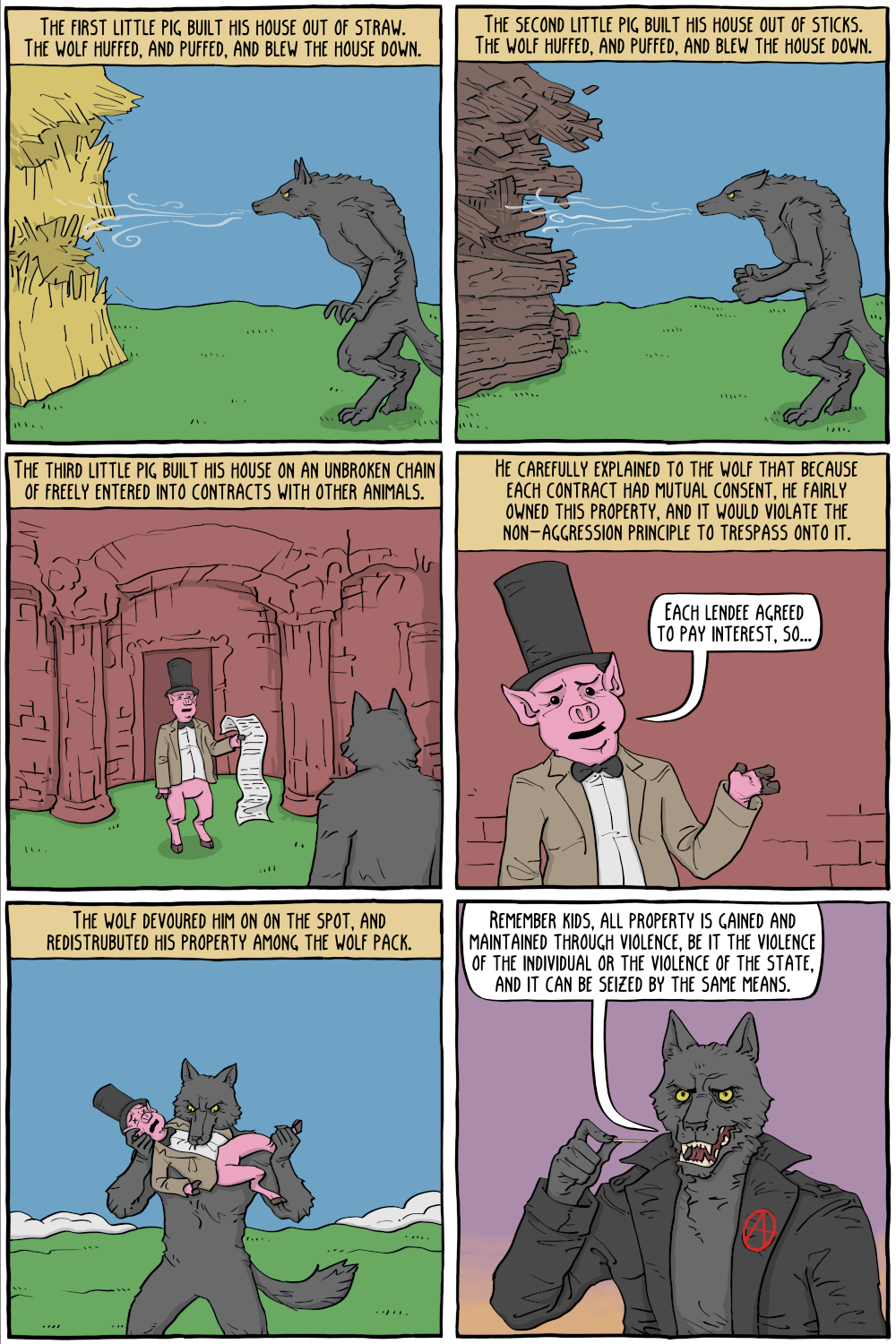
Sadly people only seem to react to the visceral violence of the wolf attacking the pig, not the more subtle systematic violence of the bourgeois pig leaving the others destitute and starving.
THERE were two “Reigns of Terror,” if we would but remember it and consider it; the one wrought murder in hot passion, the other in heartless cold blood; the one lasted mere months, the other had lasted a thousand years; the one inflicted death upon ten thousand persons, the other upon a hundred millions; but our shudders are all for the “horrors” of the minor Terror, the momentary Terror, so to speak; whereas, what is the horror of swift death by the axe, compared with lifelong death from hunger, cold, insult, cruelty, and heart-break? What is swift death by lightning compared with death by slow fire at the stake? A city cemetery could contain the coffins filled by that brief Terror which we have all been so diligently taught to shiver at and mourn over; but all France could hardly contain the coffins filled by that older and real Terror—that unspeakably bitter and awful Terror which none of us has been taught to see in its vastness or pity as it deserves.
- Mark Twain
That’s one hell of a quote. Thanks for the reminder of what a great thinker Clemens was.
dude knew who he was and what he was about. today his works are treated as if he wrote in our time. districts want to pull his books because he used the n-word, missing that through the course of the Adventures of Huck Finn he was writing about a man whose society didn’t see him as fully human. but how does the author’s protagonist see him? he loves him. he’s his friend.
the book has been labeled by modern audiences as racist despite in its context being a rebuke of racism. the fact that we read Huckleberry Finn and feel uncomfortable is a demonstration that it succeeded. someday books from our time will have the same effect on audiences.
i think today, Mark Twain would write things inspired by people like Ursula K Le Guin, Becky Chambers, or Sarena Ulibarri
People (all of us) are emotional creatures. Logic and reasoning is a hacky patch on top of that, and some people seem to be running older versions.
[Half-drunk ramblings with a dozen edits, feel free to ignore]
I don’t know. I think logic and reason (L&R) were intended to make up for our shortcomings. Our minds don’t write down facts, they remember in hazy patterns. L&R were first codified by Descartes (to my knowledge) but used in practice back to the ancient Sumerian engineers if not further. I think the fact that they have been wildly successful despite not being universally adopted just indicates how fundamentally different they are than the naturally workings of the wet brain hardware we evolved across aeons for survival and basic propagation. And while it’s certainly no end unto itself, of course it’s not hard to imagine the additional progress that would come from broader acceptance and application of L&R and the scientific process.
So yeah I wouldn’t call it a hacky patch; there’s genuine value in concrete and self-consistent philosophy. But we have to wrestle against our nature to embrace it.
I like anarchist wolf, he’s alright
He destroyed the housing of two families…
Lmao good point but they can take over the rich pig stall !
Don’t want to ignore the message but I wanna fuck the wolf
Not to defend the landlord here, but is all private ownership violence then?
Yes, this is a long established left-anarchist position. A foundational text is Proudhon’s 1840 What is Property? if you’re curious.
Current property regimes were established illegitimately by violence: manifest destiny in the US, the Norman conquest in Britain, the Frankish conquest in France, etc. Even back then they were to the detriment of the many and the benefit of a few, and since property tends to accumulate (through inheritance and moral persons) this only amplified over time. Today this regime is backed by the state’s monopoly on violence. So effectively most of us are born in a world where violent gangs stole all the land for themselves hundred of years ago and any attempt to overturn this is met by violence from their legal descendants.
Note this doesn’t apply to personal property (legitimized by usage: your home, clothing, toothbrush, etc), but only to the state-backed legal regime of property such as owning land or companies.
the most stupid thing in opposing this is that what are you going to even lose? The factory that you didnt own? The apartment that you dont own?
People tend to equate ownership with protections. So they think “owning” land (e.g. property with a house) allows them safety from things like “other random people living too close to me”.
Therefore, if they didn’t own their property, another person might start cohabiting with them, steal from them, harm them, etc, and they would be powerless to prevent this scenario.
This isn’t to say that this is correct, but this is the reality people have bought into. So even if they don’t own their workplace, nobody technically “owning” the workplace feels less secure (to them) than if it were “owned”.
Again, this is not my disposition, but one that I have come to understand many people hold.
but if no one owns it, everyone owns it
I mean, plenty of people have differing views on this.
I think I would support the idea of private ownership, but owning things like land should pay a land tax. Ownership means that improvements that you make to your property come back to benefit you, and that it cannot be arbitrarly re-assigned away from you by your co-operative/government (taking this further, a veto right against a democratic majority taking your non-commodity property).
All regular work and production should be paid back to the workers in the form of voting shares in the democratic co-operative that owns the factory, to prevent authoritarian capitalists from embezzling labor like the billionaires do today.
But I understand that many disagree with these statist ideas.
deleted by creator
Got it boss, heading out to surround my home with minefield and barbed wire.
*redistributed
Redisturbed