You must log in or # to comment.
deleted by creator
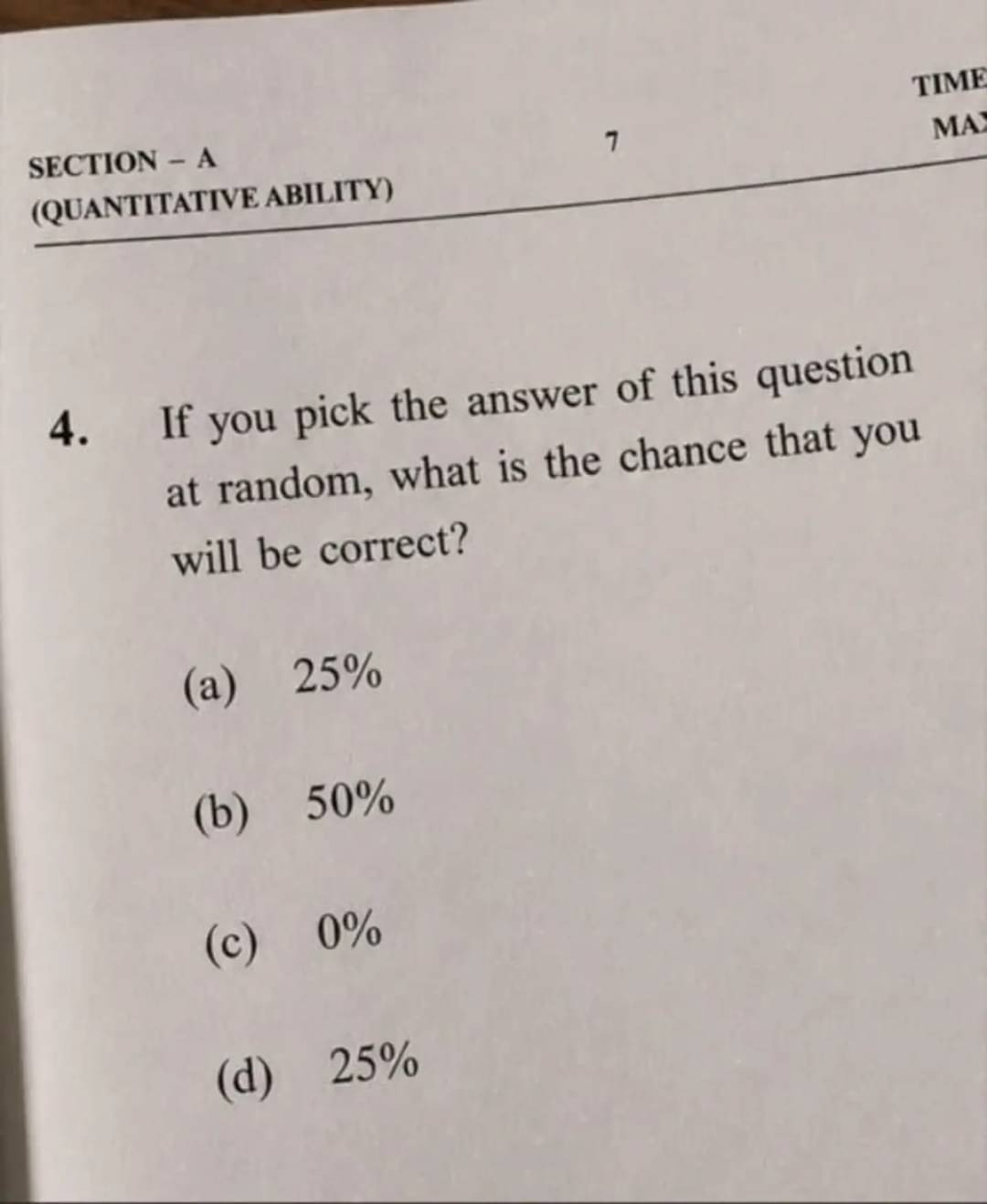
This. I.e., there is no correct answer.
Sooo, C?
if c was correct then it would be 25% then 50% and then 25% again ans 50% and 25%
False
The answer “there is no correct answer” is correct, but the answer isn’t 0%. It’s a paradox. There isn’t a solution, which isn’t the same thing as saying there’s a 0% chance of getting the right solution (when that is one of the choices).
Essentially there’s a difference between “0% of answers will be correct (because none can be)” and “the listed 0%-option self-invalidates if selected”. The problem is the interaction between answers that shouldn’t be there in normal tests, which changes the values after selection.
Therefore, the only winning move is not to play.
Well I’m not picking it at random, so C is correct.
If c is correct for you then it’s also correct for those who answered at random. And if it is, then you’re all wrong because you’re answering about those who answered at random.
The only viable approach to actually answer is to argue that the question is ambiguous and that while the hypothetical test takers face infinite recursion you the real test taker don’t have to resolve the infinite recursion and to then choose a place to halt evaluation. And if they disagree then your solution to the Halting problem invoke the all powerful oracle function “I’ll talk to the principal”.
It’s not necessary to use recursion. Simple logic solves it. If a or c are true, that implies a and c are not true. If b is true, that implies b isn’t true. If d is true, that implies d isn’t true. No recursion needed and this is complete. You could take a recursive approach, but it doesn’t halt, like you said, so it doesn’t give a result.
(Also, the halting problem is determining if something halts, not what the value is at the end. This problem does not halt, if done recursively. The halting problem is easy to resolve for this particular problem.)

Couldn’t you argue that 0% is correct?
It’s a paradox, no of the answers can be correct, so the chance that you pick the correct one is 0%.
Sure, by picking it, it makes it wrong, but you don’t care about that.
If you ran a infite monte carlo test on it, you’d end up with 0% correct answers.
Sure, picking the zero makes it not true again, but you don’t care about that - it prooves that the statistical test holds.
The trick is that there is no paradox, only the implication of one. ‘If’ being the key word - you’re not actually being asked to answer randomly, but you are being subtly trolled.
If you ignore self-referential nature of the question and stop the iteration at some point, sure, you can argue that any answer is correct.
If you ran a infite monte carlo test on it, you’d end up with 0% correct answers.
That would mean your Monte Carlo test is set up incorrectly because at least 1/4 of the results of the test would be the “correct” answer as per your own argument, thus invalidating it.
Lmao that’s fucked up hahaha
I would answer C) 0% - Ultimately I feel this isn’t a “pick the correct answer” type of test and more of a “pick the best answer” type of test.
My reasoning is there are really two questions - one is being answered at random, the other I am answering. The one being answered at random is making any answer it chooses wrong - If it picks A or D (25%), then the correct answer is B (50%). If it picks B (50%), then the answer is either A or D (25%). If it chooses C (0%) then the correct answer is A or D (25%) again. No matter which one is chosen at random, it becomes wrong as soon as it is chosen. So then back to the question on the test that I am answering, the correct answer is C) 0%.
Also, if the teacher marks that wrong, then I am even more correct.
It’s definitely B ) 50%. Ignoring the values for answers, there can only be 1 “correct” answer. If you have 4 options and 1 can be correct, a random guess is 25%. Since there are 2 options for 25%, you have a 50% chance of guessing the correct 25%.
Yes but then 50% would not be the correct answer.
I fucking hate this game 😭
It’s B - 50%; either correct (50%) or false (50%), binary 0/1, yes/no, score or not.
The correct answer is to leave all the options unmarked.
If you do pick an answer, then you didn’t do it randomly. When not marking the answers, the if-statement has the result of “false”, but that’s not the question.
If your teacher then asks why you didn’t answer it, you can safely and unparadoxically claim that inaction is also an option.
They aren’t asking them to pick an answer at random though.
If “no answer” is in the set of possible answers, then it is not a correct answer because there’s then a 20% chance of it being picked at random. But usually that’s not the case for tests anyways.
add a e) 20%
Here’s a more fun one:
If you pick an answer to this question at random, what is the chance that you will be correct? Mark at least one of the applicable options.
(a) 20%
(b) 6.25%
(c) 0%
(d) 20%
And as another puzzle, what happens if you swap “at least one of the” for “all”?
A) 50% B) 50% C) 25% D) 0%
Doesn’t make it much easier.
Still too hard. I’ll take the 50/50 joker. Which answers remain?
0% and 50%
If it’s a part of the standardized test that actually does make it much easier. A standardized test only allows to mark one option and that option needs to be derived unambiguously from the question. As such, neither A nor B are actually possible answers under this framework, D is not a possible answer to the question, and we’re left with C.
If I was given the original question as part of some standardized test, I would probably think about it for a while, flip a coin mentally, choose either A or D, and then contest it afterwards if it gets marked as being incorrect.
Its 25%. The rules of answering a question with a set of options is that you may only choose one and only one is right unless explicitly stated otherwise. Anything else is breaking the rules, which as the taker would be disqualifying. If you start narrowing it down, as in “its 25% and theres two so now i need to guess therefore its 50” you are no longer answering the question at random and you have answered wrong. But you do have to make that coin flip. Good luck.
This is the only correct answer to the question as stated.
That of course opens a second can of worms, since now you are actually forced to “pick the answer at random”, now with the probability of 50%. But such double entendres are typically not considered for test questions unless explicitly specified.
Yeah, in my opinion the answer is 50%. You got a 50/50 shot at picking the correct 25% answer.
I’ve never heard that rule. It sounds like an assumption you’re making about the question!
What coin do you have with 4 sides
Diabolical
It’s gotta be B, right?
Not really but you’re thinking in the right direction!
There is no correct answer because the question and the answers exclude themselves:
For four different options it is 25% but here two options are the same - so you have a 50% chance to land on a 25% - but this means that the correct answer is only in one of the four answers, therefore you’re having a 25% chance.
It’s a nice demonstration of what happens when the answer and question are intervined and any result changes an aspect of the answer - you’re fucked, basically.
well, you are either right or wrong which is 2 options, and 100%/2 is 50%. or something like that
hah I see what you did there!
The right answer is neither a nor b nor c nor d, but “beer with tzatziki”.
Mixed?
Aye.
Nobody said it was uniform random, there’s probably infinite probability distributions that end up correct