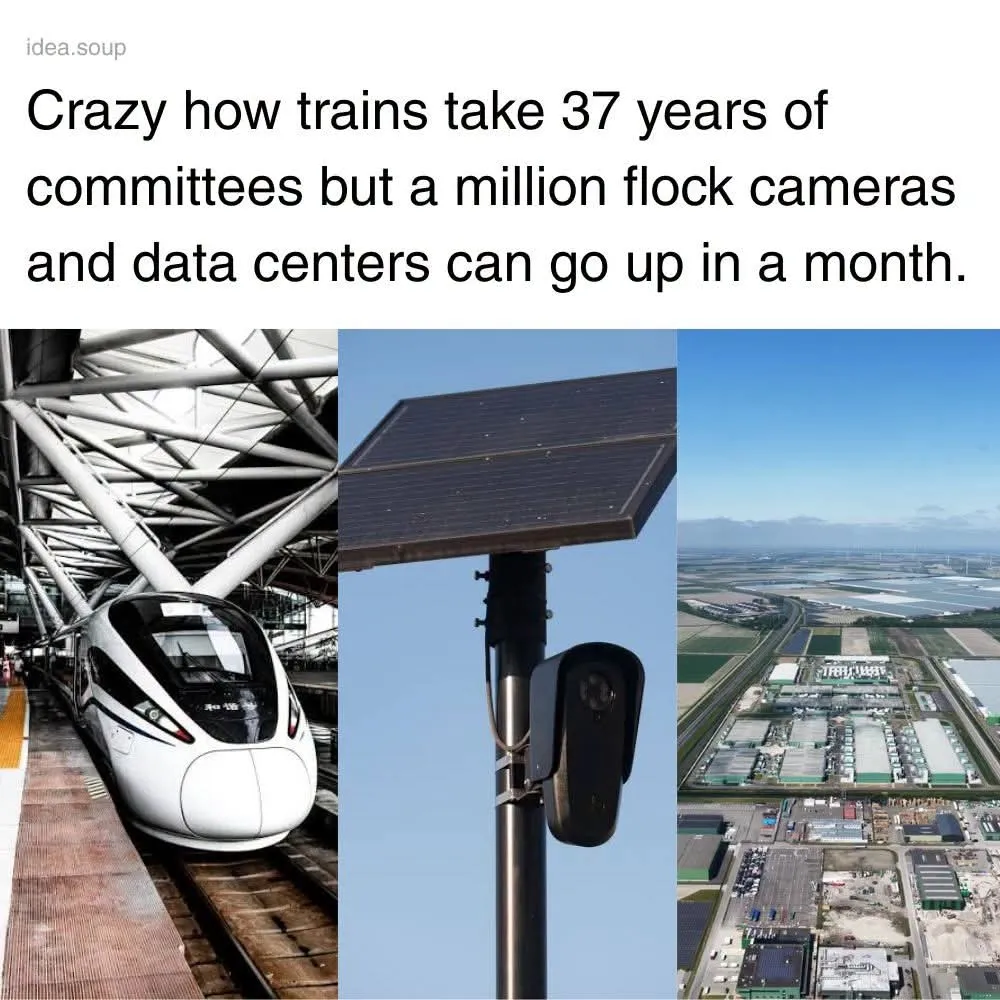

Trains benefit people, those other things benefit billionaires.
California high speed rail was something my parents voted on when I was a child.
I had this friend who was a year under me in school. Her kid voted for it too.
It still doesn’t exist. California can’t build something as modern and cutting edge as a train.
Real trains are cutting edge though. But yeah the usa just cannot.
We can’t manage a steam engine.
no you were really good at those! it’s just that you should probably have continued after that.
We were, we aren’t.
All the funding was eaten up by Muskolinis hyperloop project that didn’t bear any fruit. All according to plan, now they can sell more Teslas.
All of that is correct however I am also currently watching my government fail to be able to construct a train station along an existing track. So far the process has been going on for about six years and no one has so much has dug a hole yet. It’s barely even a construction project, they just need to pour some concrete into a rectangle and then add some stairs and call it a station. But apparently even that requires six years worth of committees.
Meanwhile in Scotland, somewhere with similarish land and planning laws. We’re electrifying the whole network, dualing large sections that were single track, removing peak fares, upgrading the rolling stock, and opening brand new stations.
Having a decent rail service is entirely a political choice. Whether those in power want to make it happen or not.
In early 2010s, I worked in a city that was planning to remove a huge useless highway section. When I moved away from that city in 2025, they were still having hearings about plans to potentially start thinking about removing that highway.
Flock cams don’t even need a power connection because they run on solar+battery, and wireless data connection. You can put one practically everywhere without any preparation - even the post it sits on is pretty optional, could use cable binders to hang them on a tree.
Data centers often get built where land is cheap, and at least in the US there is a (horrifying and stupid) trend to design them to run off-grid with gas turbines, so you don’t even need utilities there, just data connections that you can run underground.
Trains take up a lot of space, and if you want them to be useful, they need to be where the population density is high enough. That means high cost for land, often buying up big amounts of smaller lots where you have to work something out with a multitude of land owners who might not want to part with their - often prime location, because it’s in the city - land. A single land owner not selling their land can grind a project like this to a halt, at least if there is hesitancy using eminent domain, which is a crowbar approach and leads to resistance to your project.
Don’t get me wrong, i really think the USA would benefit greatly from modernizing and expanding their rail network! But realistically, refitting a train line into a city center where you preferably want the station to be is a hard task, doubly hard if you want to actually pass through the city because its not the head end of the line - it doubles the land acquisition woes. A possibility would be going underground, but underground construction is an expensive endeavor, and the US would probably need to get outside expertise from Switzerland or Austria where we construct tunnels through mountains and below cities on the regular to make it work.
The US famously bulldozes whole districts for their stupid highways, to build a whole highway junction inside cities (or whatever is left inbetween highway and parking lot).
Sure both train tracks and highways are harder than flock cameras or data centers, but the US certainly has no issue with building highways. All the issues are home-made. We have the same fucking issues here in Germany, it just so happened that more of our rail network (relative to size & population) survived the neolibertarian onslaught of the past ~60 years.
At the end of the day train networks primarily serve people, not capital.
That wasn’t just for the highway, that was blatant racism to cut through the heart of thriving black communities.
Everyone is talking about obtaining land and eminent domain and whatnot. …We have streets. 🤷
I’ve wondered how impactful it would be to pass a law allowing all interstates to also count as passenger train right-of-ways. Obviously there would have to be some engineering and modifications to turn a highway median into a train line but it would simplify the land rights probably.
I am all for calling out privacy-invading cameras but comparing the putting up of small wireless cameras on already existing poles with prepping existing rails for high speed train connections, not to speak of actually buying the trains and maintaining them properly, like what? The cameras have no risks of causing accidents either, aside from people accidentally cutting them down (as one does). So the comparison feels pretty silly to me.
Now compare it to something like building another 3 lanes on a highway, thats more appropriate.
Just one more lane and traffic will be gone. Trust me on this.
Just put the datacentres on trains
“Sloppiercer”
@grok plz generate this movie, no woke
The Chinese build a 50000 km high speed railway network in 18 years. The first high speed train was in 2008. If there is a will, there is a way. Infrastructure benefits the people.
In California for example the high speed railway was authorized in 2008 for only 795 kilometers long. The project is expected to be completed between 2031 and 2033. So in the same time frame, China build 49205 additional kilometers of track.
In western countries, everything and everyone needs to be consulted and 99% of the time a court case follows because of some animal found or it is too close to houses or whatever shit people think of, causing massive delays. Than of course there are the changes in government. Think about the Biden infrastructure bill that got scraped like the second day the current regime took over.
Yeah the changes in government is a big thing I think. In the US nobody can be president for more than 8 years (in theory at least, I guess you guys will be testing that in 2028) and in place like the UK no Prime Minister really lasts more than about 10 years at most, and that’s pretty rare. Nobody wants to do all the work and spending on something that will pay off for the next person, so it’s sort of hard-coded into these systems that any project which takes more than a decade to finish probably won’t get done.
China can do it faster because it’s a dictatorship that simply takes the land on which it wants to build rail and pays the previous owner. In the US, there are far more legal hurdles for the government to acquire that land. Too many hurdles IMO, but going full dictatorship in order to have rail built faster is not the way.
Again with the propanda. China is not a dictatorship. People actually have a lot of rights and power.
Even more than in the US, strangely when it comes to privacy for example. China has a system almost stricter than the European GDPR. American citizens can only dream of this sort of protection because your government is run by tech lobbyists.
Anyway you’re making excuses for the inability of ‘the greatest country on earth’ to even build proper infrastructure for the people. Not only high speed rail, but the state of the roads, bridges and other crucial infrastructure is deplorable.
If you protest the government or attempt to unionize, and then the government disappears you or threatens to disappear your family, it’s a dictatorship.
You’re noticing a bit too well citizen…
??? Flock seems shitty (I’m Canadian) but it seems like a lightpole or so. A train and the network requires a million times the property appropriation. And to be effective, a chunk of that should be the most sense/expensive land around!
They are consistently full of shit
Hmm let’s have a think about how much each system costs, what the consequences could be if implemented poorly, and how much they involving depriving people of what they currently have?
I mean Flock cameras, if implemented poorly (or successfully) involve depriving people of their privacy and their consequences include aiding aspiring tyrants in violating people’s rights.
Oh yes, that aspect is a deliberate part of the comparison. I don’t know about you though, but I’d rather have a flock camera outside my house streaming my every move directly into the secret service’s masturbatorium than have no house at all, or to have a high speed railway 100m away from my house, depriving me of the peace and quiet I used to enjoy.
(So, in my country the government has to pay me the fair market value of my house, plus an additional percentage, to compel me to sell them my house when I don’t want to, so the former scenario may not work out as a “deprivation” but instead come under the “cost” category - but it’s a cost because the alternative is seriously depriving people of much more than their privacy)
Ask Gavin Newsome how long it will take to finish his train? O that’s right, never
I want working trains. We fucked that one up a long time ago.
Society is based on roads. Business locations, homes, all roads.
Every time a City in the US puts in a light rail line, every target community loses their shit because it connects the poorer parts of town with the affluent parts of town. It fucks up the crime rate a bit.
People don’t want trains here because people don’t ride trains here.
People don’t ride trains here because trains don’t go from affluent houses to places where the affluent work.
affluent being median wage earners.
Removed by mod