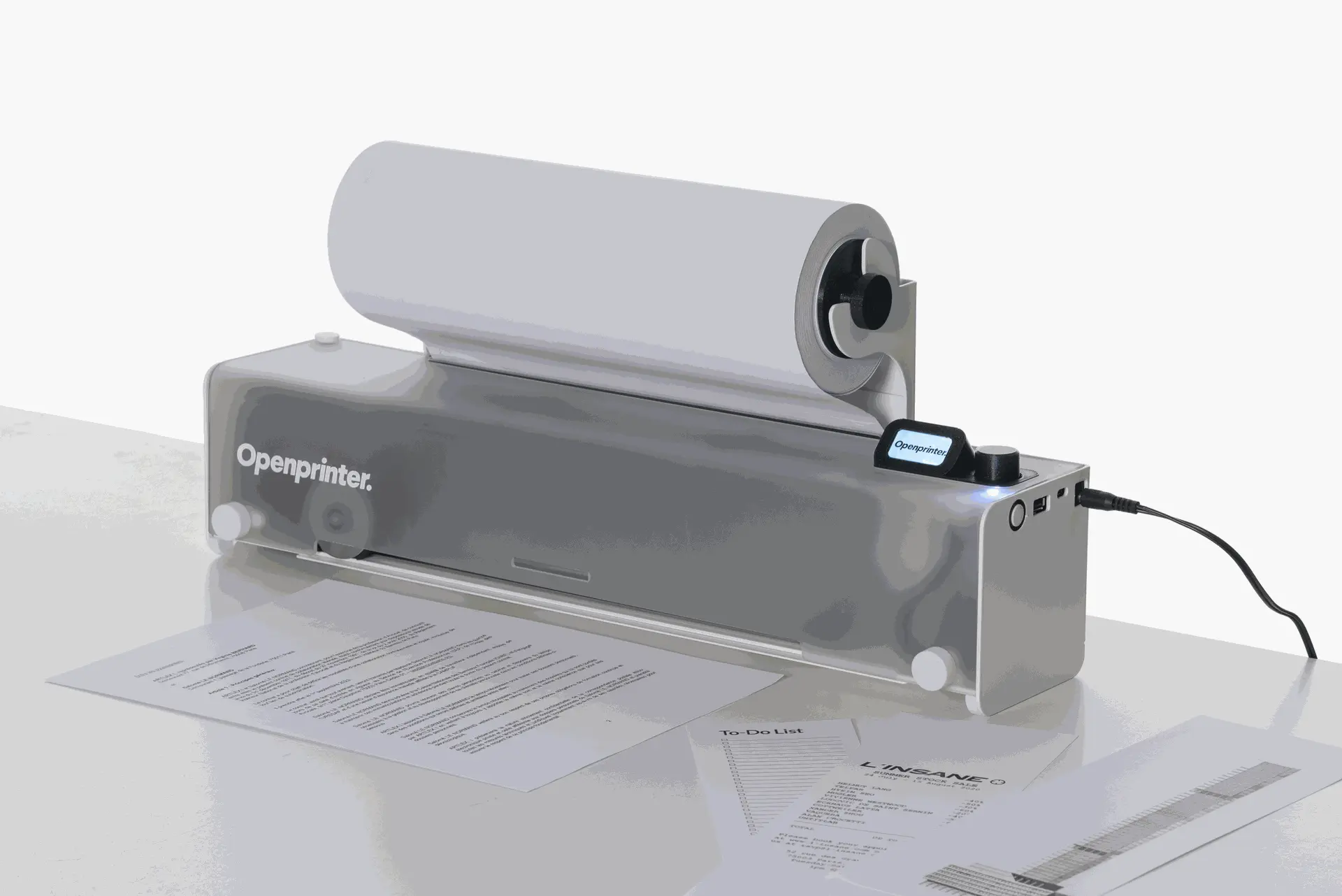
Open source printer with refillable ink, no bullshit, accept rolls of papers.
Finally an open source printer ! I dealt with so much stupidity with printers. it warm my heart.
I do have too much joy to practice mandatory critical thinking about the release of a new project. Lets talk about it? i am not the only one to be happy about it, i have no info about the price though :/
Slight open-washing involved though - the license is CC-By-NC-SA, which sadly makes it incompatible with open hardware projects, and restricted from being available as a pre-assembled kit.
Well you are right ! Still i see it as a massive positive win in this particular sector, but sure, lets see what happen and be greedy with licensing! May the next one/release/update be more open.
I thank you a lot
They do have a survey that includes the kit question.
Here is the link if you are interested: https://docs.google.com/forms/d/e/1FAIpQLSc0MLIj1Mfv81vaiOIQG1yMEilruRfNgx7h36l5a0qC-G9TZw/viewform
From this update : https://www.crowdsupply.com/open-tools/openprinter/updates/on-the-road-to-launch
creative commons doesn’t even recommend their licenses be used for software (it’s in their faq). i’m guessing the same would apply to hardware designs as well.
Creative Commons does not have any guidelines about using their licenses for hardware. It would still be a better idea to use CERN-OHL for hardware though.
Thanks ;) I learned something!
Fuck NC.
In the linked survey they’re talking about selling an ink kit. With that, the non-commerical license meaning nobody but them can sell spares, and them filing a patent, it’s almost like they’re just trying to start another printer company and just using the open source community to do advertising 🫠
I’m not an expert in those legal fingerprints, but i can imagine that you might need a parent even if you want to open source it, simply so nobody else can patent it. on the other hand, in right now to lazy/sleepy to read the article, so don’t mind me :)
The hardware is pretty trivial. The cartridges, which are the most problematic part are HP. This is so underwhelming.
it’s still a good start . Also aftermarket cartridges exists.
oh, and also they offer refill kits.
HP carts have the printhead included, disposable, so quality will degrade fast with refilling. Epson/brother and some Canon have permanent printheads which will last orders of magnitude longer. If the cart/printhead is still going to be propietary, epson/brother printheads, which are readily available, and which can be setup pretty easily in a CISS configuration would have been way better. The project is really bad. The fact that they use paper rolls is also dumb. Are you really going to cut every single sheet? Rolls make sense for large format printing. Epson/brother with aftermarket CISS are the way to go, especially because you can get actual Epson ink in bottles for refilling, the ones used in their ecotank line, super cheap.
it also takes normal sheet paper. but it has an integrated cutter so the rolls enable A4 or A3 (us letter or 11x17), or any other length, or continuous from the same source.
permanent printheads are not really any better from a longevity standpoint. they still do degrade and need replacement. more often than not, that replacement either doesn’t exist, hasn’t been manufactured since the printer was a new model, or is prohibitively expensive and/or only available from random third-parties.
the last ink tank + separate printhead setup that you could very easily get tanks and printheads for was some old canon printers from 25+ years ago. the printheads were in a removable caddy, and that caddy was sold in stores with and alongside ink tanks.
printheads also need to be used, regularly. once you go a few weeks without printing, every day that you don’t increases your chance those printheads will never print again. when the printhead is in the consumable, it gets replaced far easier and automatically on a cartridge swap. yes, that is at the expense of higher cost new consumables.
we’ve had to bin three brothers, two hp, an epson, and a canon over the twenty years because of bad and unreplaceable printheads. coincidentally we’re currently using two salvaged hp printers that use the same cartridges as this ‘open’ printer, use refilled consumables, and the printers are old enough they don’t scream and refuse to print if the color is empty–we can use and print black only.
the problem here with this project is they don’t have their own printheads and cartridges, which means some of their code was either lifted from hp printers or reverse engineered; and they rely on hp as the only source for new consumables and printheads. hp would be very hostile to this project, so i hope they fully documented their entire process of development and are ready for the inevitable lawsuit.
Now do a laser printer
Certainly a cool idea, and I hope it succeeds and turns out to be what it seems.
No price listed on their crowd fund page, so who can say what this might cost? Uses a Raspberry Pi Zero W for the brains and a STM32 for the cartridge board.
While I understand why are they unwilling to allow commercial usage of the final product, it also makes it difficult to actually put in the hands of people. I agree, hopefully they can reconsider for a later iteration.
Aren’t printers pretty restricted due to needing to have surveillance and anti-counterfeit features? Is this legal at scale?
I think the feds just asked printer manufacturers nicely
The counterfeit features from my understanding are just matching one simple dot pattern. That could be included in the firmware here as well.
In their discord server the open printer staff said they explicitly aren’t including thst kind of stuff.
The perfect color for a printer doesnt exi…
spoiler

You know, vintage printers offer much the same.
I have an HP 4050DTN from a good quarter century ago that has no DRM of any kind, no tracking dots, no reporting home to the mothership, is eminently repairable, and can accept overstuffed toner cartridges that are advertised to do 20,000 sheets at 5% coverage.
And the toner claim largely bears out. Two degrees later and I’m only on my third cartridge in the machine’s entire life. Last I ran a duty report the sheet count was getting close to 50k. Low 40s, at the very least. So it’s tracking decently close.
Sure, it now needs some parts refreshed. Rollers, fuser, and so forth. After a quarter century of use I would be surprised if something wasn’t starting to go. But parts are still readily available and surprisingly cheap. I mean, I have the parts in, I just haven’t had the time yet to swap them in.
The only downside of kit this old is that networking was an afterthought. Most units will come with USB, DIN-8, serial, and parallel ports, but finding a good JetDirect Ethernet network card - ideally 635n or newer - is difficult and expensive (the 615n bricked itself with distressing regularity, avoid at all costs).
I also have an HP 5000DTN that is of the identical build quality and can do oversized sheets up to 11×17. Beautiful machine in its early-2000s brutalist beigeness.
So if you want HP at their peak of printer glory, long before enshittification set in, hop on over to Wikipedia and consider any LaserJet model first released before 2006-2012.
Thanks a lot ! I learned so much things. Thanks for the precise references.
It is a solution but i am not sure the supply will last. It can only dwindle.
Your arguments are sounds and valids. I have another solution to a problem, thanks again !
Get an extra roller kit and fuser kit, and you should be golden for the next two decades. The cartridges aren’t going away any time soon.
To fix the networking you could get a dedicated USB print server or a RasPi with CUPS and attach the printer via USB. Probably cheaper than a vintage printer network card.
Yes but JetDirect is still cheaper and better integrated. There is the issue with outdated certificates and max. TLS 1.2 with the print server, but in a home/SOHO environment this should not be a critical security shortfall.
Curious how 3D beat 2D by, what, 10 years?
Ease really. Once the patents expired it was fairly simply to make a 3d printer, which is essentially a hot nozzle squirting plastic. It’s more akin to a pen plotter
An inkjet printer is significantly more complex. Even if you know how it works you essentially need a semiconductor level fab to make the printhead. That’s why all these projects just reverse engineer hp cartridges. Literally every inkjet printer patent could’ve expired 10 years ago and it wouldn’t change the engineering and manufacturing challenges
3D is actually 100% open source.
This still uses proprietary cartridges.
Never will i go back to ink cartigage or refillable ink… Those wear off faster than speed of light.
I switched 2 month ago and it’s day and night…
Sacré bleu, c’est magnifique!!
I’m not sure if most will know, but an open source printer is a very challenging thing to do correctly. Tons of people have been pouring their hearts and souls into this effort.
One primary issue has been practicality. Open source is only as good as the ability to actually utilize that openness in practice. This includes the being able to actually repair the device as an end user whether on your own or with assistance. This doesn’t even touch on the fact that if it doesn’t print well, it doesn’t matter how open it is because nobody will care to use it.
Obviously this is pre-release so don’t quote me on this, but I think this may just be one of the best attempts I’ve personally seen. Parts are off the shelf and reasonably priced, it can print in multiple sizes right at release, and from the videos the print quality looks very good!
I wish I could get my hands on one of these. I can’t say too much publicly, but there is a group of people who I would love to demonstrate this to and educate about. I know for a fact that even for those who don’t give a damn about open source, people do give a damn about the realities around modern-day printing.
For everyone’s sake, these need to reach the average Joe and be understood. Much of my life seems to be acting as a bridge between the OSS heavyweights and the average consumer if I think about it.
I’m waiting for a machine to appear with an operating system with an source code, it would be funny
Cool!! i was literally just thinking about this as part of my effort to be more analogue. I will follow this hungrily.
I’m interested. Any info on how much it will cost?
Not yet hopefully soon